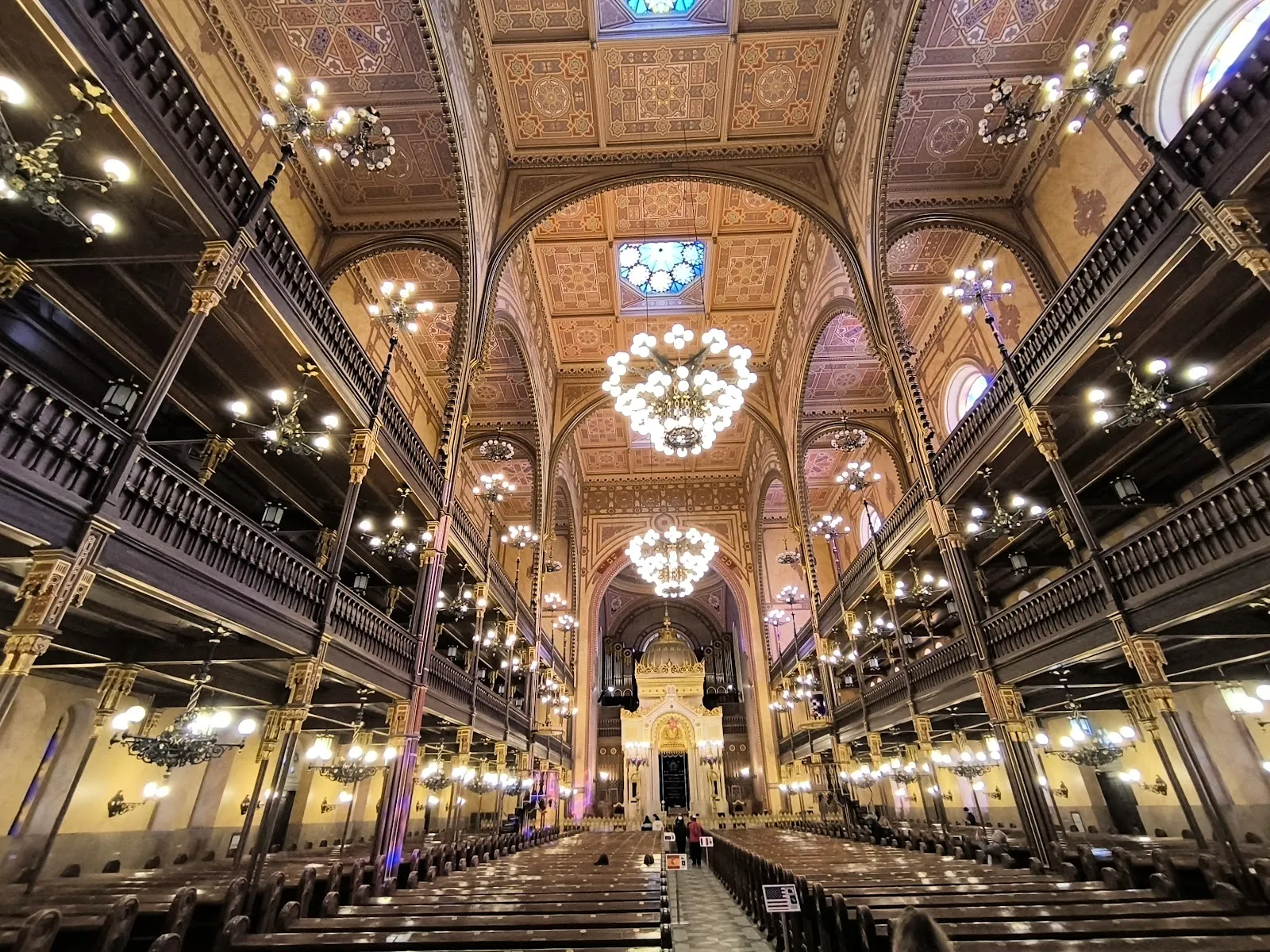
The Great Synagogue on Dohány Street is a major Jewish heritage site in Budapest’s Jewish Quarter. Completed in 1859, it is known for its Moorish Revival design, with Byzantine, Romantic and Gothic elements, and an interior decorated with frescoes by Frigyes Feszl. The complex also includes the Hungarian Jewish Museum, a cemetery and the Raoul Wallenberg Memorial Park. Take a guided tour to learn about the building and Hungarian Jewish life, then visit the memorial garden, where a metal willow tree commemorates Holocaust victims.
A synagogue shaped by several styles
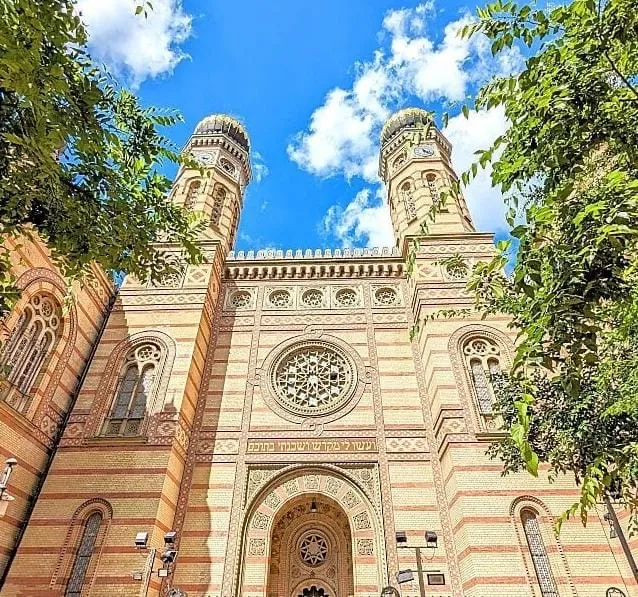
The Great Synagogue stands on Dohány Street in Budapest’s Jewish Quarter. Designed by Viennese architect Ludwig Förster, it was completed in 1859. Its Moorish Revival design draws on Islamic architecture from North Africa and medieval Spain, alongside Byzantine, Romantic and Gothic elements.
Two towers with onion-shaped domes define the exterior. Inside, Frigyes Feszl’s frescoes add Hungarian architectural detail to the richly decorated space. The building’s scale and arrangement differ from many synagogues: it has a church-like layout, with the interior oriented towards the front. The synagogue can accommodate about 3,000 worshippers.
The museum and the Jewish Quarter
The Hungarian Jewish Museum is part of the complex. Its collections relate to Jewish religious and everyday life, including objects connected to the history of Hungarian Jews. Among the items noted in the collection are a Jewish headstone from Roman Pannonia, dating to the third century, and a handwritten burial society book from the late eighteenth century.
The complex also includes the Heroes’ Temple and the Jewish cemetery. These sites sit within a neighbourhood shaped by the history of Budapest’s Jewish community. The Dohány Street, Rumbach Street and Kazinczy Street synagogues are close to one another; their presence is linked to a nineteenth-century division within the Jewish community over assimilation.
The memorial garden
Behind the synagogue, the Raoul Wallenberg Memorial Park provides space to remember Hungarian Jews murdered during the Holocaust. Its Tree of Life is a metal willow sculpture, with names on its leaves commemorating people killed or missing during the war. The cemetery beside the synagogue is also tied to wartime events: people who died during the Budapest ghetto period were buried there.
The synagogue and its garden were restored in the 1990s. A visit brings together architecture, museum collections and memorials, so allow time to move through the different parts of the site. A guided tour can explain the building’s history and its place in Budapest’s Jewish community; an English-language option is available.
FAQ
Where is the Great Synagogue in Budapest?
It is at Dohány Street 2 in Budapest’s Jewish Quarter.
What can you see at the Great Synagogue complex?
The complex includes the synagogue, the Hungarian Jewish Museum, the Heroes’ Temple, a cemetery and the Raoul Wallenberg Memorial Park.
Are guided tours available?
Yes. Guided tours are available in multiple languages, including English.
What is the Tree of Life memorial?
It is a metal willow sculpture in the memorial park behind the synagogue. Its leaves bear names commemorating Holocaust victims.