
Rouen Cathedral, Notre-Dame de Rouen, stands on the Place de la Cathédrale at the end of the rue du Gros-Horloge. Its Gothic west façade, carved like lace, is the one Claude Monet painted more than 30 times. The cast-iron spire rises 151 metres and is the tallest of any church in France. Inside, look for the tomb holding the heart of Richard the Lionheart, the stained glass and the Escalier des Libraires at the back. Entry is free, and on summer evenings a free light show plays across the façade.
From a 4th-century church to the 19th-century spire
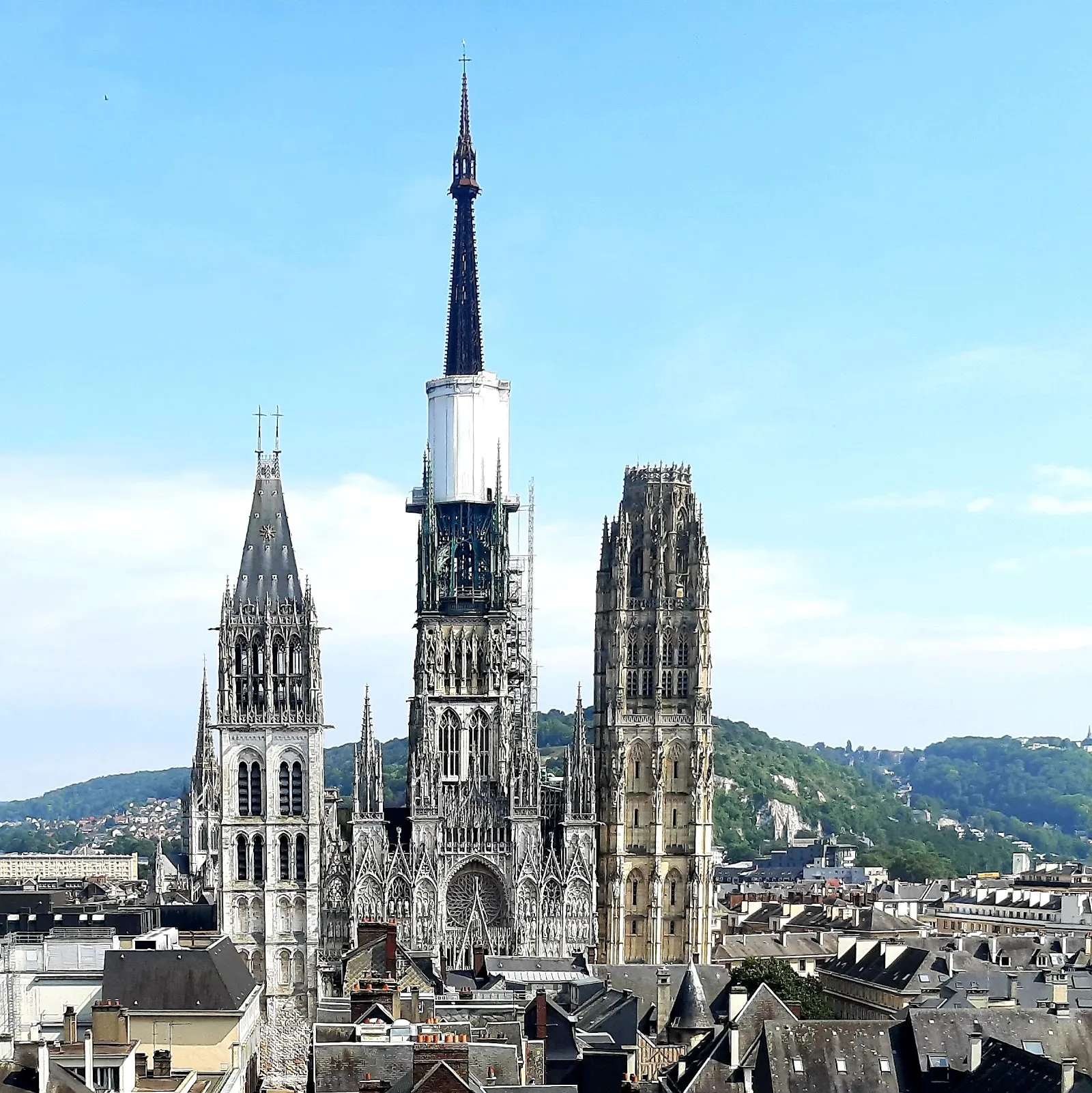
A church has stood on this site since the 4th century. A Romanesque cathedral replaced it, and its crypt has been preserved beneath the present building. The Gothic cathedral was begun in the mid-12th century, around 1145, and work went on for centuries, slowed by fires, lightning strikes and the French Wars of Religion.
A fire in 1200 destroyed much of the earlier work. Only the left-hand tower, the Tour Saint-Romain, survived. The wooden spire over the crossing was destroyed by lightning in 1822 and replaced by a slender cast-iron spire, built between 1825 and 1876. At 151 metres it is the tallest church spire in France. From 1876 to 1880 it made Rouen the tallest building in the world, until Cologne Cathedral took the title.
The cathedral was heavily damaged in the Second World War, when Allied bombing also destroyed much of the city to its south. It has since been rebuilt.
The west façade and the paintings of Monet
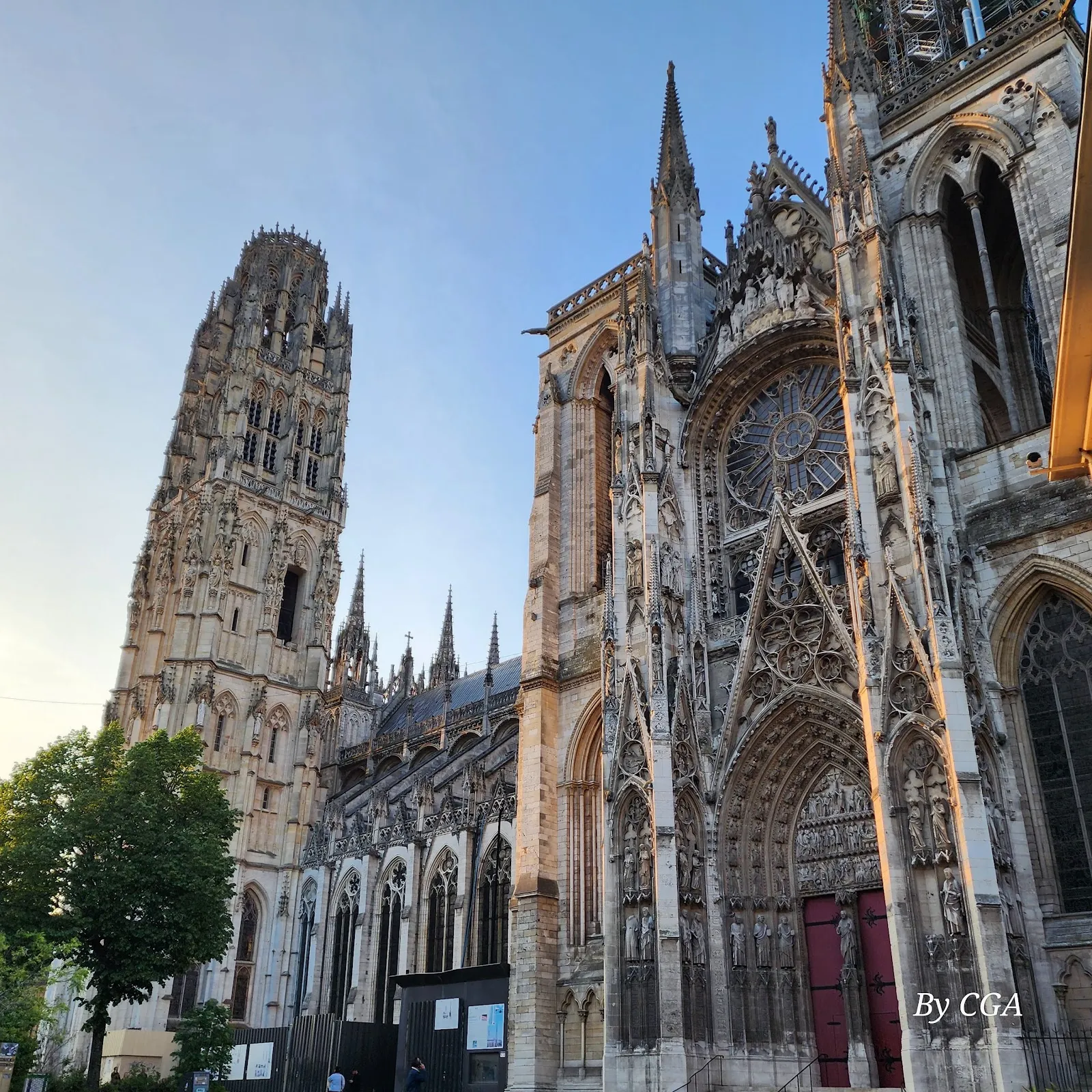
Stand on the Place de la Cathédrale and the front shows its long construction. It is not symmetrical. The Tour Saint-Romain is on the left and the Tour de Beurre, the Butter Tower, is on the right. Locals paid for the Butter Tower with money tied to permission to eat butter during Lent. The stonework is cut so finely that it reads as lace.
The central doorway carries sculptures of the Tree of Jesus, and some of the figures are missing their heads. The Porte Saint-Jean and Porte Saint-Étienne on either side date from the 12th century.
In the 1890s Monet painted this façade more than 30 times, at different hours and in different seasons. He worked from the former Bureau des Finances across the street, which is now the tourist office. One of his paintings of the cathedral hangs in the Musée des Beaux-Arts de Rouen.
Inside the cathedral
The nave has eleven bays under a six-part vault, and the lantern tower over the crossing gives the interior its height. Stained glass fills the building with coloured light, and the rose window is one of the details people come to see.
The tombs include those of Norman dukes. Richard the Lionheart's tomb holds his heart, and Rollo, the first ruler of Normandy, is also buried here. Many of the old statues have lost faces or hands to wars and centuries of weather.
At the back of the cathedral is the Escalier des Libraires, the Booksellers' Staircase. Its stonework is intricate, and you will walk past it if you do not look for it.
The archbishop's palace and Joan of Arc
The cathedral is the only one in France that still has its archbishop's palace attached, and the palace is still used by the archbishop. This is where Joan of Arc was tried and condemned in 1431. A second trial here in 1456 cleared her name. The palace now houses the Historial Jeanne d'Arc, a museum about her story.
The guided part of the museum visit has been given in French, so check the language options before you book. The Place du Vieux-Marché, where Joan was burned in 1431, is a short walk away along the rue du Gros-Horloge.
The summer light show
From June to September a free sound and light show is projected onto the façade after dark. The carved stone makes a detailed screen, and the colours bring out the same play of light that drew Monet. In summer it runs in the evening, and by mid-September the season is ending, so check the dates before you plan around it.
The square can be packed on Saturday nights and nearly empty on a Sunday. Seeing the show and then visiting the cathedral by day gives you both sides of the building.
Getting there
The cathedral is in the old centre and is easy to find because the spire shows from far away. Trains from Paris Saint-Lazare take just over an hour to Rouen Rive Droite, and from there the historic centre is a short walk. The cathedral is at the end of the rue du Gros-Horloge, beyond the astronomical clock.
FAQ
Is there an entry fee for Rouen Cathedral?
No, entry to the cathedral is free.
Is the light show free, and when does it run?
Yes, it is free. It is projected onto the façade after dark from June to September, and by mid-September the season is ending. Check the current timetable before you go.
How tall is the spire?
The cast-iron spire is 151 metres high, the tallest of any church in France. From 1876 to 1880 it made the cathedral the tallest building in the world.
Where is Richard the Lionheart's tomb?
It is inside the cathedral. The tomb holds his heart, and the cathedral also has the tombs of Norman dukes.
Is the cathedral wheelchair accessible?
Yes. It has a wheelchair accessible entrance, accessible seating and an accessible restroom, and it offers a hearing loop and assisted listening devices.


