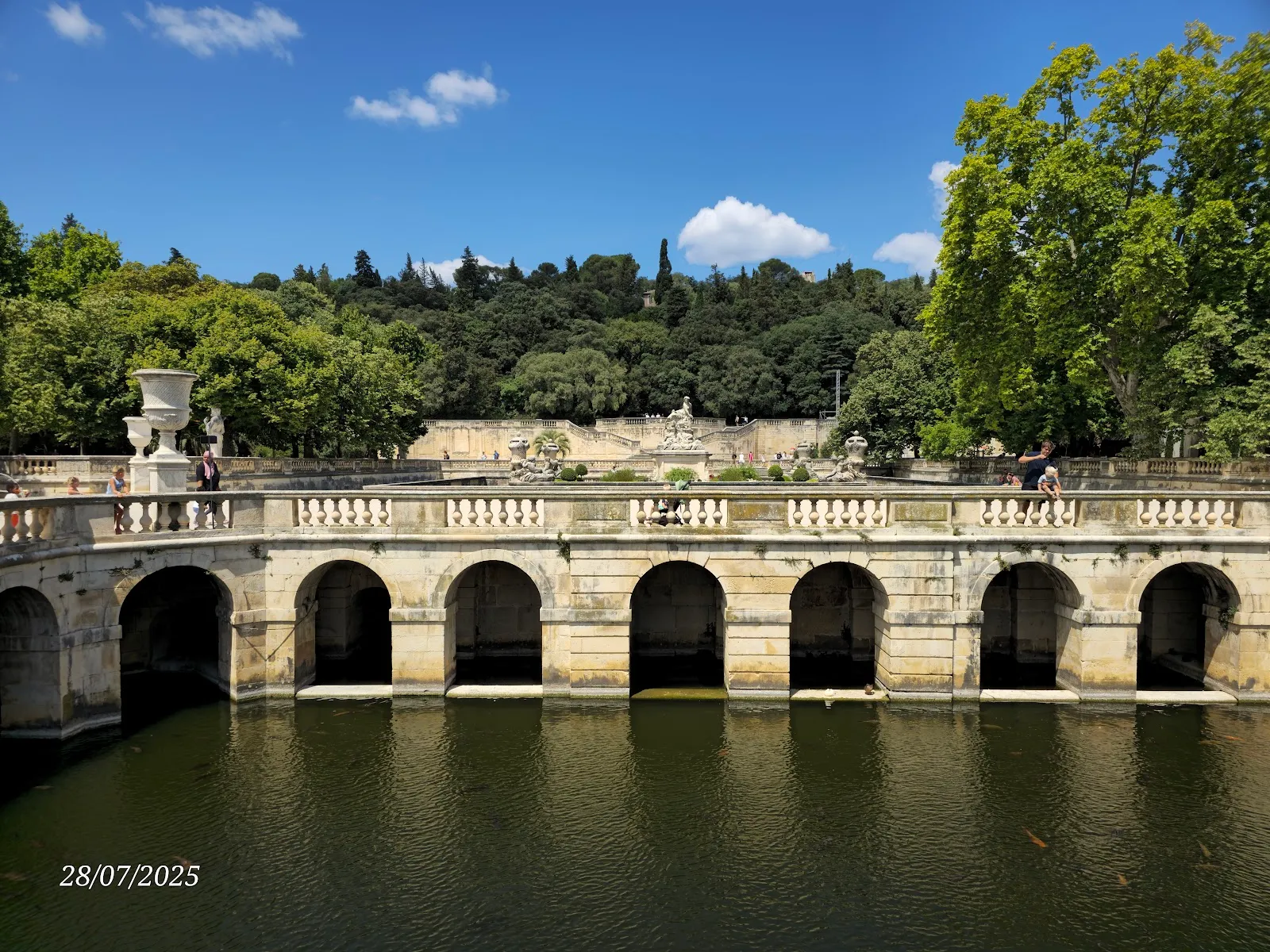
Jardin de la Fontaine is a public garden on the north-western edge of the old town in Nîmes, about a 10 minute walk from the arena. Engineer Jacques-Philippe Mareschal laid it out from 1745 around the spring where the city began, and it is counted among the first public gardens in Europe. Canals, pools, balustrades and broad stone staircases fill the lower part, while pines and cedars cover the slope of Mont Cavalier. The ruins of the Temple of Diana stand beside the water, and the Tour Magne crowns the hill. Entry to the garden is free.
The spring before the garden
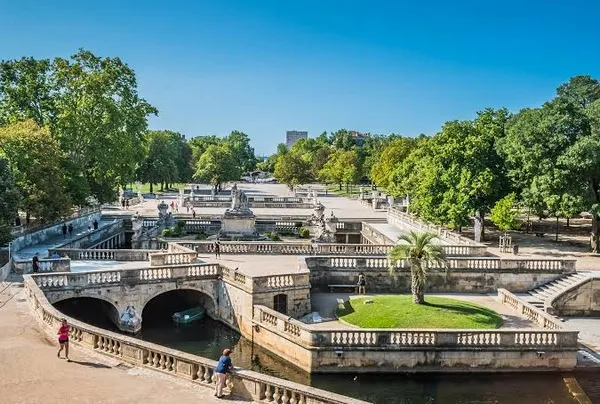
The garden stands where the history of Nîmes began. A spring rises at the foot of Mont Cavalier, and the Gallic tribe known as the Volcae Arecomici held it sacred long before the Romans came. The Romans named it Nemausus and made it the centre of a larger sanctuary tied to the imperial cult, with a monumental fountain surrounded by porticos.
The site was forgotten for centuries. When work in the 18th century set out to channel the spring, the remains of Roman structures came to light, and an altar from the end of the 1st century AD was found in 1752. The water still flows through the grounds today.
Laying out the garden, 1745 to 1755
The gardens were begun in 1745 under King Louis XV, to a design by Jacques-Philippe Mareschal, a military engineer. Work ran until about 1755. Mareschal based his plan on the ruins of the ancient sanctuary and built on the line of the city's old western defences.
The result belongs to the neo-classical taste of its day: long stone staircases, balustrades, marble vases, Baroque-style statues and a network of canals and pools. It is counted among the first public gardens in Europe, and it holds the French label Jardin remarquable. Later additions include a rock garden, the Montgolfier pool with aquatic plants, and the Mazet garden.
Two gardens on one hill
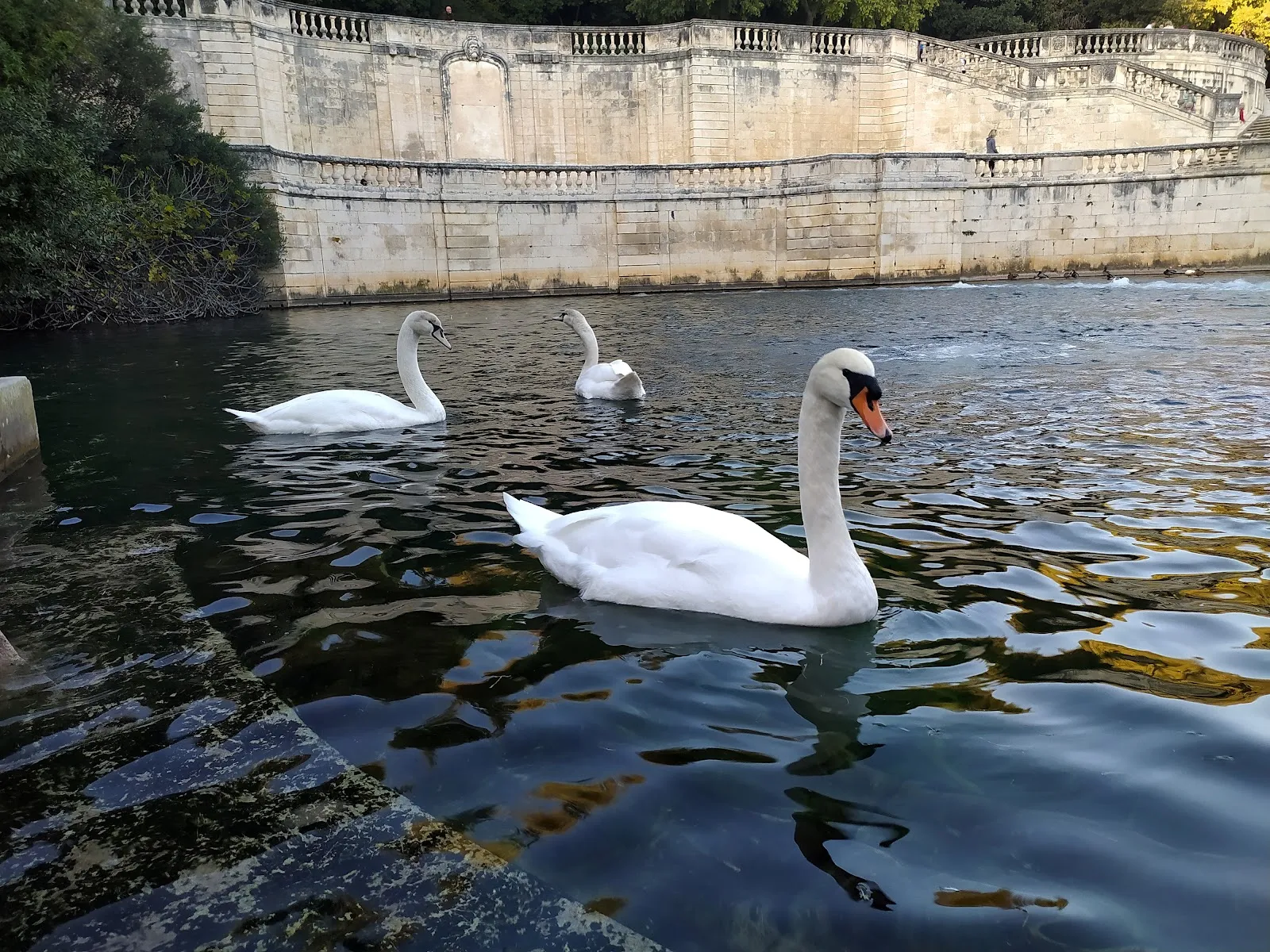
The grounds cover about 15 hectares and fall into two distinct parts. The lower section is the classical French garden, where water runs through channels and pools past statues and bridges. Swans and ducks use the basin of the main fountain, and fish swim in the ponds. At the source itself you can see bubbles rising to the surface.
The upper section climbs Mont Cavalier along winding paths and is planted in Mediterranean style, with pines, cedars and other plants suited to a dry climate. The two halves look quite different, and walking from one to the other takes only a few minutes. The main fountain is lit at night.
The Temple of Diana and the Tour Magne
Next to the main fountain are the ruins of the so-called Temple of Diana, from the 1st century. Only arches and broken walls remain. The name probably comes from a misreading, and the building's original purpose is still uncertain. One explanation is that it was a nymphaeum, a shrine to the nymphs of a spring, linked to the cult of Augustus and his family. The structure survived into the Middle Ages and was later used as a place of worship. It was badly damaged during the Wars of Religion.
At the top of the hill stands the Tour Magne, about 30 m high and raised around 15 BC. It is the largest of a chain of towers along the city's 7 km Roman fortifications and the last trace of those walls. A spiral staircase of 140 steps winds around a central column to the top. From there you see the rooftops of Nîmes and the countryside beyond.
FAQ
Is there an entry fee for Jardin de la Fontaine?
No, the garden itself is free. A ticket is needed only for the Tour Magne, and a multi-pass also covers the arena, the museum and one other site.
How long do you need at Jardin de la Fontaine?
Plan on one to two hours. That is enough to walk both parts of the garden, see the Temple of Diana and climb the Tour Magne.
How far is the garden from the arena?
It is about a 10 minute walk. The garden lies on the north-western edge of the old town.
How many steps are there to the top of the Tour Magne?
There are 140 steps on a spiral staircase. People go up and down on the same stairs, so it can slow at busy moments.
Is the garden suitable for children and dogs?
Yes. There is a playground, picnic tables and open space, and dogs are allowed. The entrance and parking are wheelchair accessible.