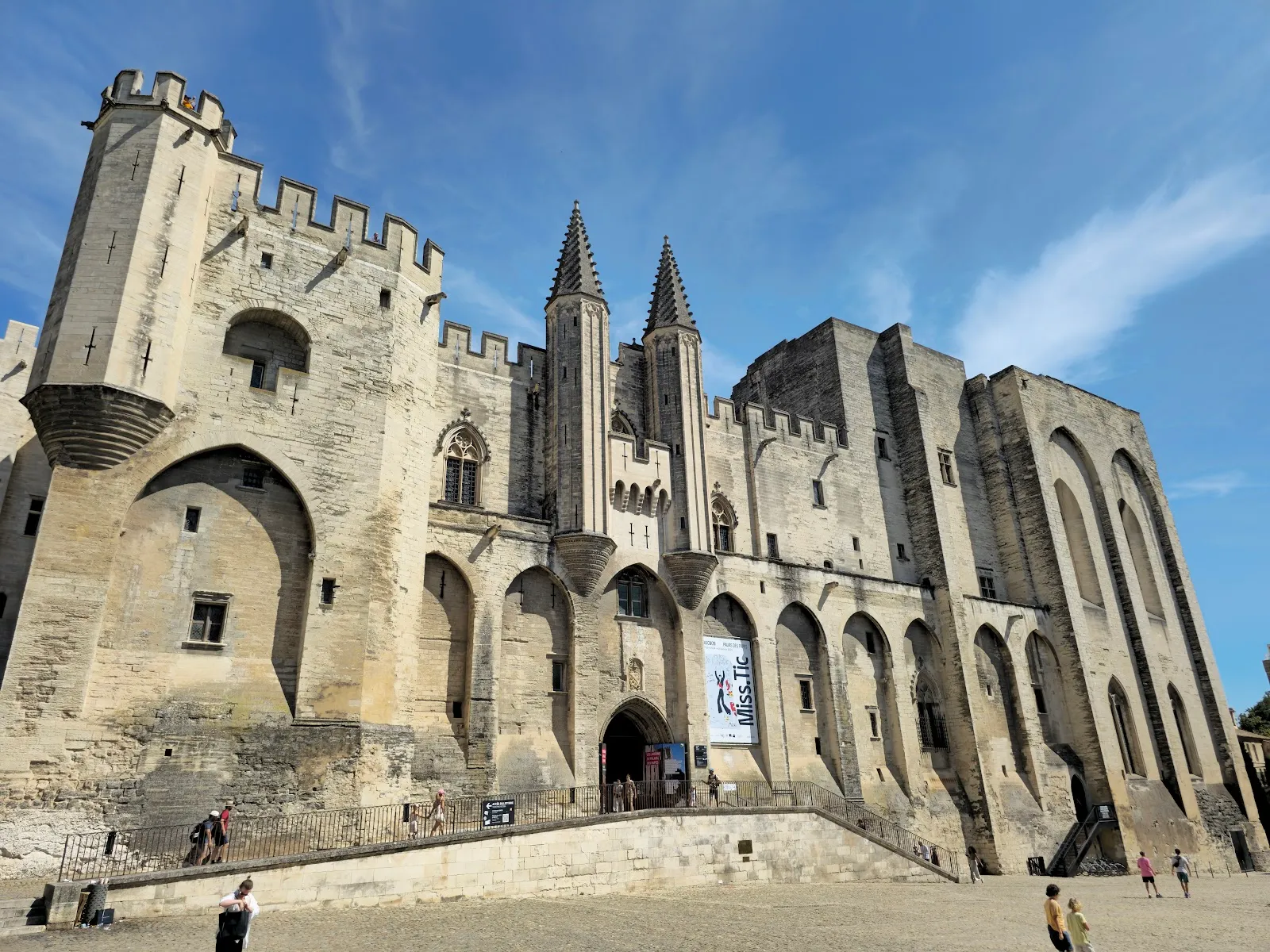
The Palais des Papes is a Gothic fortress-palace on the Rocher des Doms in Avignon, built in the 14th century for the popes who left Rome in 1309. It is two buildings joined by the Great Court: the plain Old Palace of Benedict XII and the more decorated New Palace of Clement VI. Most rooms are bare today, so the ticket includes a tablet that shows how they looked in papal times. The main stops are the painted chapels, the vaulted feast hall and the stag-hunt chamber with its view over the city.
Why the popes came to Avignon
In 1309 Pope Clement V left Rome after violent disorder following his election and settled the papal court in Avignon. The city stayed the seat of Western Christianity until 1377, and the palace on the Rocher des Doms became the centre of papal power.
The arrangement ended in division. After the election of Clement VII in 1378, Roman and Avignonese popes each claimed legitimacy and denounced each other until 1417. The Avignon popes were recognised mainly in Naples, France and Spain.
The building was ransacked during the French Revolution and later served as a prison and as barracks. It has been listed as a historic monument since 1840 and, together with Avignon's historic centre, has been on the UNESCO World Heritage list since 1995.
Two palaces joined by one court
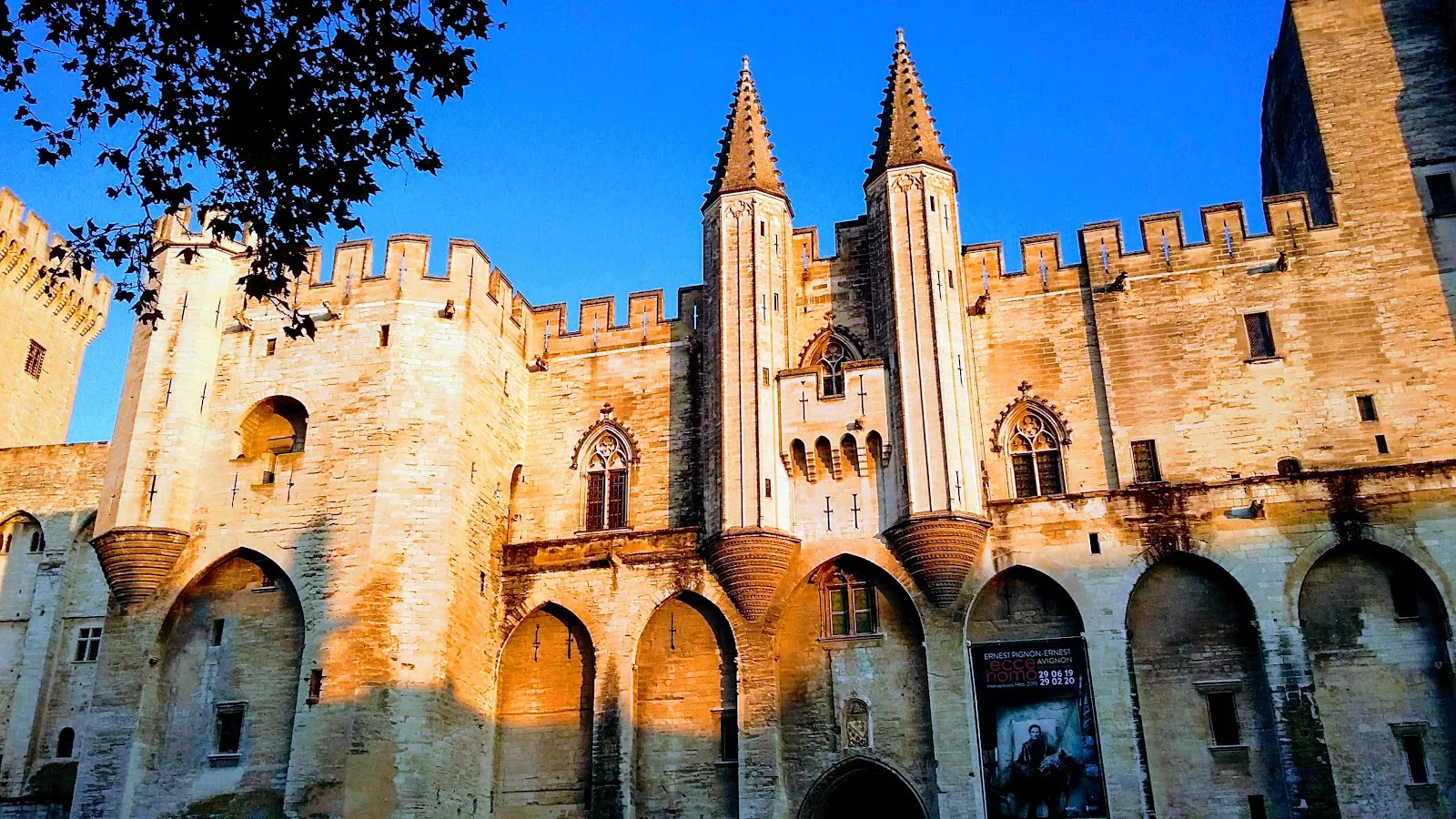
The palace looks like a single colossal block, but it is two structures. The Palais Vieux, the Old Palace, was built between 1334 and 1342 for Benedict XII, a Cistercian, and it is severe by design. The Palais Nouveau, the New Palace, followed in the next decade under Clement VI, who preferred a more decorative style. The Great Court is the entrance to the complex and links the two.
The scale is easy to underestimate from outside. The walls are about three metres thick, and the floor space is around 15,000 square metres. The battlements and the sluices for pouring hot oil on attackers are still visible and show that this was a fortress as well as a residence.
Rooms worth stopping for
The interiors are austere. Many original furnishings went back to Rome with the papacy, and others were lost in the Revolution, so some imagination is needed. Frescoes by Simone Martini and Matteo Giovanetti, two Italian painters of the Trecento, once decorated the palace. Some rooms keep only fragments, and in others the painting is badly damaged.
In the Palais Vieux, the Chapelle St-Jean and the Chapelle St-Martial hold original frescoes by Giovanetti. The Grand Tinel, or Feast Hall, has a vaulted roof and a series of 18th-century Gobelin tapestries. The Chambre du Cerf has a richly decorated ceiling, murals of a stag hunt and a view of Avignon.
The ticket includes a tablet, known as a Histopad, that works as a 3D audio guide. It shows the rooms as they would have looked in papal times, which helps most in the empty halls. A separate exhibition space, the Musée de l'Oeuvre, traces the history of the building from its construction.
The Cour d'honneur and the Festival d'Avignon
The Cour d'honneur is the main courtyard, about 1,800 square metres of medieval stone rising roughly thirty metres. It is the birthplace of the Festival d'Avignon. The festival runs across more than 30 venues in the city and the surrounding region, including cloisters, chapels, gardens, quarries and churches. It draws more than 120,000 spectators to over 400 events: performances, debates, readings and screenings.
If your trip overlaps with the festival, the courtyard is where the main stage productions are held. At other times you can see the same space as part of the visit.
On the same square
The Petit Palais Museum is a short walk across the square, in a 14th-century building on the north side. It holds Italian and Provençal paintings from the 13th to the 16th centuries, early Renaissance works, and examples of Avignon sculpture. Avignon's Romanesque cathedral, Notre-Dame des Doms, is next door to the palace, and the Place de l'Horloge is nearby.
FAQ
How long do you need at the Palais des Papes?
Plan on about two hours for the interior with the tablet guide. If you add the outdoor areas and read each room's history, it can fill a good part of a day.
Is the Palais des Papes open on Mondays?
Yes, it is listed as open every day, from 9 am. It is one of the few museums in Avignon that open on Mondays.
Should you book tickets in advance?
Buying in advance is recommended. Tickets include a tablet guide that shows 3D reconstructions of the rooms.
What is inside the palace?
The rooms are largely bare, as many furnishings left for Rome or were lost in the Revolution. You see painted chapels, the vaulted Grand Tinel, the Chambre du Cerf with its stag-hunt murals, and the Musée de l'Oeuvre on the building's history.
Where can you park near the Palais des Papes?
The underground car park beneath the Place du Palais exits directly in front of the palace. Driving inside the city walls is not advised.