Pianifica un viaggio
Lingua: Italiano
Pianificatore di viaggiPianifica il tuo viaggio su una mappa

Le migliori destinazioni

EnglishDeutschFrançaisEspañolPortuguêsPortuguês (BR)Italiano
Avviso di viaggio · EgittoAlcuni governi sconsigliano di viaggiare in alcune zone di Egitto.Gli avvisi riguardano solo queste aree: Fascia di 50 km lungo il confine libico, Striscia di Gaza, Confine libico (senza profondità definita), Governatorato del Sinai settentrionale, Confine sudanese (senza profondità definita), Deserto Occidentale, Governatorato di Ismailia (a est del Canale di Suez), Nord del Governatorato del Sinai meridionale (oltre la strada Santa Caterina–Nuweiba).Le indicazioni dipendono dal tuo passaporto. Leggi quelle del tuo governo prima di prenotare.Indicazioni ufficiali
Aree con avvisi
  • Fascia di 50 km lungo il confine libico · evitare ogni viaggio · Canada, Nuova Zelanda
  • Striscia di Gaza · evitare ogni viaggio · Canada, Francia, Nuova Zelanda
  • Confine libico (senza profondità definita) · evitare ogni viaggio · Germania, Spagna, Francia, Italia
  • Governatorato del Sinai settentrionale · evitare ogni viaggio · Canada, Spagna, Francia, Irlanda, Nuova Zelanda, Regno Unito
  • Confine sudanese (senza profondità definita) · evitare ogni viaggio · Germania, Spagna, Francia, Italia
  • Deserto Occidentale · evitare ogni viaggio · Canada, Nuova Zelanda, Regno Unito, Stati Uniti
  • Governatorato di Ismailia (a est del Canale di Suez) · evitare i viaggi non essenziali · Canada, Regno Unito
  • Nord del Governatorato del Sinai meridionale (oltre la strada Santa Caterina–Nuweiba) · evitare i viaggi non essenziali · Canada, Nuova Zelanda, Regno Unito

Segnalata anche da un solo governo: Fascia di 20 km lungo il confine libico (Regno Unito), Zone di confine (zone militari) (Stati Uniti), Zona di confine egiziano-israeliana (Germania), Penisola del Sinai settentrionale e centrale (Stati Uniti), Governatorato di Port Said (a est del Canale di Suez) (Canada), Zona di confine di Rafah (Spagna), Governatorato di Suez (a est del Canale di Suez) (Canada), Strada Bahariya–Siwa (Regno Unito), Trapezio di Bir Tawil (Regno Unito), Deserto a ovest di Marsa Matruh, Fayyum e Abu Simbel (Francia), Regione dal Gebel Uweinat al Gilf el-Kebir (Italia), Triangolo di Halaib (Regno Unito), Aree desertiche non turistiche (Italia), Valico di frontiera di Rafah (Irlanda), Penisola del Sinai meridionale (Germania)

GovernoConsigliAggiornatoLeggi le indicazioni
Regno Unito (FCDO)No advice against the whole country (regional advisories)–Leggi le indicazioni
Stati Uniti (Dipartimento di Stato)Exercise increased caution (regional advisories)15 lug 2025Leggi le indicazioni
Canada (Affari globali)Exercise a high degree of caution (regional advisories)–Leggi le indicazioni
Germania (Auswärtiges Amt)Besondere Vorsicht walten lassen (keine Gesamtwarnung) (regional advisories)13 ott 2026Leggi le indicazioni
Nuova Zelanda (SafeTravel)Exercise increased caution elsewhere in Egypt (regional advisories)–Leggi le indicazioni
Irlanda (Dipartimento per gli Affari esteri)High degree of caution (regional advisories)–Leggi le indicazioni
Francia (Ministero per l'Europa e gli Affari esteri)Increased vigilance for the rest of the country (regional advisories)–Leggi le indicazioni

Verificato ogni giorno dalle indicazioni pubblicate dai governi; ultima verifica 2 nov 2026.RoamLedger riassume le indicazioni ufficiali; non è un consiglio di alcun governo.

The Mosque of Rifai and Sultan Hassan in the historic city of Cairo, Egypt
Moschea

Mosque-Madrasa of Sultan Hassan

Near Cairo’s Citadel, the Mosque-Madrasa of Sultan Hassan is a vast 14th-century complex that combines a mosque with four religious schools.

Near Cairo’s Citadel, the Mosque-Madrasa of Sultan Hassan is a vast 14th-century complex that combines a mosque with four religious schools. Built between 1356 and 1363, it is a major example of Mamluk architecture. Pass through the recessed entrance and dark, bending corridor to reach a quiet square courtyard, where four tall vaulted halls, or iwans, face one another. Look closely at the carved stonework, geometric decoration and Arabic calligraphy, then take time to see the prayer hall and the central fountain.

A mosque and four schools
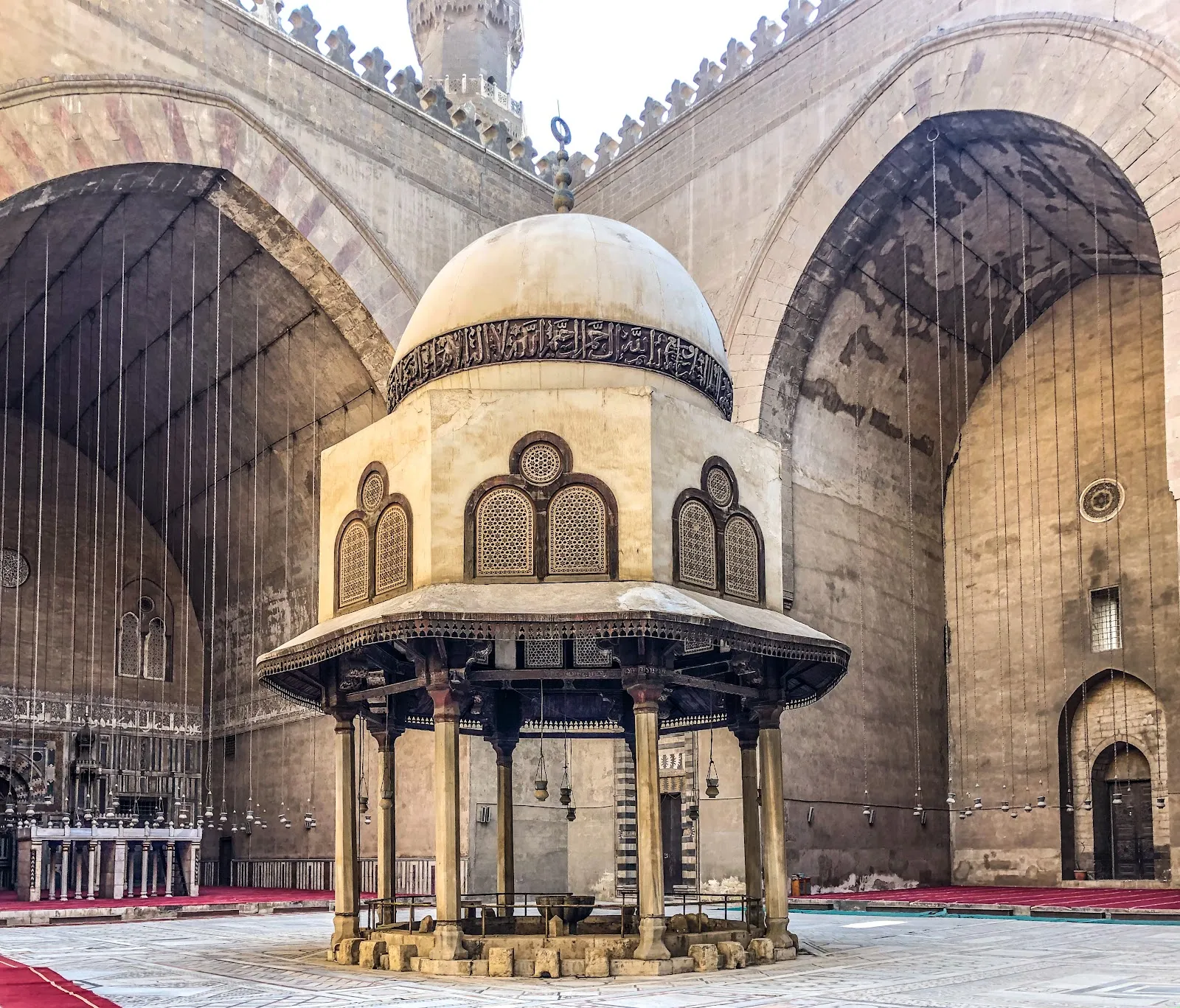
Mosque-Madrasa of Sultan Hassan

Sultan Hassan commissioned the complex, which was built between 1356 and 1363 during the Mamluk period. It combined a congregational mosque with a madrasa, an Islamic school, and was among the largest religious buildings of its time. Sultan Hassan was the grandson of Sultan Qalaun. He became ruler as a teenager, was deposed and returned to power several times, and was killed shortly before the building was completed.

The madrasa was arranged around four iwans, vaulted halls associated with the four main Sunni schools of law: Hanafi, Maliki, Shafi’i and Hanbali. This educational role is reflected in the monument’s name. The building’s scale and layout were ambitious, and its architectural details make it one of Cairo’s defining examples of early Mamluk design.

Through the entrance to the courtyard
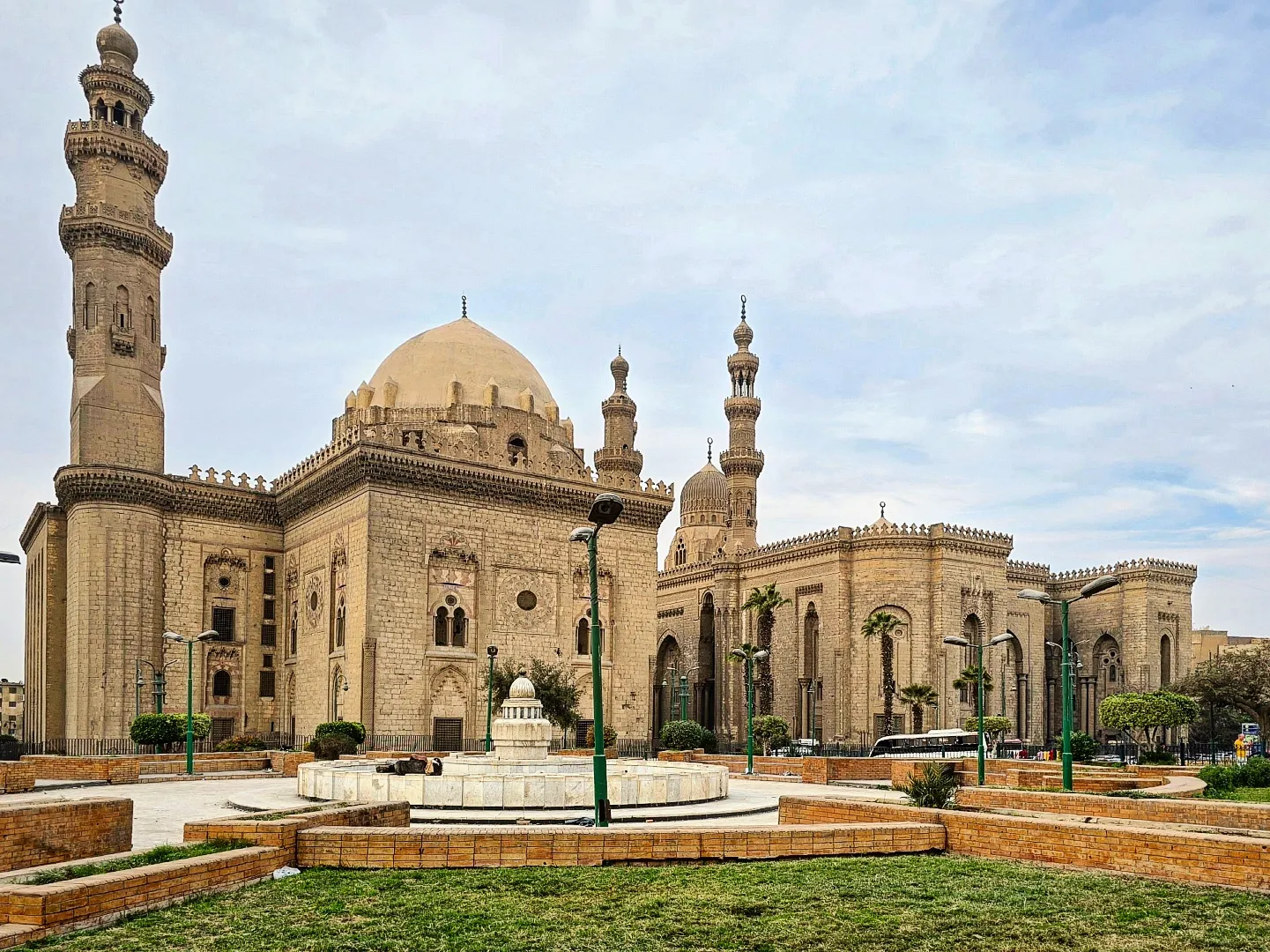
Mosque-Madrasa of Sultan Hassan

The recessed entrance portal leads into a dark passage that bends before opening onto the square central courtyard. The change from the confined corridor to the open space is one of the visit’s defining moments. A fountain stands in the courtyard, with a tall iwan on each side. Doorways from the halls lead into spaces connected with the former schools.

Pause in the courtyard to take in the four vaulted halls and the height of the surrounding walls. The building’s great scale is clear here, but the finer work rewards a closer look. Examine the stone carving, patterned surfaces and calligraphy, including the decoration around the entrance and overhead. The prayer hall and its mihrab, the niche that indicates the direction of prayer, are also among the interior details to notice.

Architecture and atmosphere

The complex is known for its monumental proportions and carefully worked Mamluk decoration. Its entrance portal, soaring iwans and large courtyard give the building a strong sense of order, while carved details and geometric patterns bring variety to the stone surfaces. The architecture served both religious and educational purposes, bringing the mosque and the four schools together in one structure.

Although the mosque is close to Cairo’s Citadel and the streets of historic Cairo, the courtyard provides a quieter space to look around. Allow time to move through the entrance passage, courtyard and interior rooms at an unhurried pace. Staff may be able to share historical details, and guards may demonstrate how sound carries in the indoor spaces.

FAQ

When was the Mosque-Madrasa of Sultan Hassan built?

Construction began in 1356 and the complex was completed in 1363, during the Mamluk period.

What are the four iwans?

They are vaulted halls around the central courtyard. The four halls were associated with the Hanafi, Maliki, Shafi’i and Hanbali Sunni schools.

Do you need to remove your shoes to enter?

Yes. Visitors should remove their shoes at the entrance; small change can be useful for the shoe attendants.

Altre attrazioni imperdibili a Il Cairo

Esplora tutto