At 380 Sussex Drive in Ottawa, the National Gallery of Canada pairs a glass-and-granite building by architect Moshe Safdie with galleries of Indigenous, Canadian and international art. Inside, light enters through skylights and the Great Hall’s glass roof; its upper walkway looks toward Parliament Hill and the Ottawa River. The collection ranges from works by the Group of Seven and Inuit artists to European painting and contemporary installations. Outside, Louise Bourgeois’s bronze spider sculpture, Maman, is a landmark in its own right. Allow time for the galleries, courtyards and chapel.
A gallery designed around light
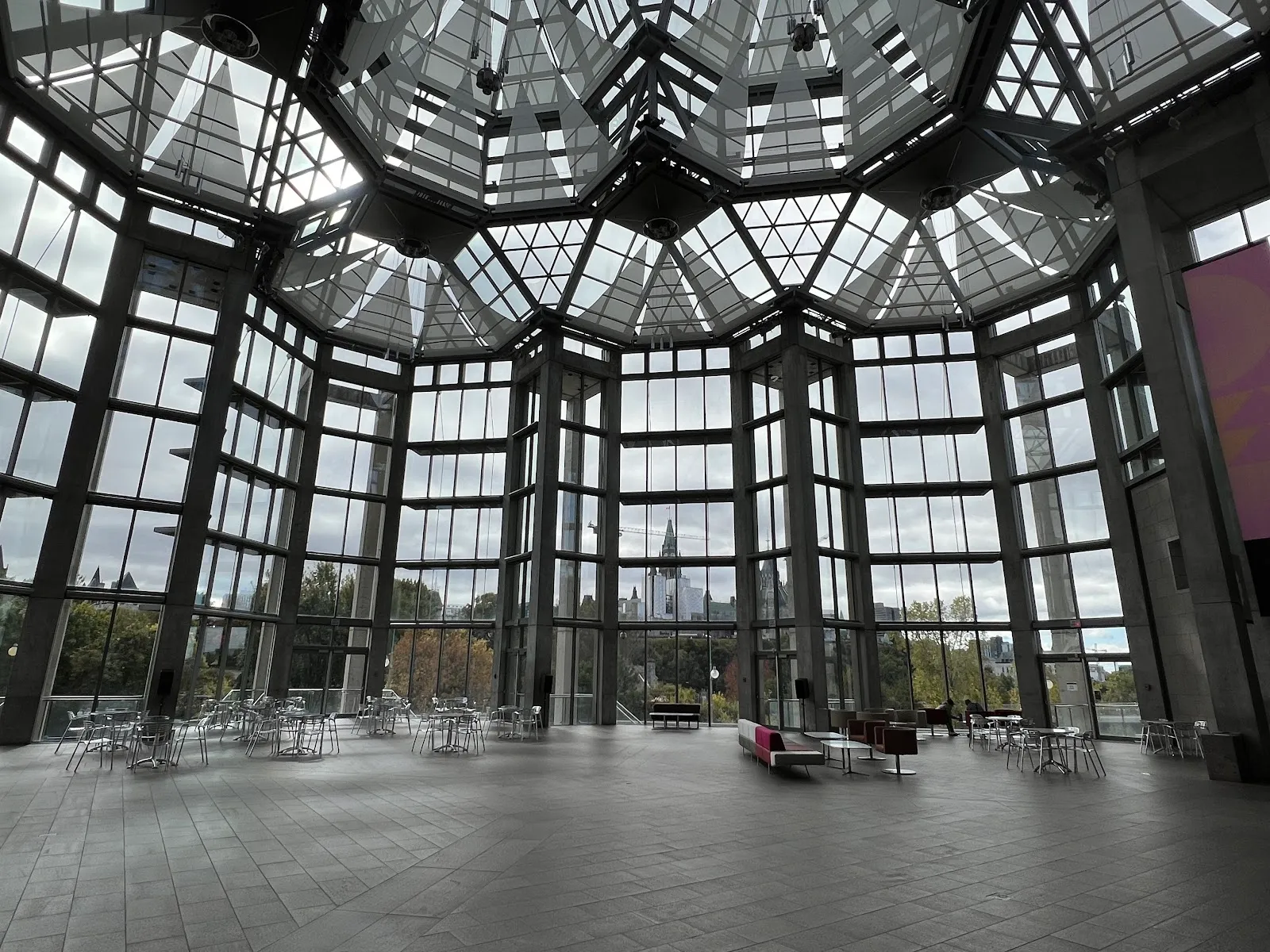
Architect Moshe Safdie designed the National Gallery of Canada’s glass-and-granite building, which opened at this location in 1988. Pink and grey granite gives the exterior weight, while glass towers and broad windows bring daylight into the interior. The building’s forms echo the nearby Parliament buildings.
The approach leads through the Colonnade to the Scotiabank Great Hall. A long ramp rises into this glass-roofed space, where triangular sun shades break up the light. Look upward at the roof, then out through the windows toward Parliament Hill, Major’s Hill Park, ByWard Market and the Ottawa River. The views change with your position in the hall, so take a moment to look around before moving on.
Canadian and Indigenous art

The galleries bring together Indigenous and Canadian art from across the country’s history, including Inuit works and paintings by members of the Group of Seven. Interpretive panels help place the art in the context of Canada’s history and cultural development. Displays include paintings, sculpture, prints, photographs and decorative art.
The collection is not limited to Canadian artists. European and American works sit alongside contemporary art and temporary exhibitions, so the selection changes as exhibitions rotate. Works by artists such as Emily Carr, Tom Thomson and the Group of Seven are among the Canadian art highlights. Rather than trying to see every room at once, you can choose a focus, such as Indigenous art, Impressionism or contemporary installations, and leave time to explore galleries that catch your attention.
The chapel and garden court
The Rideau Street Chapel is a reconstructed 19th-century chapel with a fan-vaulted ceiling. Its details offer a quieter change of pace from the open galleries. The Fred and Elizabeth Fountain Garden Court is another place to pause: it is lit from above and has an indoor garden with a gravel path edged by ferns and orchids.
Outdoor sculpture extends the visit beyond the galleries. Maman, Louise Bourgeois’s monumental bronze spider, stands near the entrance. The grounds also hold other artworks, and nearby Nepean Point provides views across the river toward Major’s Hill Park, Parliament and the Canadian Museum of History.
FAQ
Is admission to the National Gallery of Canada free?
Admission is free on Thursdays after 5 pm. The gallery is open until 8 pm that evening.
How long should I spend at the National Gallery of Canada?
Allow about two to three hours for the galleries and time to see the building and its outdoor sculpture.
What can I see at the National Gallery of Canada?
The collection includes Indigenous and Canadian art, European and American works, contemporary art and temporary exhibitions. The building also has the Great Hall, a reconstructed chapel and an indoor garden court.
Where is the National Gallery of Canada?
It is at 380 Sussex Drive in Ottawa, near ByWard Market and Parliament Hill.