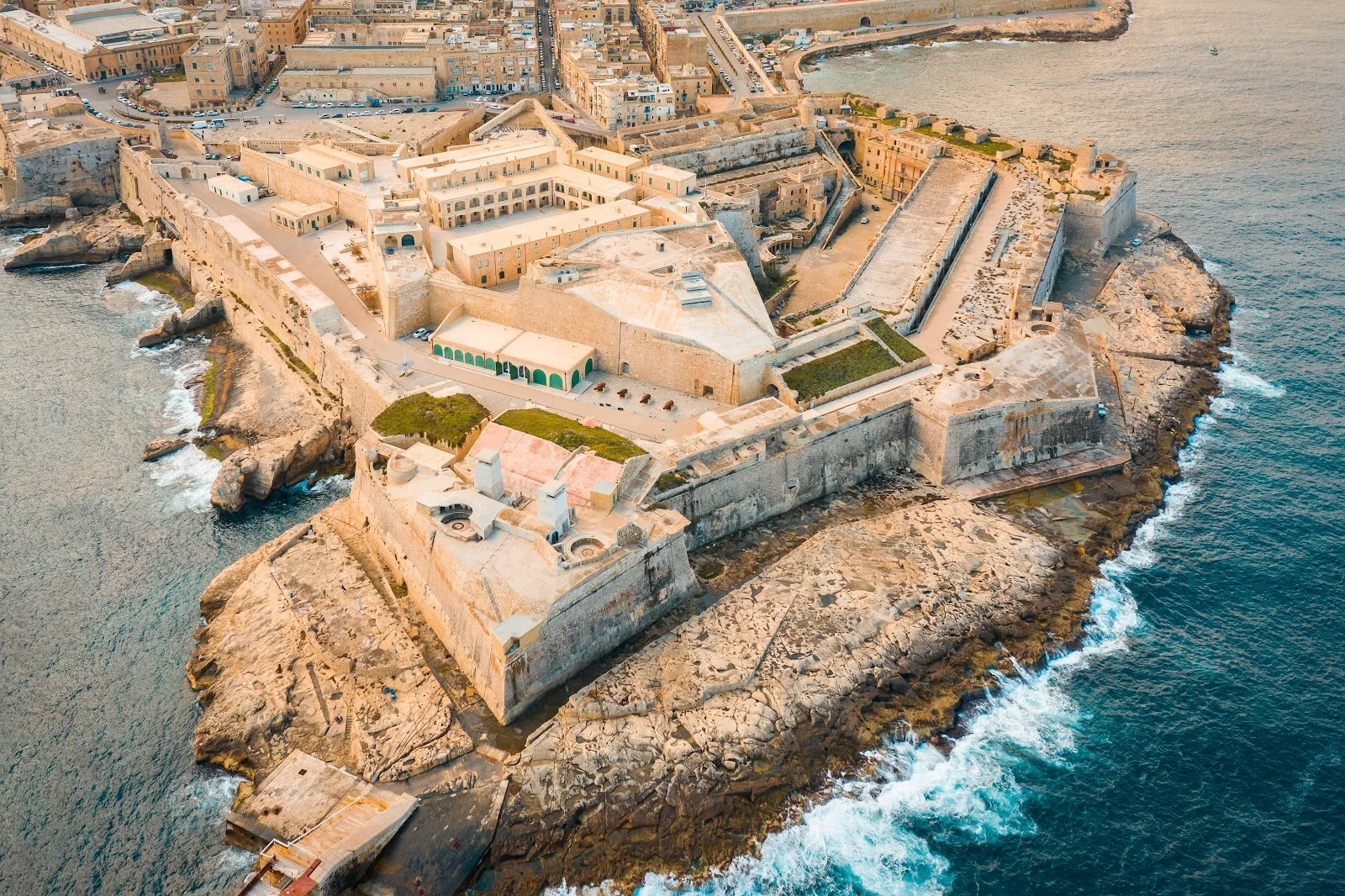
Fort St Elmo sits at the tip of Valletta's peninsula, where it guards the Grand Harbour and Marsamxett Harbour. The Knights of St John built it in 1552, and it took the brunt of the Ottoman attack during the Great Siege of 1565. Inside, the National War Museum traces Malta's story from prehistoric times through the Knights and British rule to the Second World War, using clear panels, artefacts and projected video. The ramparts give wide views over Valletta and the harbours.
From the Knights to the Great Siege
The Knights of St John built the fort in 1552 to guard the harbours on either side of the Sceberras Peninsula. It is named after St Elmo, the patron saint of mariners, and it was built in a short time, in around four months.
In 1565 the fort held out against the Ottoman forces during the Great Siege of Malta. The Ottomans bombarded it for weeks before they took it, and the defenders who were still inside were killed. The siege is one of the best-known episodes in Malta's history, and the fort is central to it. Valletta was planned soon afterwards, on the same peninsula.
What the National War Museum shows
The displays run in rough chronological order, starting with prehistoric finds from the early Bronze Age and moving through Malta's successive colonisations and the Great Siege. Two halls are devoted to Malta's part in the First and Second World Wars, and a section covers the role of Valletta in both wars.
Several objects stand out. The George Cross is shown alongside military armour and uniforms, weapons, documents and a Bofors anti-aircraft gun. A Gloster Sea Gladiator aircraft, named Faith, is one of the planes that defended the island when Italy attacked in 1940. A Jeep named Husky, dating from 1943, is another highlight. Photographic panels show how civilians lived through the hardest years of the wars.
The museum also includes a First World War memorial, and the Book of Remembrance is displayed among the wartime relics.
Chapels, granaries and the ramparts
Two chapels dedicated to St Anne are inside the fort, and one of them is the resting place of knights who died in battle. The stonework of both is well kept, and they are worth a short look between museum rooms.
On the landward side of the fort are granaries from the 17th century. Their lids are raised above subterranean pits that once stored grain for the island's residents. Stray cats live around them, and local people leave food for the animals on the lids.
The ramparts are the place to take in the view. From them you can see across Valletta's harbours, and the lower parts of the city are visible below the fort walls.
Perguntas frequentes
Are there chapels inside Fort St Elmo?
Yes. Two chapels dedicated to St Anne are inside the fort, and one of them is the resting place of knights who died in battle.
What are the main highlights of the National War Museum?
The George Cross awarded to Malta, a Gloster Sea Gladiator aircraft named Faith, and a Jeep named Husky from 1943 are among the main objects. The museum also has weapons, uniforms and photographic panels about civilian life during the wars.
Can I leave my bag somewhere during the visit?
Yes. Free left luggage lockers are available on site.
How far is Fort St Elmo from the Grandmaster's Palace?
The walk takes about 10 to 15 minutes. The route is hilly, and the last stretch runs beside a coastal road with car traffic.


