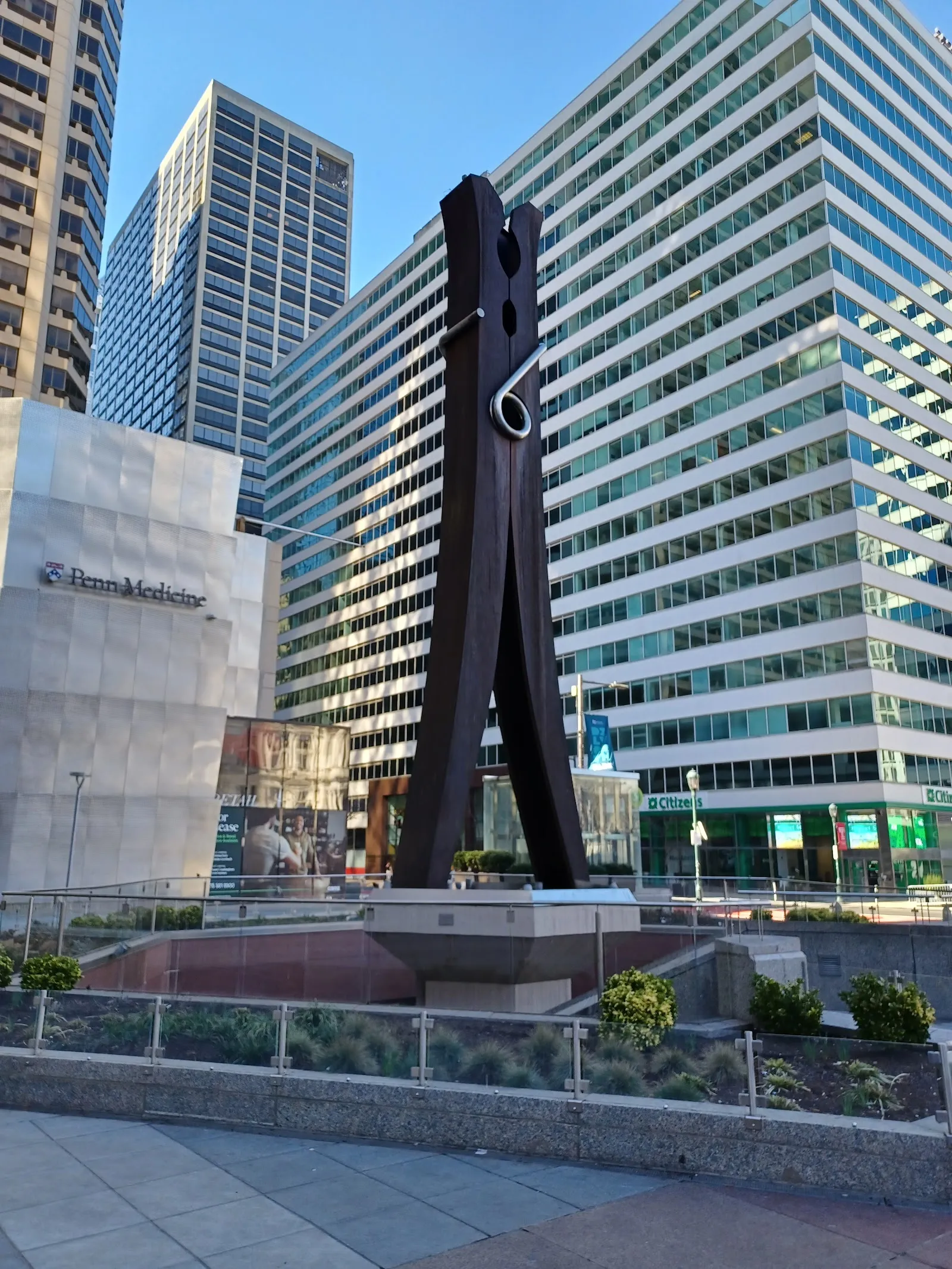
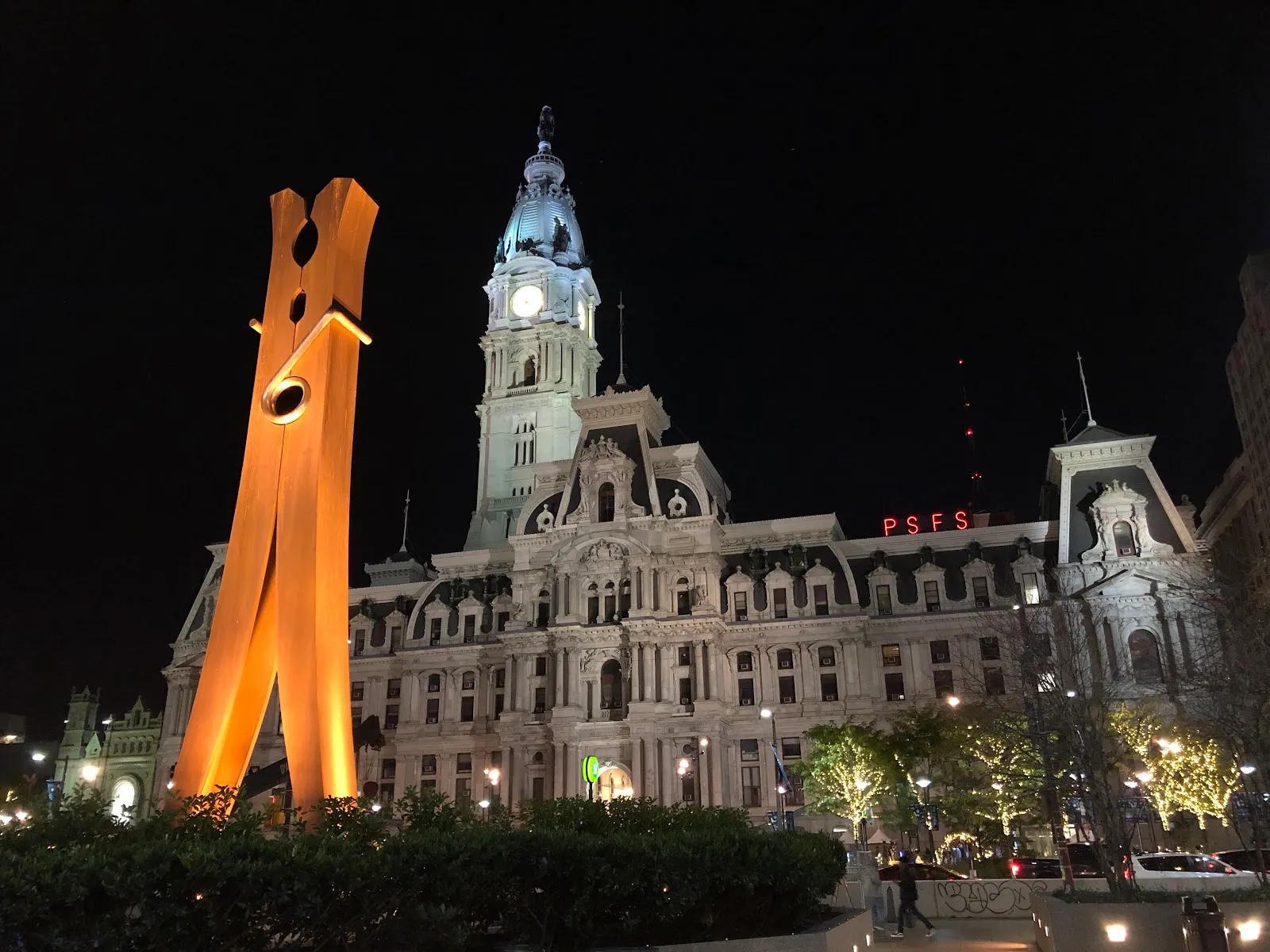
At Market and South 15th streets in Center City, Claes Oldenburg’s Clothespin turns a familiar household object into a 45-foot public sculpture. Installed in 1976, it stands near City Hall and Centre Square, where its scale and distinctive shape invite a closer look. The Cor-Ten steel develops a warm reddish-brown surface as it weathers, and the sculpture takes on a different appearance after dark when illuminated. Stop for a photograph, or pause to consider how Oldenburg reshapes an everyday form into a work of public art.
A familiar shape at monumental scale
Clothespin was designed by Claes Oldenburg, the Swedish-American artist, and unveiled in 1976 during Philadelphia’s year-long Bicentennial celebration. At 45 feet tall and weighing 10 tons, it was Oldenburg’s first major public artwork in the city. The sculpture stands at Centre Square Plaza, at Fifteenth and Market streets, close to City Hall.
Its subject is instantly recognizable, but the scale changes how it reads. Oldenburg turns a household object into a downtown landmark, placing it among office towers and city streets. Seen beside City Hall’s tower and its statue of William Penn, the clothespin’s familiar outline feels unexpected in its urban setting. That contrast is central to the work: an ordinary form becomes something to stop and look at when enlarged and placed out of context.
Steel, shape and interpretation
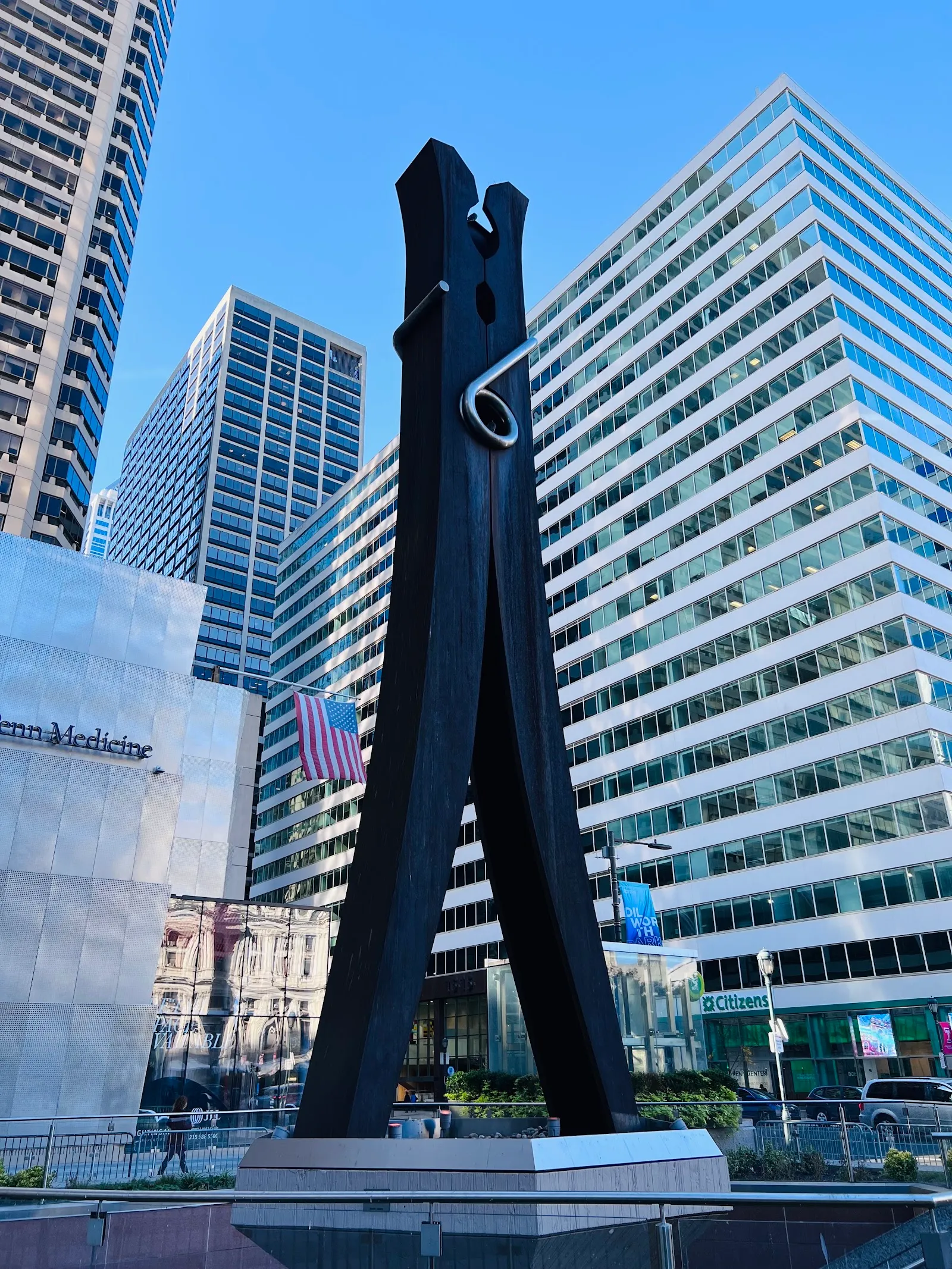
The sculpture is made from Cor-Ten steel, which develops a reddish-brown patina as it weathers. Its surface and sweeping outline change with the light; after dark, illumination gives the work another appearance. The shape is stylized, not a full-size copy enlarged. Its two parts come together in a way that has also been compared with an embrace.
Oldenburg connected the sculpture’s form to Constantin Brancusi’s The Kiss at the Philadelphia Museum of Art. That reference offers one way to think about the meeting forms, but the work leaves room for different readings. Its familiar subject can prompt humor as readily as interpretation, and the difference between the object people recognize and the artwork in front of them is part of the encounter.
A public artwork in Center City
Developer Jack Wolgin commissioned Clothespin through the Redevelopment Authority’s one-percent program. The work entered public space in 1976, where pedestrians, office workers, cab drivers and art audiences encountered it in the course of daily life. It became a Philadelphia landmark soon after its installation.
The sculpture is directly accessible from the surrounding public streets, at the corner of Market and South 15th. Its central location makes it easy to include on a walk around City Hall or as a stop on a city tour. The entrance is wheelchair accessible. Because the work is outdoors beside busy sidewalks, take care with your footing while viewing it or taking photographs.
Perguntas frequentes
Where is the Clothespin Sculpture?
It is at Market Street and South 15th Street in Center City Philadelphia, at Centre Square Plaza near City Hall.
Who made the Clothespin Sculpture?
Claes Oldenburg designed the sculpture. It was unveiled in 1976.
What is the Clothespin Sculpture made of?
It is made of Cor-Ten steel, which develops a reddish-brown patina as it weathers.
Can you see the sculpture at night?
Yes. It is illuminated after dark, giving it a different appearance.