
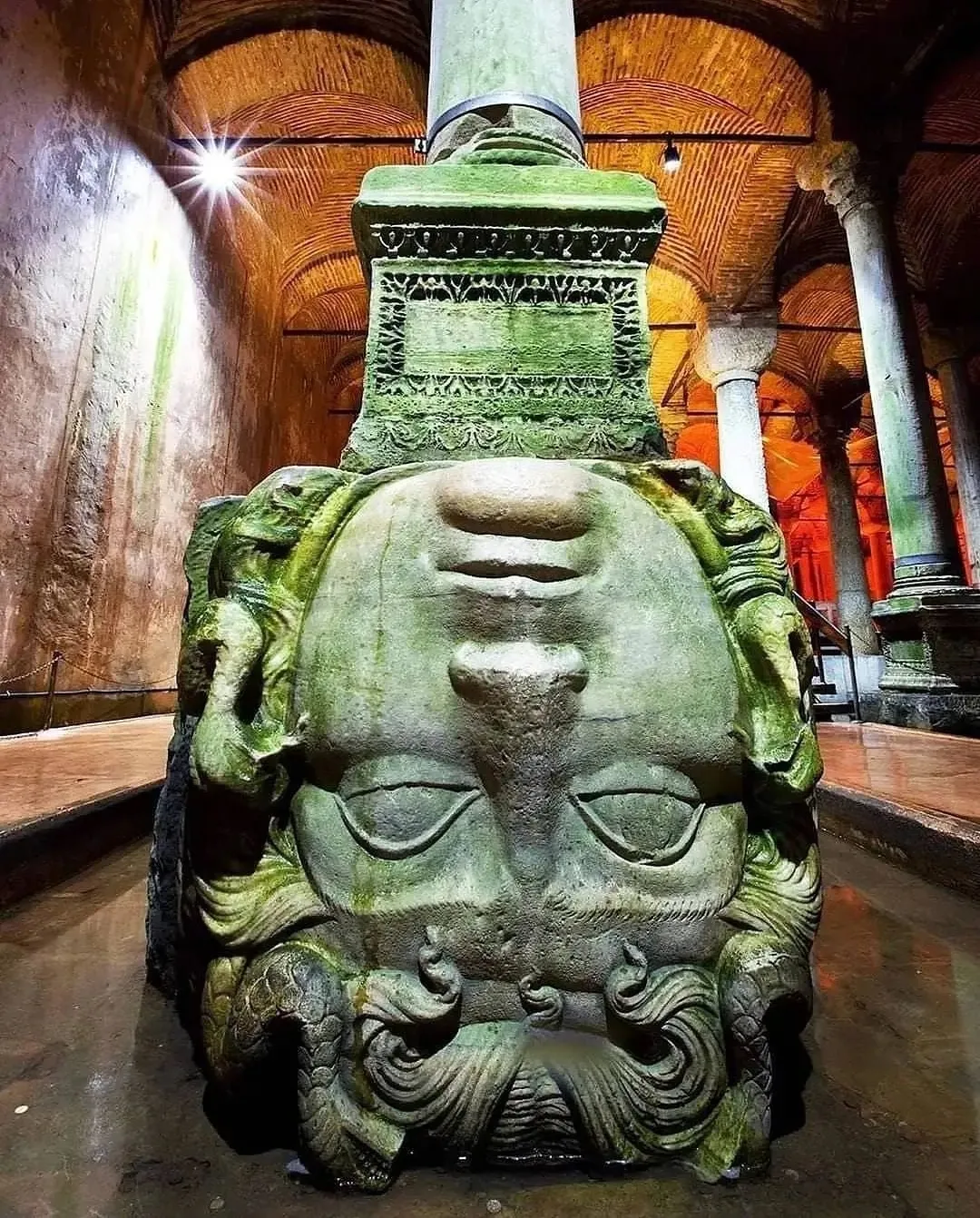
Beneath Sultanahmet, close to Hagia Sophia, the Basilica Cistern is a vast underground reservoir built during the 6th century under Byzantine Emperor Justinian I. Its 336 marble columns rise from shallow water beneath vaulted brick ceilings, with reflections and subdued lighting lending the chamber a striking atmosphere. Look for the two carved Medusa heads set at the base of columns near the back. The space also hosts contemporary art installations, giving you another reason to pause as you explore this feat of Byzantine engineering.
A reservoir beneath Sultanahmet
The Basilica Cistern, also called Yerebatan Sarnıcı or the Sunken Palace, is one of hundreds of ancient cisterns beneath Istanbul and the largest surviving Byzantine example. Emperor Justinian I commissioned it in the 6th century to store water for the city’s palaces. It was built beneath the Stoa Basilica, a large public square on Constantinople’s First Hill, which gave the cistern its name.
Water reached Istanbul through a network of aqueducts. The reservoir supplied the Great Palace of Constantinople, and it continued to provide water to Topkapi Palace after the Ottoman conquest of 1453. Its original function was practical: keeping water available for the city and its palaces. Today, the chamber is maintained as a place to visit, with the water kept low enough for visitors to take in the structure.
Columns, arches and Medusa carvings
A grid of 336 marble columns supports the cistern’s vaulted brick roof. They stand in rows beneath the surface streets, creating the impression of a long, enclosed forest. The columns do not all share the same design: many appear to have been reused from older buildings, and their capitals include Ionic and Corinthian forms.
The best-known carvings are two Medusa heads, set sideways and upside down beneath columns near the back of the cistern. Their original purpose is uncertain. The heads have prompted stories about why they were positioned that way, but their placement may simply have suited the builders’ needs. Look around the chamber for a column marked with teardrop-shaped carvings as well; these are associated with a belief that they can grant wishes.
A historic space with a modern display
The cistern’s dim illumination reflects across the water and marble, while fish move around the column bases. Lighting installations and works of contemporary art now accompany the historic structure, changing how its details appear as you walk through the chamber. The combination of water, brick vaults and rows of columns is a reminder that the cistern was engineered as part of a much larger urban water system.
The building fell out of use and was forgotten for centuries. After renovation work, it opened to the public in 1987. A later extensive restoration ran from 2015 to 2022, and the cistern reopened with new lighting and art. The underground setting also appears in films, including From Russia with Love and Inferno.
Perguntas frequentes
When was the Basilica Cistern built?
It was constructed in the 6th century during the reign of Byzantine Emperor Justinian I.
What are the Medusa heads in the cistern?
They are two carved heads used as column bases near the back of the chamber. Their original purpose is uncertain.
How long do you need at the Basilica Cistern?
Allow about 30 to 60 minutes to walk through the underground chamber and see its columns and carvings.
Where is the Basilica Cistern?
It is beneath Sultanahmet in Istanbul, close to Hagia Sophia.


