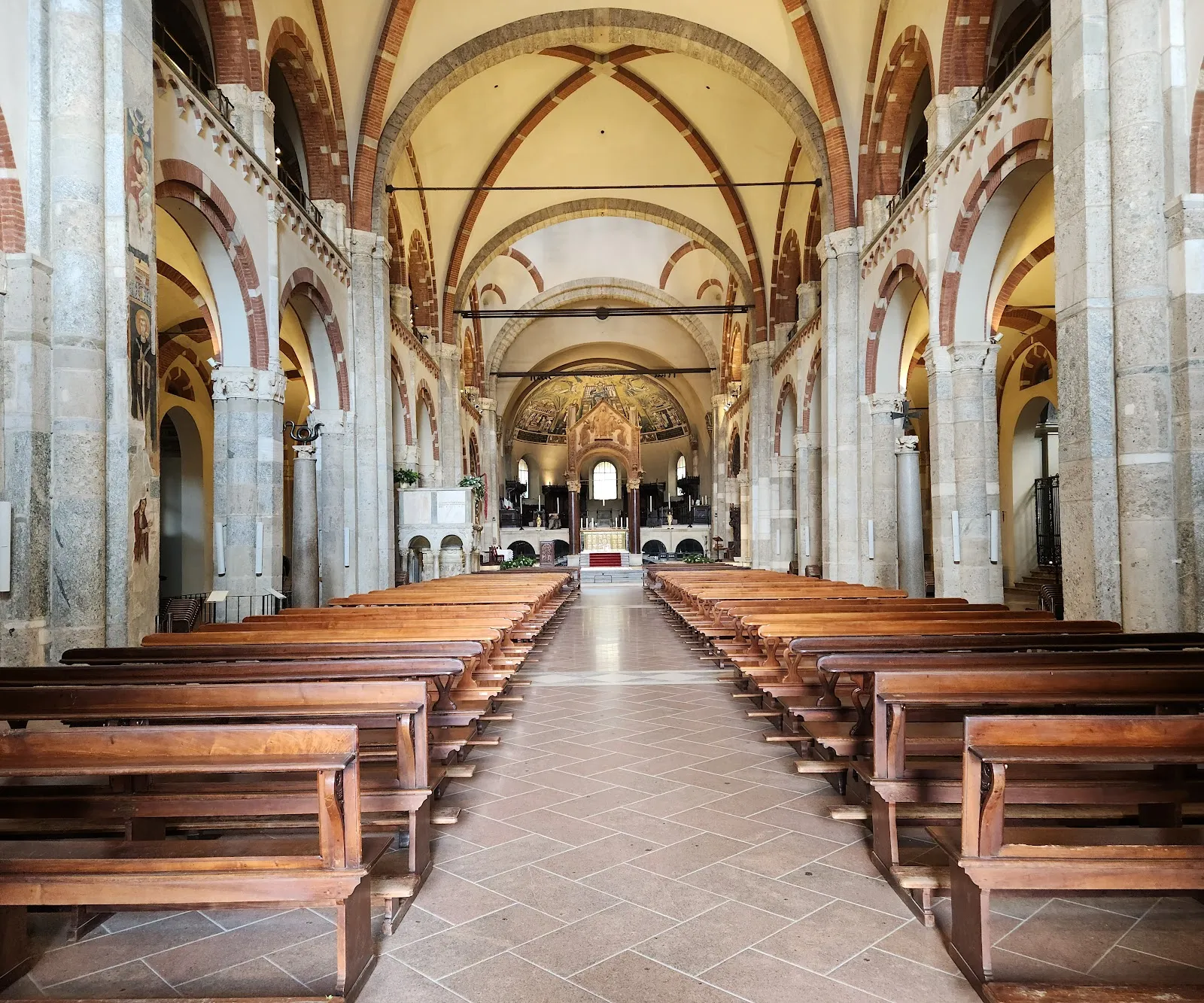
At Piazza Sant’Ambrogio, this early Christian church is one of Milan’s oldest and a landmark of Lombard Romanesque architecture. Its brick exterior, twin bell towers and broad atrium lead into a vaulted interior with a gold altar, mosaics and the crypt holding the remains of Saint Ambrose, Milan’s patron saint, and Saints Gervasius and Protasius. Look for the fourth-century Stilicone sarcophagus and the mosaics in the Oratory of San Vittore in Ciel d’Oro. Allow time to take in the courtyard and the church’s layers of history.
From an early Christian church to a Romanesque basilica
Bishop Ambrose began the church in the late fourth century, on ground associated with Christians who died during Roman persecutions. Its first name, Basilica Martyrum, referred to those martyrs. Ambrose, who became Milan’s bishop in the fourth century, was later buried here and became the city’s patron saint.
The building visitors see today took shape through successive rebuilding and restoration. A major Romanesque reconstruction in the medieval period preserved the basilica plan of the earlier church. The result is a place where early Christian history and Lombard Romanesque design meet, rather than a single building from one era.
The atrium, towers and church interior
The red-brick exterior is marked by two bell towers and a large atrium in front of the entrance. Pause in the atrium to examine the stone capitals and portal. Its arched colonnades frame the approach to the church and provide a sense of the scale of the complex before you enter.
Inside, the vaulted space is subdued, with mosaics and religious artworks drawing attention toward the altar. The gold altar is among the basilica’s central works. The church also contains the fourth-century Stilicone sarcophagus and a carved pulpit. Look for mosaics behind the ciborium, the structure above the altar, as well as frescoes and paintings in the interior.
The crypt and the Oratory of San Vittore
The crypt lies beneath the altar and is associated with the remains of Saint Ambrose and Saints Gervasius and Protasius. Ambrose’s burial here links the church’s architecture to the history of Milan’s early Christian community. The crypt is a quieter space for reflection; observe it respectfully as a place of worship and burial.
The Oratory of San Vittore in Ciel d’Oro is known for its mosaics. The basilica complex also includes a cloister and a museum route called Ambrosius, focused on Saint Ambrose’s legacy. These spaces add context to the church itself, so check what is accessible during your visit. The basilica remains an active place of worship, with services that may affect access to parts of the building.
Perguntas frequentes
Where is the Basilica of Sant'Ambrogio?
It is at Piazza Sant’Ambrogio 15 in Milan.
What should I see inside the basilica?
Look for the gold altar, the fourth-century Stilicone sarcophagus, mosaics and the crypt associated with Saint Ambrose and Saints Gervasius and Protasius.
How old is the Basilica of Sant'Ambrogio?
Bishop Ambrose began the church in the late fourth century. The present basilica reflects later Romanesque rebuilding and restoration.
Is there a museum at the basilica?
A museum route called Ambrosius explores Saint Ambrose’s legacy. Check the basilica’s website for current information about access.