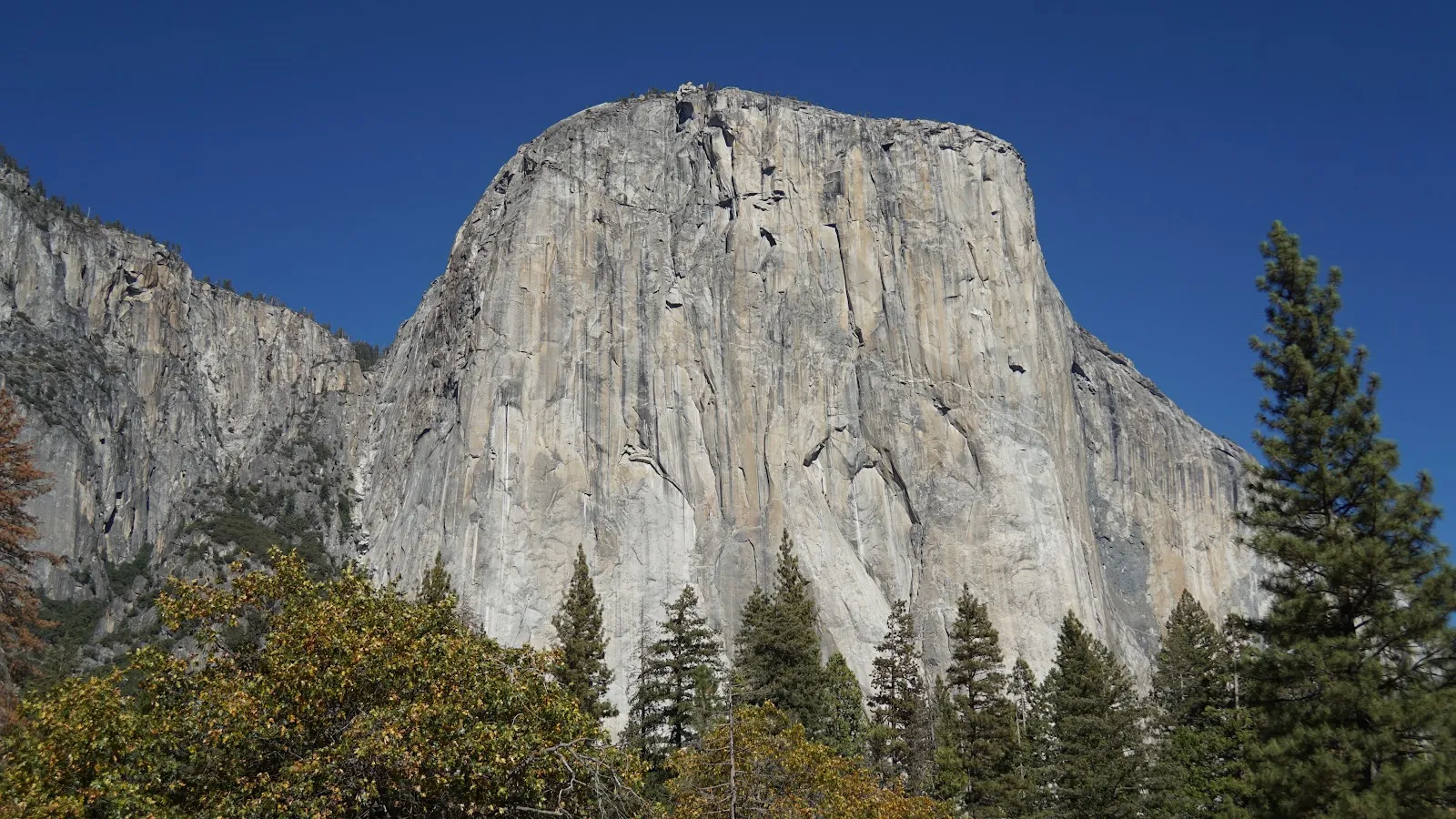
At the western end of Yosemite Valley, El Capitan is a granite cliff that rises about 3,000 feet above the valley floor. Its immense face draws expert climbers, but you can take in the scale from El Capitan Meadow without attempting a climb. Bring binoculars to look for climbers on the wall, or follow the changes in light across the granite in the morning and late afternoon. The cliff is also known for Alex Honnold’s 2017 rope-free ascent and the famous Nose route.
A granite wall above Yosemite Valley
El Capitan stands at the western end of Yosemite Valley, with a sheer granite face rising about 3,000 feet above the valley floor. It is one of the valley’s most recognizable formations and a major destination for big-wall climbers. From below, the people on its face can appear tiny against the rock, so binoculars help when you want to follow their progress.
The cliff’s name means “The Captain” in Spanish. It is also known as Tutokanula, a name associated with the Ahwahneechee people. Its imposing face has drawn climbers for decades, while its scale makes it a striking sight even if you have no plans to climb.
The Nose and El Capitan’s climbing history
The Nose is among El Capitan’s best-known routes. Warren Harding, Wayne Merry and George Whitmore made the first ascent in 1959, establishing a landmark in the history of climbing on the cliff. The route remains part of El Capitan’s reputation as a demanding big-wall objective.
Alex Honnold brought the formation to a wider audience with his 2017 free solo ascent. He climbed the Freerider route without ropes or other safety gear. The achievement is the subject of the documentary Free Solo. These climbs are not a measure of what a casual visitor should attempt: the routes are challenging, and climbing requires appropriate experience and safety preparation.
Where to look for climbers
El Capitan Meadow gives you a place to view the cliff from the valley floor. In warm seasons, the Ask a Climber program may be available there, with telescopes and information about how climbers tackle big walls. Bring binoculars if you visit at another time or want to scan the rock for people moving along its face.
The view changes as sunlight moves across the granite. Early morning and late afternoon are suggested times for photography, while spring and fall are good seasons to watch for climbing activity. From the meadow, you can focus on the full cliff or search the face for climbers. Either way, give yourself time to look carefully: they can be difficult to pick out against the vast wall.
Häufige Fragen
Where can you see El Capitan from the valley floor?
El Capitan Meadow is a place to view the cliff and look for climbers on its face.
Should I bring binoculars to El Capitan?
Yes. They make it easier to spot climbers on the large granite face.
When is a good time to photograph El Capitan?
Early morning and late afternoon are suggested for photography, when the light changes across the cliff.
Is El Capitan suitable for beginner climbers?
The routes are described as challenging and intended for experienced climbers. Follow safety guidance and do not treat the cliff as a beginner climb.