
The Alcázar de Segovia is a fortress-palace on a rocky spur at the western end of Segovia's old town, where the Eresma and Clamores rivers meet. Its slate-roofed turrets and prow-shaped outline make it one of Spain's best-known castles. Inside, the route passes the Throne Room, the Hall of Kings with its gilded frieze, Mudéjar ceilings and an armory of medieval weapons and armour. A separate timed ticket takes you up the Tower of Juan II, with views over the city toward the Guadarrama mountains.
From Roman fort to royal residence
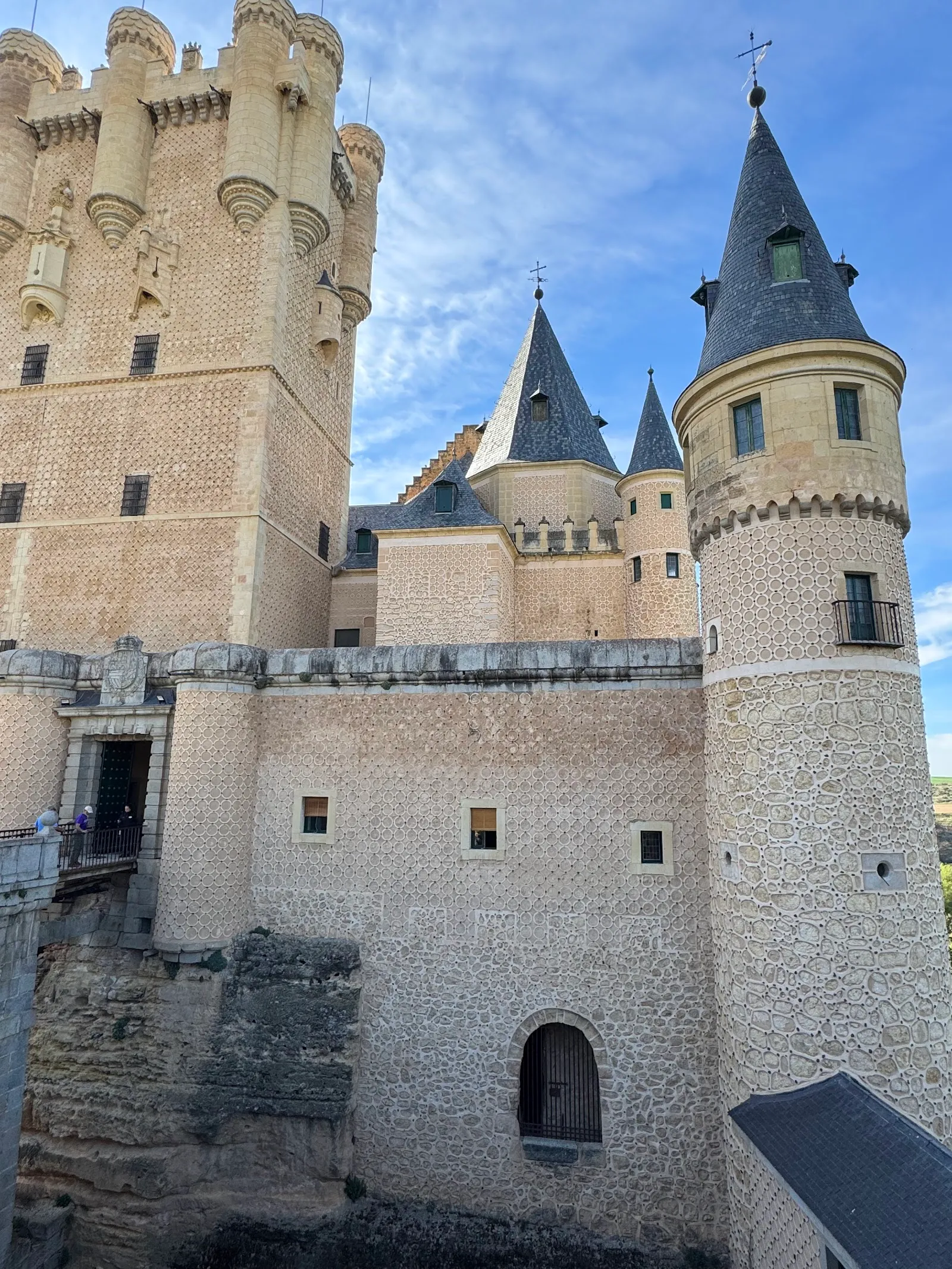
The Alcázar stands on a rocky headland at the junction of the Eresma and Clamores rivers, a position that made it easy to defend. Sources point to Roman foundations and an early Moorish fortress. The first written mention is Christian and dates from the early 12th century, though building may have begun in the 11th. Segovia was taken by Castile in 1085, and the fortress was then extended in Spanish styles.
It became a favourite residence of the kings of Castile. Alfonso X, known as the Wise, made astronomical observations from the tower in the 13th century, and a lunar crater carries his name. On 13 December 1474 Isabella the Catholic was proclaimed Queen of Castile within these walls. Work continued over the centuries, with additions in the 14th and 15th centuries and changes late in the 16th, until the architect Francisco de Mora completed it in 1587.
When the court settled permanently in Madrid, the Alcázar stopped being a royal home. It later served as a state prison, then as a Royal Artillery College and a military academy.
The fire of 1862 and the rebuilt castle
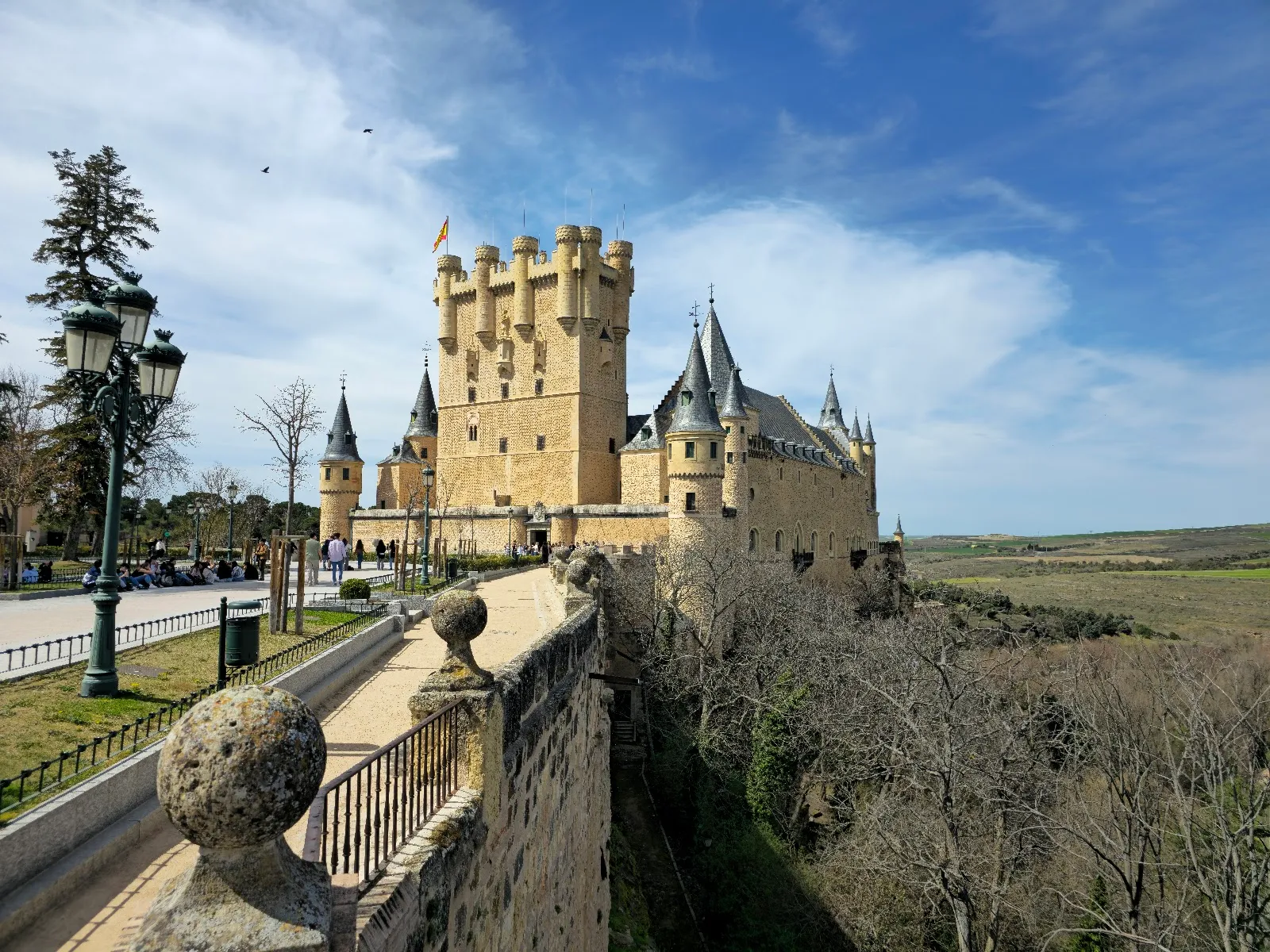
In 1862, while the building was used as an artillery school, a fire gutted most of it. It was reconstructed afterwards, and the result is a castle that follows a 19th-century idea of the medieval. That is why its turrets and slate spires look closer to the storybook castles of northern Europe than to a typical Castilian fortress.
The prow-like shape of the building, narrowing toward the point where the rivers meet, has often been compared to the bow of a ship. The outline is also said to have inspired Walt Disney's castles, and the 1967 film Camelot used the Alcázar as Lancelot's home. Entry is across a drawbridge over a dry moat.
Inside the rooms
The visit runs through a sequence of ceremonial rooms. The Throne Room and the Hall of Kings are the best known. Under the ceiling of the Hall of Kings runs a gilded frieze depicting Spain's rulers in order, from Pelagius of Asturias in the 7th century to Juana la Loca in the 16th.
The Mudéjar ceilings, worked in gold and cedar with geometric patterns, show the Moorish influence that remains in the decoration. Tapestries hang on the stone walls. The armory, called the Hall of Armour, holds armour, swords and other medieval weapons, and today the building also houses a museum and military archives.
The mood changes from room to room, from the plain defensive character of the armory to the richer ornament of the state chambers.
The Tower of Juan II
The tower is reached by a narrow stone spiral stair, and its entry is sold separately from the castle ticket. From the top you see Segovia's walls and cathedral, the plains around the city and the Guadarrama mountains to the southeast.
Visits to the tower run in timed groups. You wait in the main courtyard until your slot, and the time at the top is limited to about 30 minutes, so have your camera ready. The climb has many steps and is hard going for some visitors, though one walker managed it with a stick.
Planning the visit
Tickets are timed, and the castle recommends buying in advance. Entry opens only about 10 minutes before your time. The ticket queue and entrance are organised to keep waits short.
A useful order is to see rooms until your tower time, climb, then come back for any rooms you missed. An audio guide is available, and some visitors download it to their phone. The gift shop sells books on local history and typical souvenirs.
If you do not go inside, you can still walk around the grounds in front of the castle, which is free. For the ship-like profile, walk down into the valley or follow the Ruta Panorámica. The walk from the rest of Segovia is on foot but hilly. Segovia is a common day trip from Madrid.
Häufige Fragen
Is there an entry fee for the Alcázar de Segovia?
Yes. There is a ticket for the castle and a separate, additional ticket for the Tower of Juan II. Check current prices on the official website. Walking around the grounds in front of the castle is free.
Do I need to book tickets in advance?
Booking ahead is recommended. Entry to the castle and to the tower is timed, and you need a tower ticket in advance if you want to go to the top.
How long does a visit take?
A visit to the rooms takes about 45 minutes, a little longer with the tower. The tower slot lasts about 30 minutes.
Is the Alcázar suitable for children?
Yes. Armour, swords and weapons in the armory, and the towers and drawbridge, suit children. The tower stair has many steps.
Is the Alcázar accessible for wheelchair users?
The entrance, seating and a restroom are listed as wheelchair accessible. The tower is a spiral stair with many steps, and the basement toilets are down stairs, while step-free ones are at the ticket office.


