
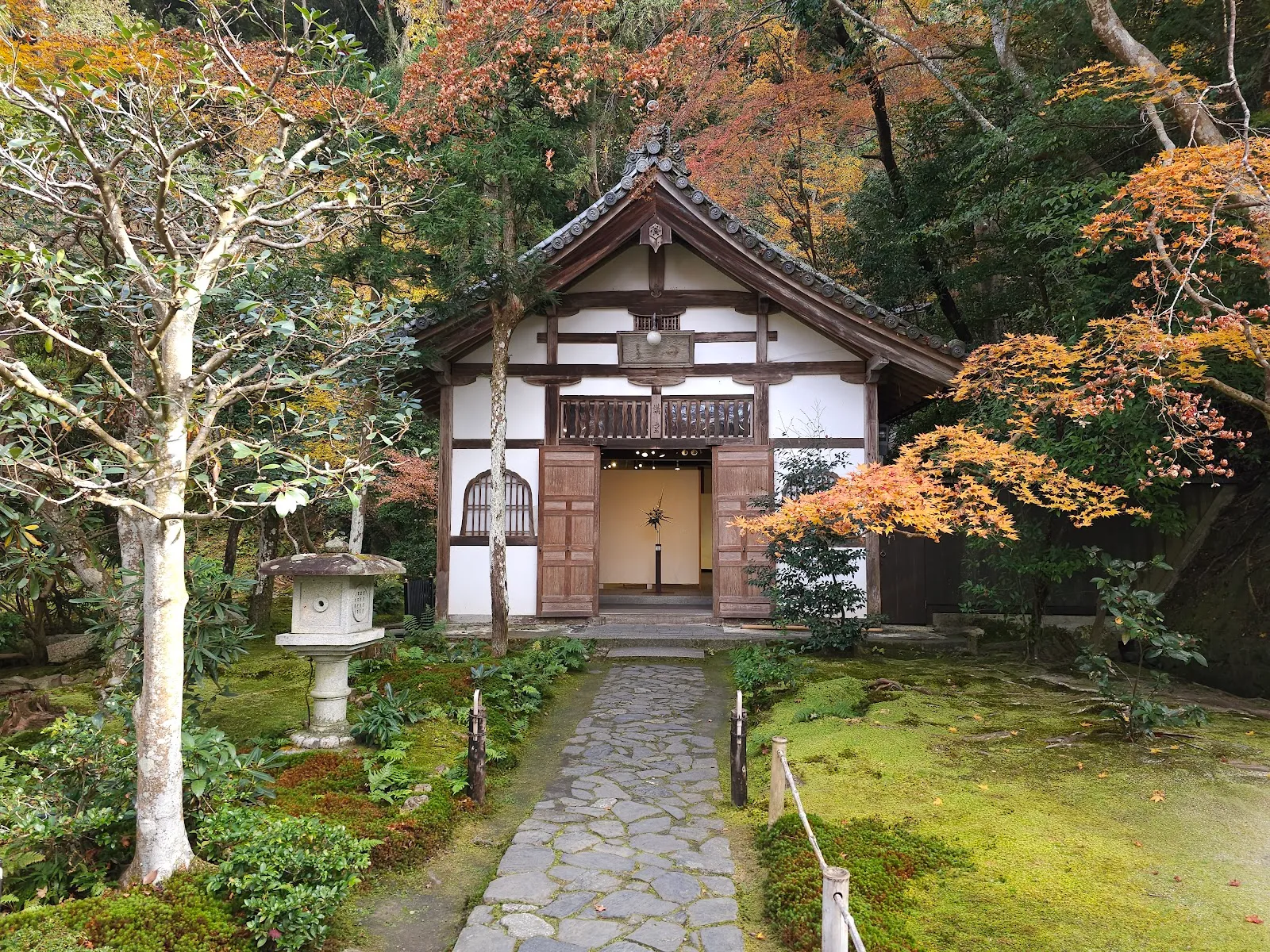
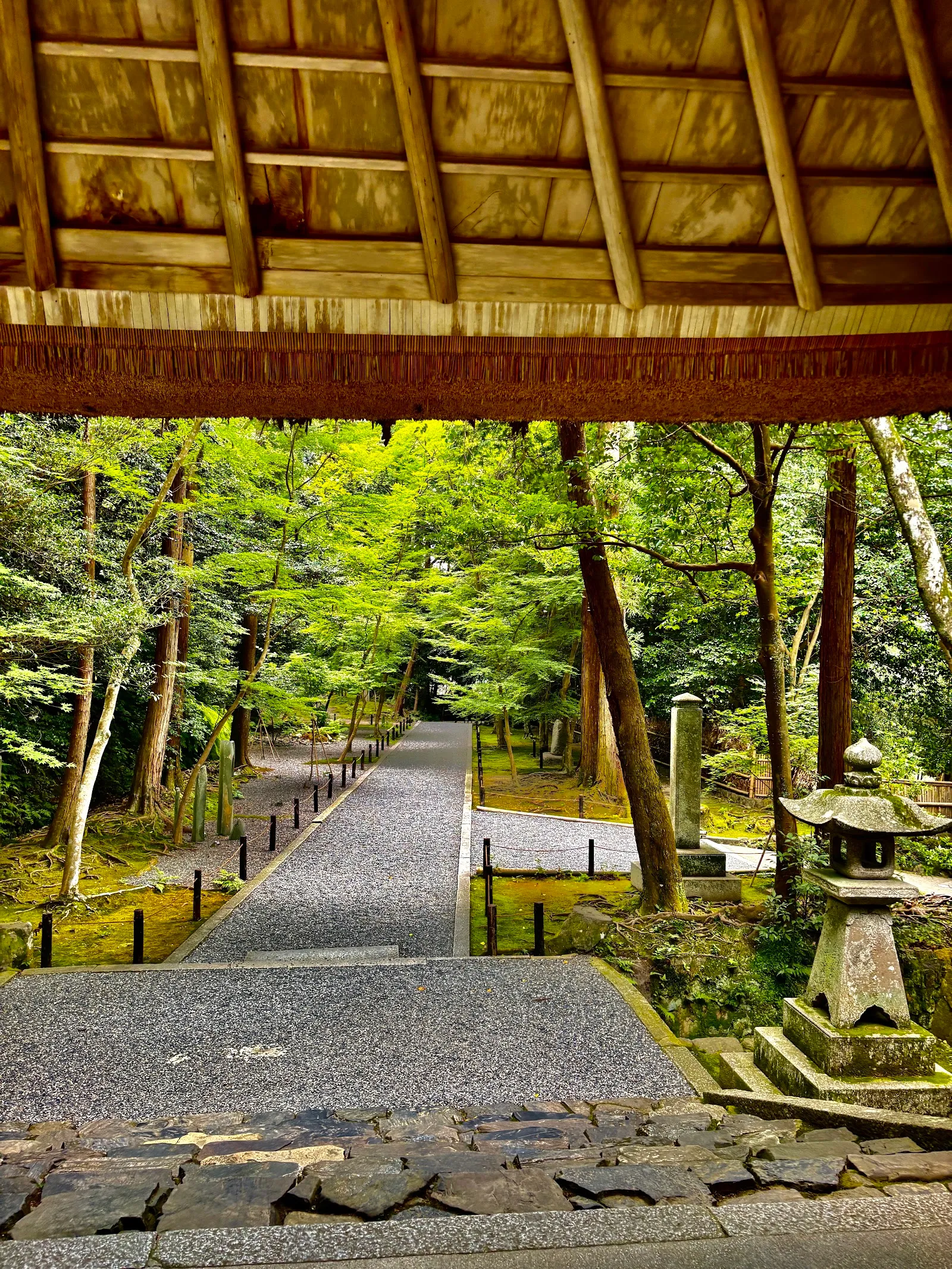
Hōnenin Temple is a Buddhist temple just off Kyoto’s Philosopher’s Path, in the city’s eastern Higashiyama area. Its thatched entrance, softened by moss, opens onto quiet garden paths, a pond and maple trees. Two shaped mounds of white sand sit in the courtyard and symbolize purification; their forms are changed with the seasons. Come to slow down between larger sights, or look for the small on-site building that hosts art exhibitions. The temple is especially atmospheric among autumn leaves.
A temple beside the Philosopher’s Path
Hōnenin stands just off the Philosopher’s Path in eastern Kyoto. The temple began as a hermitage where Hōnen practised Buddhism with his disciples in the early Kamakura period. It was reconstructed in 1680 in his honour. Hōnen, who lived from 1133 to 1212, founded the Jōdo sect of Japanese Buddhism.
The entrance is modest in scale, but distinct: a thatched gate sits beneath trees, with moss around the approach. Inside, the grounds bring together a garden, small buildings, bridges and a pond. The compact setting suits a slow walk rather than a hurried stop.
White sand and the garden
Two long mounds of white sand stand in the courtyard. Their shapes represent the changing seasons, and they are associated with purification. The garden also has moss-covered areas, maples and camellias. Three camellias are noted in the temple’s courtyard, and a small camellia garden can be viewed from Hōjō Hall.
Maples colour the grounds in autumn, with the first week of November noted as a time to see crimson leaves. Cherry blossoms are another seasonal draw in April. The garden’s appeal comes from its plants and quiet details, not grand architecture.
Interior access and exhibitions
Some interior spaces are not always open. When access is available, the visit can include additional garden areas, painted screens and rooms inside the temple. A small building on the grounds hosts art exhibitions, with works that can range across different styles.
Access to the interior has been reported during limited periods, including the first weeks of April and November. Check current arrangements before making it a central part of your visit; the garden and approach remain the main reasons to stop here.
Häufige Fragen
Is Hōnenin Temple free to enter?
The grounds are described as free to enter, while a small fee may apply to the Main Hall. Confirm the current arrangement before your visit.
How long should I spend at Hōnenin Temple?
Allow around 30 to 60 minutes to walk the grounds and pause by the pond.
When is Hōnenin Temple especially scenic?
Autumn brings maple colour, with the first week of November noted for crimson leaves. Cherry blossoms are another reason to visit in April.
Can you go inside the temple buildings?
Interior access is limited and has been reported during short periods in April and November. Check current access details before you go.


