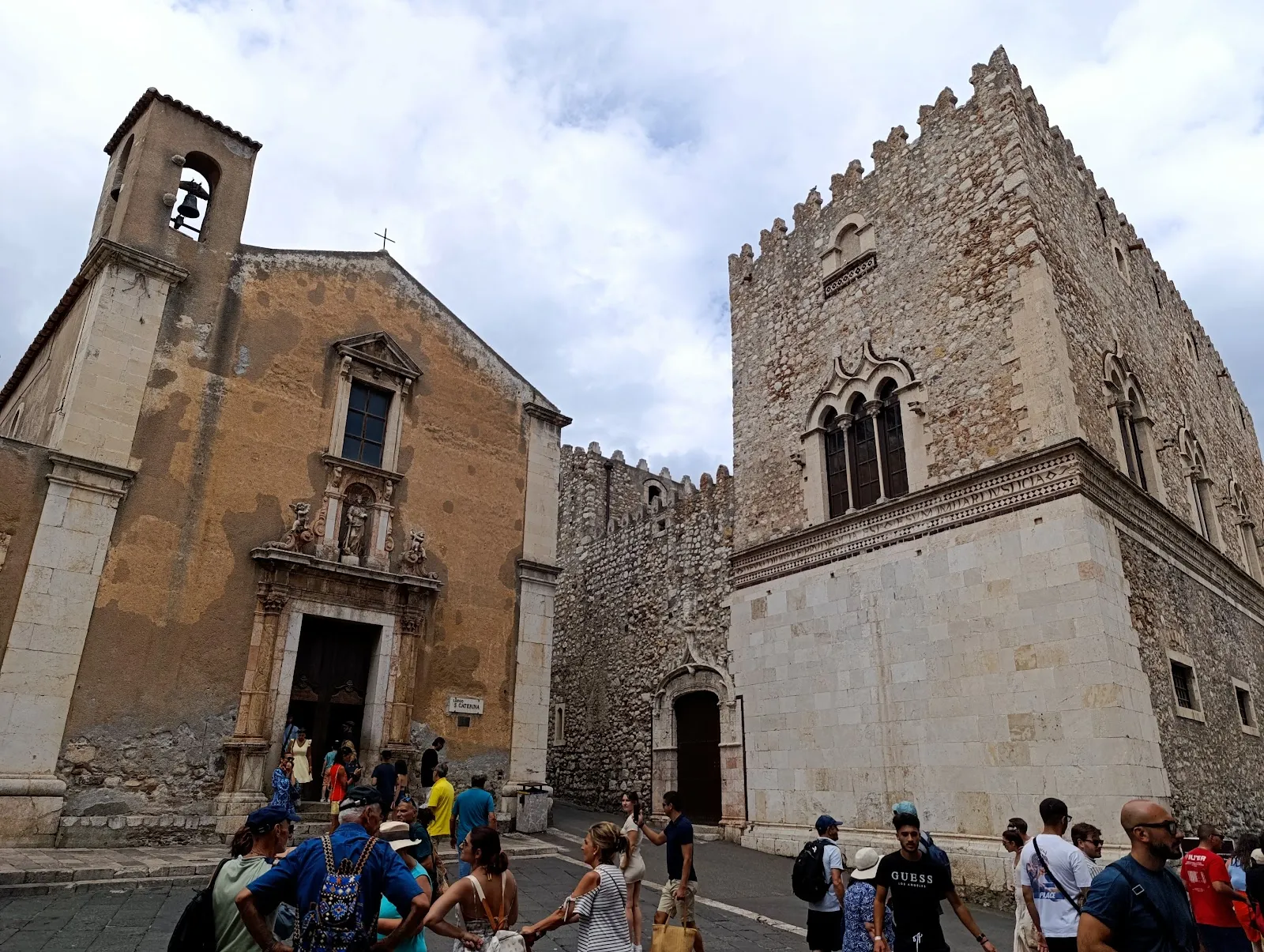
Palazzo Corvaja is a medieval palace in Piazza Vittorio Emanuele II, beside the Church of Saint Catherine, at the start of Corso Umberto in Taormina. Its Arab, Norman and Gothic details trace the town’s layered past, while the courtyard has pointed windows and an ornamental balcony reached by a 13th-century staircase. The palace housed the Sicilian Parliament in 1410 and now contains the Museum of Sicilian Art and Popular Traditions alongside the tourist information office. Look for folk art and objects that record everyday Sicilian life.
A palace built in layers
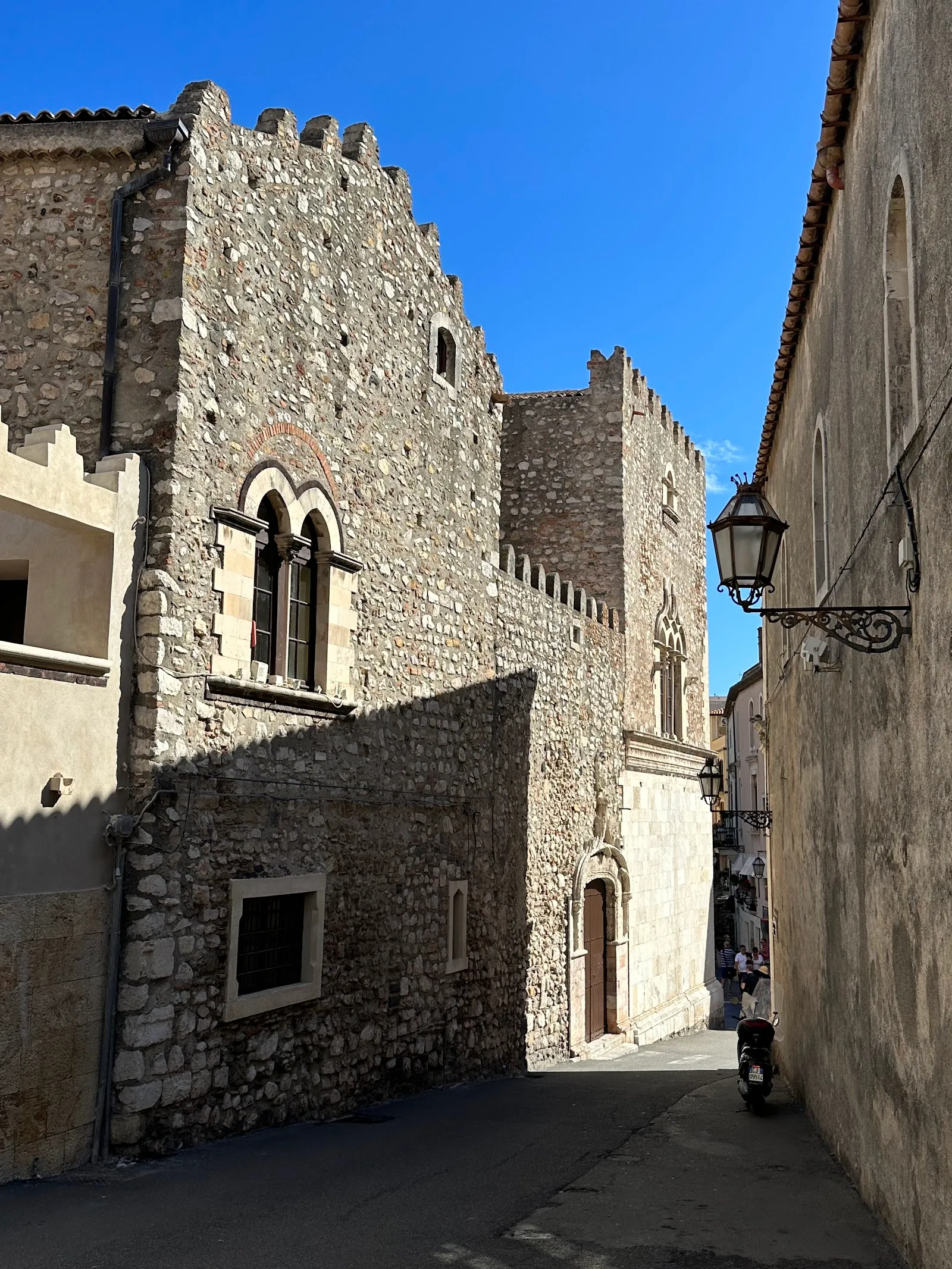
Palazzo Corvaja stands in Piazza Vittorio Emanuele II, beside the Church of Saint Catherine and near the beginning of Corso Umberto. Its building history spans several periods. An early fortified tower, associated with Arab rule in Sicily, forms the core; the palace was expanded over the centuries, with additions continuing into the 15th century.
The architecture reflects those changes. The tower is Norman in style, while the arched windows and doorways in the courtyard show Gothic influence. Arab, Catalan-Gothic and Norman elements are also visible across the building. Rather than belonging to a single period or style, the palace records the successive phases of its construction.
The courtyard and staircase
The inner courtyard is one of the clearest places to look for the palace’s architectural details. Pointed arches frame windows and doorways, and an ornamental balcony overlooks the space. A staircase dating to the 13th century leads to the first floor.
Look closely at the façade as well as the courtyard: its small paired windows and pointed arches are among the details associated with the palace. The building’s parts were added and altered over time, so the different styles appear side by side rather than as one uniform design.
The Sicilian Parliament and the Corvaja family
The palace housed the Sicilian Parliament in 1410. It later became the residence of the Corvaja family, whose name it carries. The family lived there for centuries, and the building was renovated in 1945.
Its changing use is part of the visit: a fortified structure became a noble residence and a setting for political meetings. The palace now also houses Taormina’s tourist information office. Its location near Corso Umberto makes it easy to include on a walk through the historic centre.
Inside the folk museum
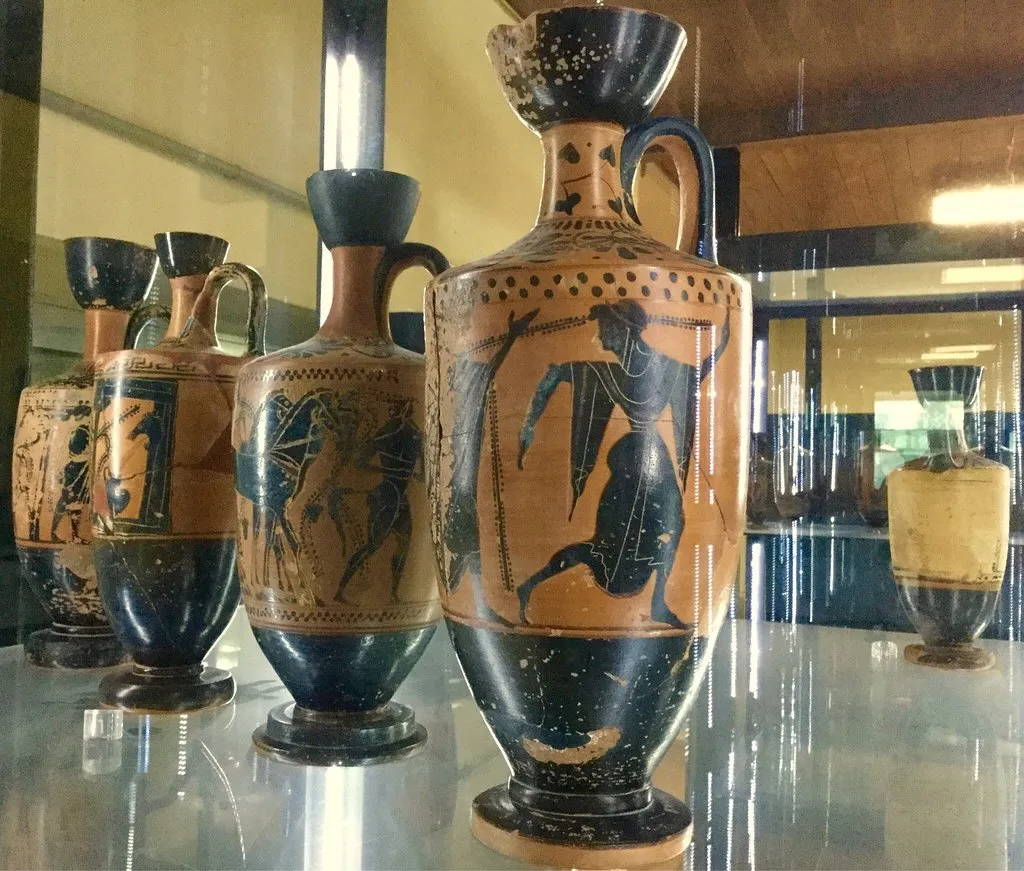
The Museum of Sicilian Art and Popular Traditions presents objects connected with local history and everyday culture. Its collection includes oil portraits, painted glass, embroidery and donkey carts. Folk paintings are another part of the collection, including devotional images made in gratitude after a danger or misfortune had passed.
These works give the museum a different focus from the palace’s architecture. Alongside the stonework and courtyard, they offer a look at Sicilian customs and domestic life through paintings, crafts and objects. The museum occupies part of a building that remains in use as the tourist information office.
Häufige Fragen
Where is Palazzo Corvaja?
It is in Piazza Vittorio Emanuele II in Taormina, beside the Church of Saint Catherine and near Corso Umberto.
What is inside Palazzo Corvaja?
The palace houses the Museum of Sicilian Art and Popular Traditions, with objects including portraits, painted glass, embroidery, donkey carts and folk paintings. The tourist information office is also there.
What is Palazzo Corvaja known for?
Its medieval architecture combines Arab, Norman and Gothic elements. The Sicilian Parliament met in the palace in 1410.
How much time should I allow for Palazzo Corvaja?
The available information does not give a typical visit length. You can combine the palace with a walk along Corso Umberto or other sights in Taormina’s historic centre.