Chiesa di San Michele in Foro stands in Piazza San Michele, Lucca, on the site of the ancient Roman forum. Its white marble façade draws the eye with rows of columns, carved details and statues, crowned by a large figure of the Archangel Michael. The interior is quieter and more simply decorated, with artworks including Filippo Lippi’s Magrini Altarpiece. Look closely at the columns for small medieval drawings of animals, a modest detail that offers a glimpse of life centuries ago.
A church on the Roman forum
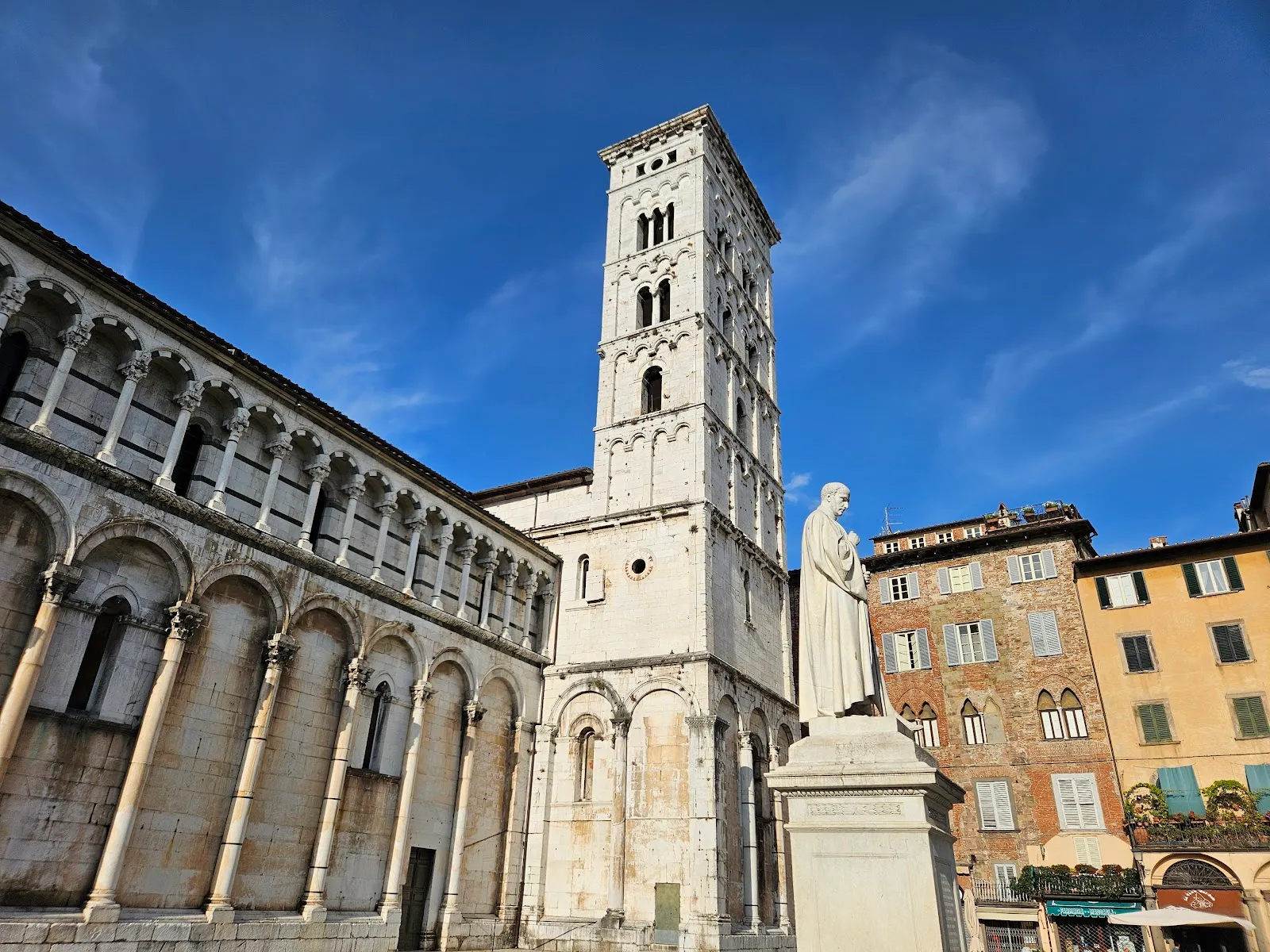
Piazza San Michele occupies the site of Lucca’s ancient Roman forum, where the city’s main roads once met. The church takes its name from that location: it was first recorded in 795 as San Michele ad foro. Its position in the square keeps the ancient street plan close at hand, even though the buildings around it belong to later periods.
The church was rebuilt and altered over time. Its principal structure dates mainly to the 12th century, while the façade was developed over the centuries that followed. This gives the building a layered appearance, with Romanesque forms and later details gathered into one prominent front. San Michele also served as the seat of Lucca’s Major Council until 1370.
Reading the marble façade
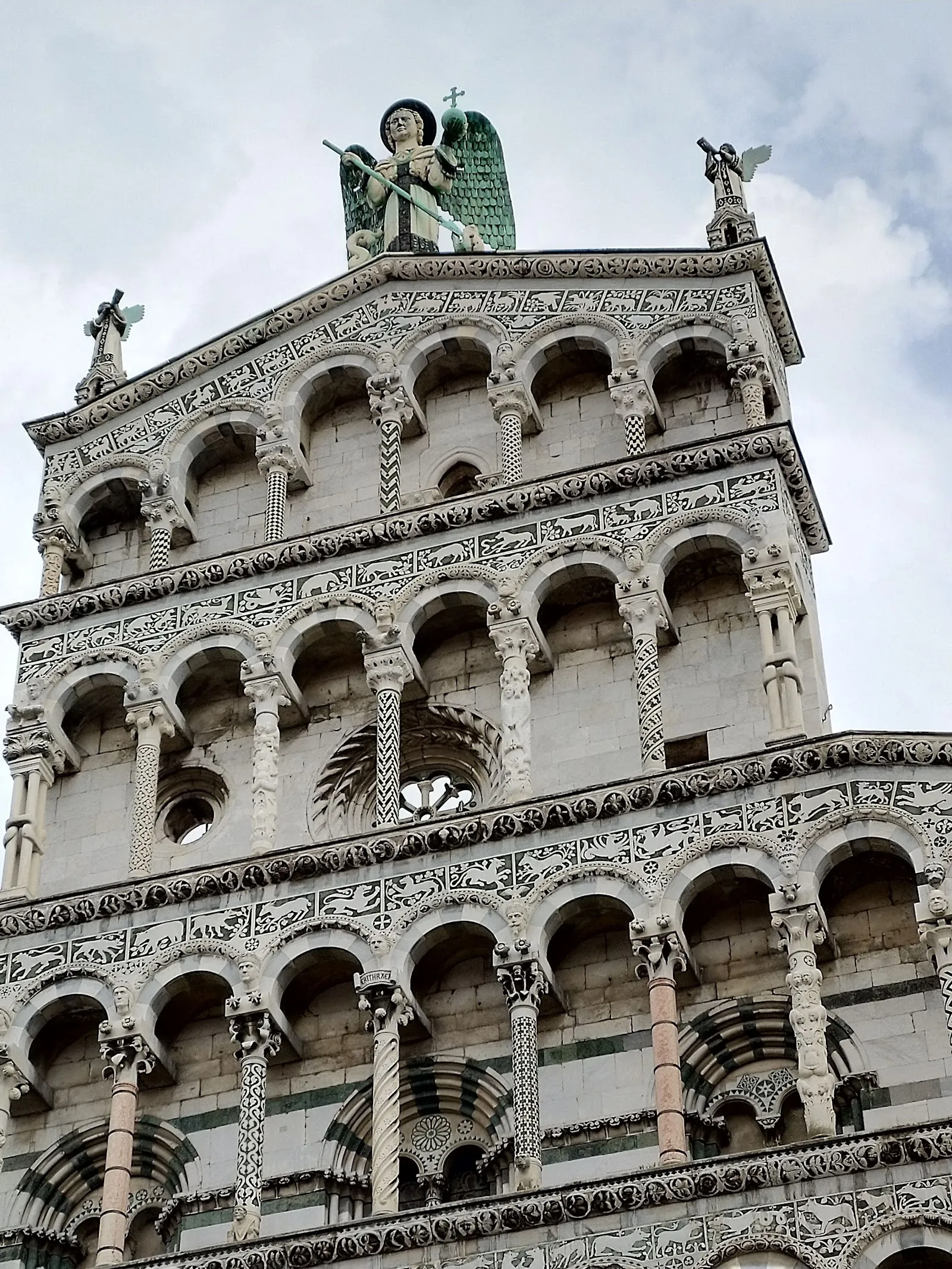
The white marble front is the church’s most elaborate feature. Rows of arches rise above the entrances, with columns, capitals, carvings and statues arranged across several levels. The upper façade is richly worked, while the lower part has a more measured pattern of arches and a small round window. Take a moment to look at individual details rather than only the overall shape: the columns are not all alike, and decorative patterns run along the cornice.
At the top, a statue of the Archangel Michael stands above the façade. The church is dedicated to him, and the figure is visible from the square. The building’s position in the centre of Piazza San Michele also makes it easy to view from different angles as you cross the open space.
Inside the church
The interior is more restrained than the exterior. Its basilica plan has three aisles, a transept and a semicircular apse. Arches rest on monolithic pillars, and the quieter setting gives the artworks room to stand out.
Look for the Magrini Altarpiece by Filippo Lippi, as well as a 12th-century polychrome wooden cross, a terracotta Madonna and Child attributed to Lucca della Robbia, and a painting of the Four Saints by Filippino Lippi. Some columns also bear small hand-drawn animal figures from the Middle Ages. These marks are easy to miss, so scan the surfaces closely as you move through the church.
The remains of San Davino Armeno lie beneath the altar. His story is one reason to pause at the altar area, alongside the church’s artworks and architecture. The interior’s simpler decoration offers a different experience from the detailed marble front, so it is worth looking both outside and in.
Häufige Fragen
Where is San Michele in Foro?
The church is in Piazza San Michele in central Lucca, on the site of the ancient Roman forum.
What should I look for inside San Michele in Foro?
Look for Filippo Lippi’s Magrini Altarpiece, the 12th-century polychrome wooden cross and medieval animal drawings on some columns.
How old is San Michele in Foro?
The church was first recorded in 795. Its main structure dates largely to the 12th century, with later work on the façade.