
The Asinelli and Garisenda towers stand side by side on Piazza di Porta Ravegnana, where the roads to the five gates of the old ring wall meet. Both date from the 12th century. Asinelli is the taller at about 97 metres. Garisenda is shorter and leans much more. They are the best-known symbol of Bologna and can be seen from many parts of the city. The towers are currently closed to climbers while Garisenda is monitored and restored, so plan this as a visit to the square and a look up at the masonry.
Where the towers stand
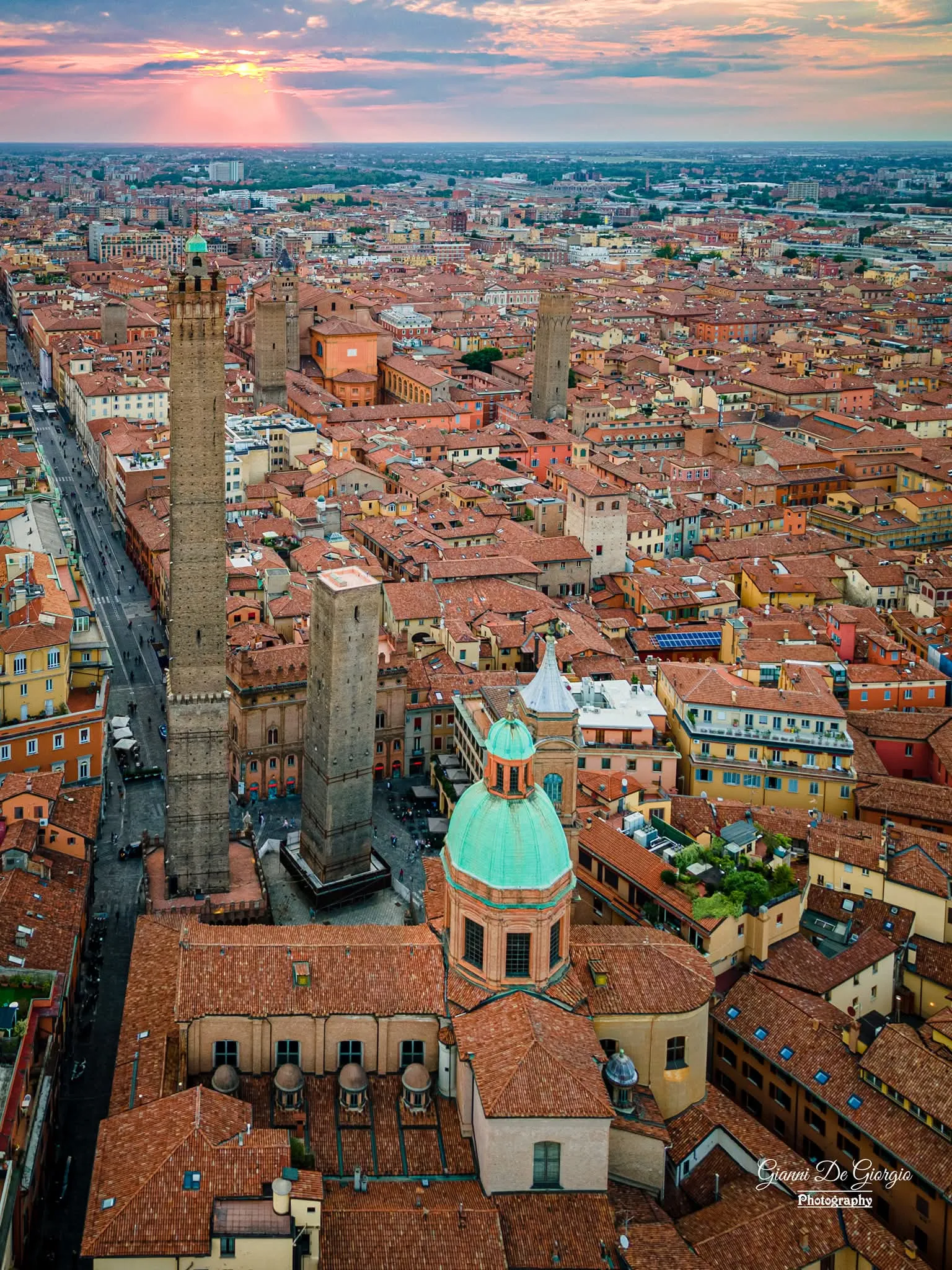
The towers rise from Piazza di Porta Ravegnana, at the point where the roads toward the five gates of the old ring wall come together. In the Middle Ages this was an entrance to the city, and the towers watched over it. Piazza Maggiore is only a few minutes away on foot.
Bologna was known as the city of towers. Sources put the number at over a hundred, and possibly around 200 between the 12th and 13th centuries. Most were pulled down over the years for safety, and about twenty remain. Until 1919 this square held five towers. Today Asinelli and Garisenda are the pair that define the skyline, and they are visible from almost anywhere in the centre.
Asinelli, the taller tower
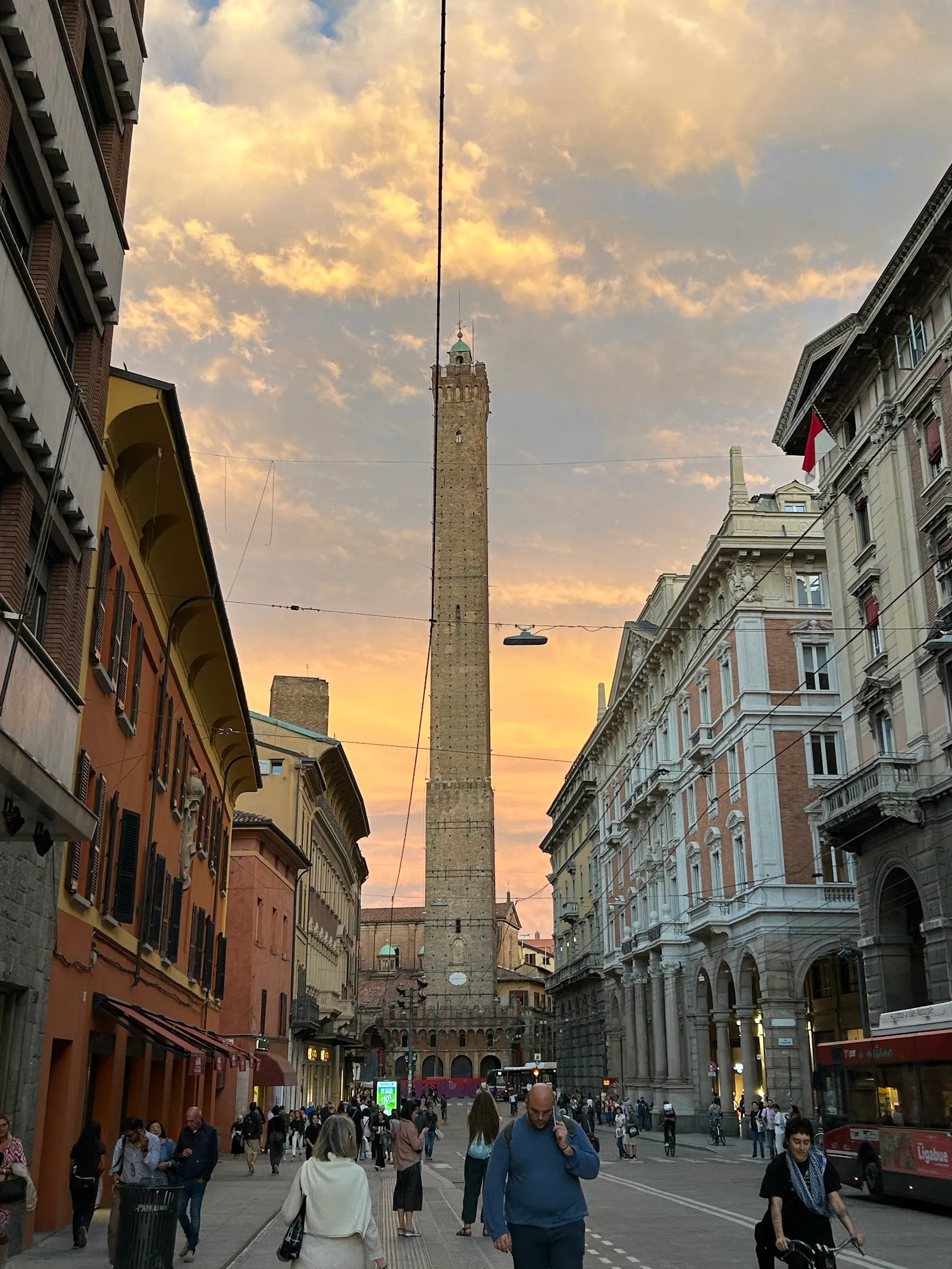
Asinelli measures about 97 metres, roughly 20 metres more than the Leaning Tower of Pisa. It is the tallest of the leaning towers in Italy. It began lower and was raised later by the city government, which had become its owner. The extra height let people watch for light signals from the surrounding countryside.
The name comes from the Asinelli family, to whom the tower is attributed. The attribution is not proven. Few documents survive from the period, and the family name first appears in 1185, decades after construction is thought to have started.
Inside, 498 wooden steps lead to the top. The climb takes about 15 minutes at a steady pace, longer with children. From the summit the view covers the red-brown roofs of the city and the hills, and on clear days people have reported seeing as far as the sea. At the foot of the tower there are small artisan shops.
Garisenda and its lean
Garisenda is the shorter of the two, at about 47.5 metres today. It was originally around 60 metres. The ground beneath it settled soon after construction, and the tower began to tilt sharply. Its upper part was later cut down for safety. It leans more than the tower in Pisa.
Dante refers to Garisenda in the Divine Comedy, comparing it to a giant bending over. Standing under the lean today, that image is easy to understand.
The tower is now under close watch. Sensors track movement in its masonry and its selenite base, and the square openings along the walls, which once held the beams of wooden bridges between towers, now carry monitoring equipment. This is the reason access to the towers is restricted.
Why families built towers
The tall towers were built by wealthy families in the 12th century. They served as lookouts and defensive points and also showed the standing of the family that owned them. Some had wooden balconies and bridges linking neighbouring towers, and residents could withdraw upward in times of conflict. Smaller towers were simply houses.
Asinelli and Garisenda are thought to date from roughly the same years, between 1109 and the late 12th century, though the exact dates are not certain. Both were part of the same urban pattern, and today they are the clearest remaining example of it.
Visiting while the towers are closed
With climbing suspended, a visit centres on the square. Walk around the base of both towers, look up at the brickwork and selenite, and see how the lean changes from each side. The towers are close to Piazza Maggiore and the Basilica di San Petronio, so they fit easily into a walk through the historic centre.
When the towers are open, tickets for the Asinelli climb are sold online through the Bologna Welcome site, and booking ahead is recommended. Ticket prices vary between sources, so check the current price on the official page.
Häufige Fragen
Can you climb the Two Towers of Bologna?
Not at the moment. The towers are closed to climbers while Garisenda is monitored and restored. Check the official Bologna Welcome page for the current status before you go.
How tall are the Asinelli and Garisenda towers?
Asinelli is about 97 metres tall. Garisenda is about 47.5 metres today, after its upper part was cut down. It was originally around 60 metres.
How many steps does the Asinelli Tower have?
It has 498 wooden steps. The climb takes about 15 minutes, and longer with children.
Where are the Two Towers?
They stand on Piazza di Porta Ravegnana, a few steps from Piazza Maggiore in central Bologna. The square sits where the roads toward the five old city gates meet.
Who built the Two Towers?
They are attributed to two noble families, the Asinelli and the Garisenda, and the towers carry their names. The attribution is not proven, because few documents from that period survive.


