Meenakshi Amman Temple stands on the southern bank of the Vaigai River in Madurai, Tamil Nadu. It is dedicated to Goddess Meenakshi, a form of Parvati, and her consort Sundareswarar, a form of Shiva. The Dravidian complex is known for its gopurams, the gateway towers covered in colorful sculpted gods, demons and heroes. Inside are the Golden Lotus Pond, the Thousand Pillar Hall and entrance passages with painted ceilings. It is an active place of worship that draws pilgrims every day, and entry is free. Come with time for the queues and expect to leave phones and bags at the counters.
Meenakshi and Sundareswarar
The temple is dedicated to Meenakshi, a form of Parvati, and to her consort Sundareswarar, a form of Shiva. Her name means 'fish-eyed', an epithet for perfect eyes in classical Tamil poetry. Worshippers believe this is the place where Shiva, as Sundareswarar, married her.
The legend tells of Meenakshi as a princess, daughter of the Pandya king Malayadwaja and Queen Kanchanamala. She was born with three breasts, and a voice from the heavens said the third would vanish when she met her future husband. She was raised as a royal heir, conquered neighboring kingdoms and set out toward Kailash, the home of Shiva. The marriage of the two deities is the story told in the temple's painted ceilings and in its biggest festival.
From the Pandyas to the Nayak rulers
Madurai appears in Tamil Sangam literature, and the goddess temple is mentioned in texts of the 6th century CE. The original temple was built by the Pandyas. Accounts agree that the complex was damaged in the 14th century and later restored.
The present form owes most to the Nayak rulers, who restored and expanded it from the 16th century and whose work continued into the 17th and 18th. The old town of Madurai grew up around the temple.
In 1946 Mahatma Gandhi came to the temple together with Dalit worshippers, on the day its gates were opened to communities that had been kept out. The visit is remembered as part of his campaign against untouchability.
Gopurams, halls and the pond
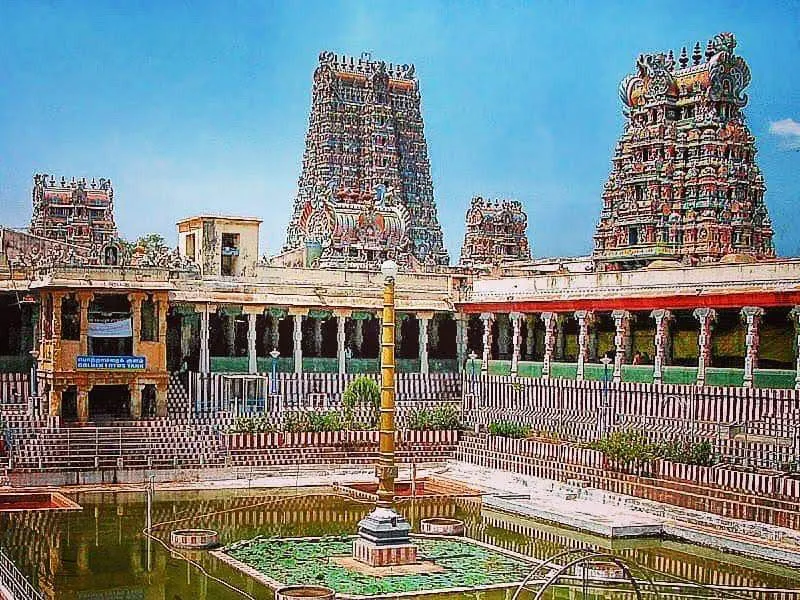
The gateway towers are the first thing you notice, and the south gopuram alone carries roughly 1,500 sculpted figures of gods, goddesses, demons and heroes. Across the whole complex the carvings number in the tens of thousands. The east tower is floodlit in the evening, and the cobbled street at its entrance fills with jasmine sellers.
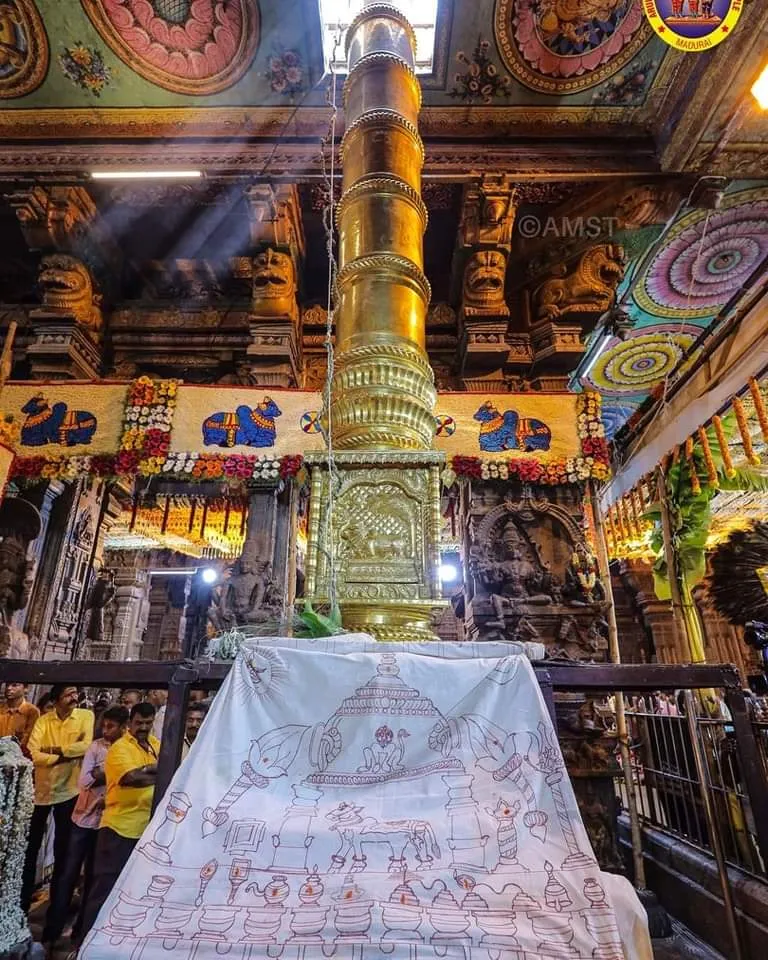
Inside, the entrance passages have restored ceilings painted with mandalas and mythological scenes. Another ceiling shows the Kumara Sambhava story and the divine marriage of Meenakshi and Sundareswarar. The silver-plated Velliambalam is the hall of the dancing form of Shiva.
The Golden Lotus Pond, Porthamarai Kulam, is the sacred tank in the complex, and the best place to see the towers reflected in still water. The Thousand Pillar Hall has been turned into a small museum of stone carvings and old idols. Entry costs about Rs 5. Renovation work was under way at the time of the latest visits and made the hall dusty, so skip it if you are short of time.
How a visit works
General entry is free. Worshippers queue for darshan, the sight of the deities, and the line moves in an orderly way even at busy hours. Staff and security manage the flow. The temple takes roughly 15,000 to 25,000 people a day, so expect some waiting at any hour. The time before the deities is short, about 10 seconds in one visit.
Paid darshan tickets can be bought near the east gate. Bags cost Rs 5 to deposit, shoes are free, and each phone, charger or power bank costs Rs 5. There are queues at both counters.
Free laddu prasad is given out, and other prasads are sold at separate counters in the complex. Shops line the streets around the temple, and a full walk around the outside is easy to add.
The temple is about 2 km from Madurai railway station and 6.8 km from the bus stand. Luggage can be left at the station cloakroom for Rs 15, and taxis wait at the exit beside it. A paid parking lot and free street parking are available, with parking about 500 m from the gates. The entrance is wheelchair accessible, and there are restrooms and drinking water.
Festivals and evening rituals
The Chithirai Festival, held every year, is the temple's biggest celebration, and devotees come from across India and abroad. During festivals the wedding procession of Shiva and Parvati is a highlight, and festival days can change the usual timings.
In the evening the gopurams are lit and priests chant at the daily aarti, when the deities are dressed in jewelry. Evening is a good time for a quieter visit once the day's long lines have thinned.
Häufige Fragen
Is there an entry fee for Meenakshi Amman Temple?
General entry is free. A special darshan ticket costs Rs 100 and covers both Meenakshi and Sundareswarar, and the Thousand Pillar Hall museum charges about Rs 5.
Can I take my phone inside?
No. Phones, smartwatches, chargers and power banks are not allowed. Counters at the gates keep them for Rs 5 per item, and shoes are free to leave. Queues form at both counters.
How long do you need at the temple?
Plan on 2 to 4 hours. Waiting for darshan can take from about 40 minutes to 3 hours, depending on the ticket, and one early-morning visit lasted from 5 am to 9 am.
What is the best time to visit?
Early morning, from about 5 to 8 am, is quieter. After 6 pm is also pleasant, and the gopurams are lit in the evening.
How far is the temple from Madurai railway station?
About 2 km. Taxis are easy to find at the station exit, and the cloakroom there holds luggage for Rs 15.
Is there parking?
Yes. There is a paid parking lot and free street parking, and in one visit parking was about 500 m from the temple.