
The Arch of Galerius, known locally as Kamara, stands in central Thessaloniki on Egnatia Street, the old Roman road that once ran through the city. Built in the early 4th century to mark Emperor Galerius' campaign against the Sassanid Persians, it carries marble reliefs of battle scenes, although weather has worn many of them. Entry is free and the arch is open at all hours. Take time over the carvings, then watch the square as the light softens in the evening and locals and students gather around the monument.
A triumphal arch on the Roman road
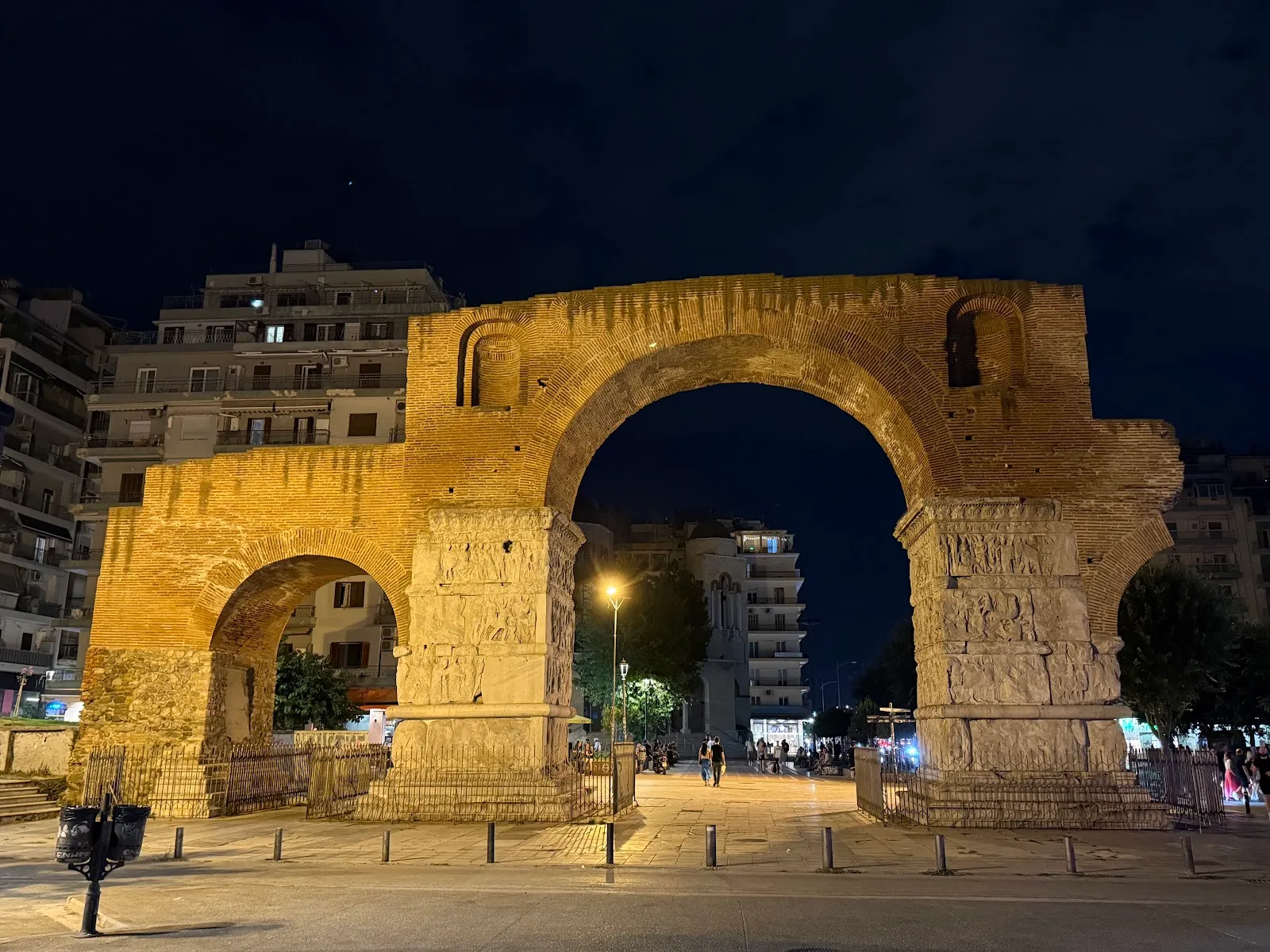
The arch was built to celebrate Emperor Galerius' campaign against the Sassanid Persians. The campaign ended with the capture of Ctesiphon, the Persian capital, in 298 AD. The name Kamara is the local word still used for the monument.
It stood on the Via Egnatia, the ancient Roman road that crossed the empire, and was built as a gateway over it. Its original form had eight pillars and a triple arch. The core was brick, faced with sculpted marble panels. The main opening measures 12.5 metres high and more than 10 metres wide, so the scale is clear from the pavement.
The arch was part of a wider imperial complex. A processional road linked it to the Rotunda and to Galerius' palace. Earthquakes destroyed the palace over the centuries, and the arch is what survives of it.
What the reliefs show
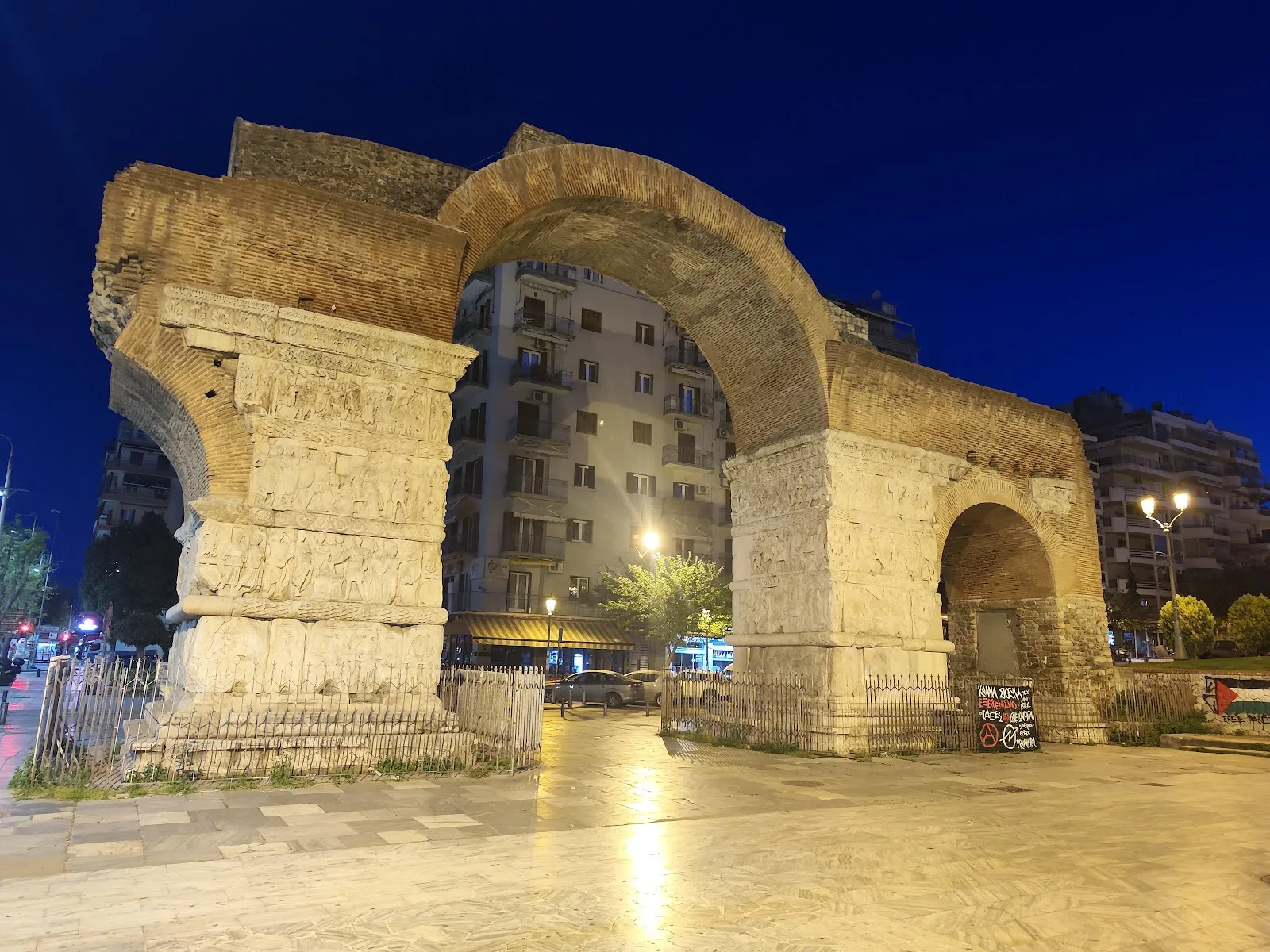
The marble panels carry the story of the campaign in scenes of battle and procession. One shows single combat between Galerius and Narses. Other panels include camels, elephants and large cats among the figures, a reminder of the distant lands the campaign reached.
Weathering has worn the carvings, and several panels are lost, so some scenes are hard to read at a glance. Take your time with each one. The figures were once painted, which would have made the arch far more striking when it was new.
How a visit works
Entry is free, and you do not need a ticket. The arch is open at all hours, so you can walk past at dawn, in the afternoon or after dark. The entrance and the parking lot are wheelchair accessible, and the site suits children.
Interpretive signage is limited, so reading about the reliefs before you arrive makes the visit richer. Few benches sit in shade, so plan your stop with that in mind.
The Rotunda and the streets around it
The Rotunda is a short walk away and belongs to the same complex. It was built as a mausoleum for Galerius, though he was never buried there. It later became a church, then a mosque, and is a Christian church again. Pairing the two monuments makes a good single walk.
Cafés and street food stalls are close by, so a snack fits easily between the sights. Post-war buildings surround the arch, so the setting is an urban square rather than an open ruin, and the monument reads as part of everyday city life.
Häufige Fragen
Is there an entry fee?
No. The arch is free to visit, and you do not need a ticket.
What are the opening hours?
The arch is open at all hours, so you can visit at any time of day or night.
Is the arch wheelchair accessible?
Yes. The entrance and the parking lot are wheelchair accessible.
Are there information panels at the arch?
On-site signage is limited, so reading about the reliefs before your visit helps.


