The Old Bridge, Alte Brücke in German and officially the Karl Theodor Bridge, crosses the Neckar in Heidelberg and joins the Old Town to the Neuenheim district. Elector Karl Theodor had it built in 1788 from red Neckar valley sandstone. It has nine arches and is about 200 metres long. On the Old Town side it ends at a medieval gate with twin towers. From the span you see the castle above, the river below and the old town roofs. Statues stand along the bridge, and a bronze monkey draws most of the photographers.
From wooden bridges to the stone bridge of 1788
The crossing at this spot is old. A series of wooden bridges stood here before the present one, and floods or ice destroyed them. The stone bridge that replaced them was commissioned by Elector Karl Theodor, whose name it carries, and was completed in 1788.
It is built of Neckar valley sandstone, with nine barrel vaults, a length of about 200 metres and an average width of about 7 metres. It is counted among the last examples of classical stone bridge building.
The bridge has also been through war. German soldiers destroyed the original structure in the Second World War. Two years later Heidelberg reopened a rebuilt bridge, paid for through a fundraising campaign. A plaque on the bridge recalls the city's defence against French troops in 1798.
The bridge gate, the statues and the monkey
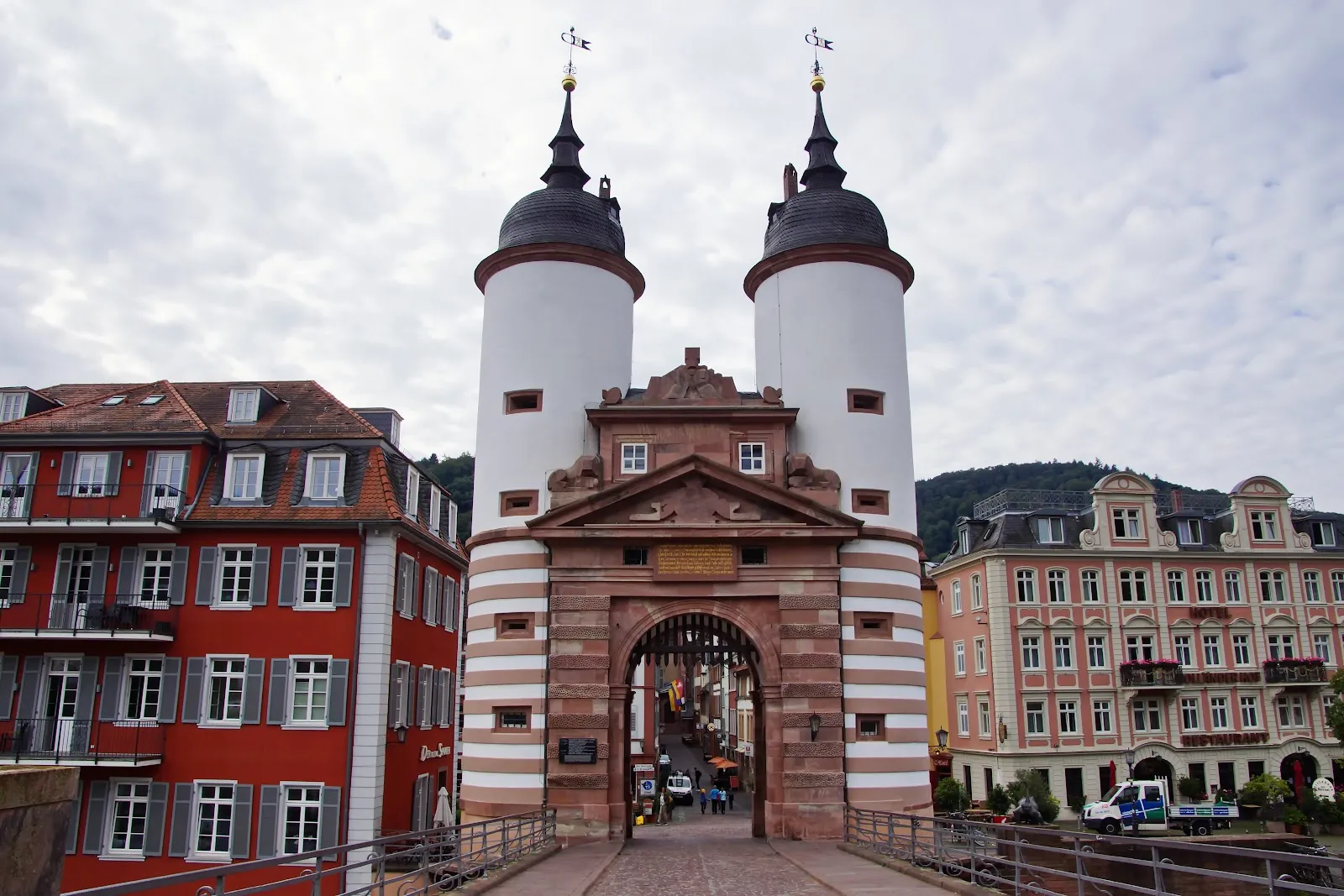
On the Old Town side stands the medieval bridge gate. It was part of the former city wall and is one of the reasons the bridge has long been seen as a symbol of Heidelberg. Its twin towers rise 28 metres, and the pointed roofs are called spitzhelm towers because they resemble old German military helmets.
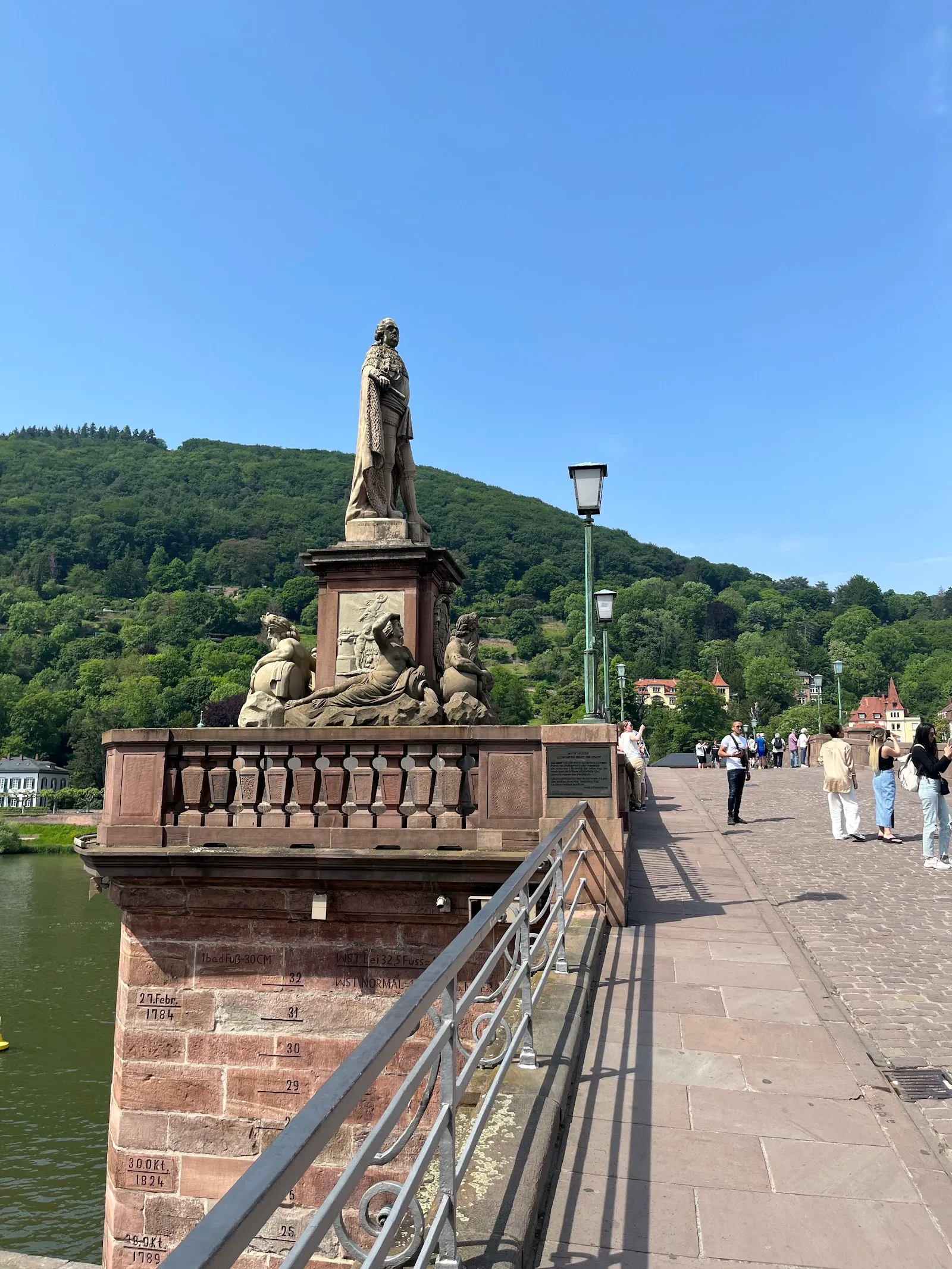
Above the Neckar you will find statues of Karl Theodor, the builder, and of Pallas Athena, the goddess of wisdom and culture.
The Bridge Monkey, in bronze, sits on the Old Town side. A monkey figure stood here centuries ago, and the present sculpture was put up in 1979. Many people touch it for luck, and it is the point on the bridge where visitors queue for photographs.
Crossing to Neuenheim and the Philosophenweg
The far end of the bridge is in Neuenheim. At the foot of the hill opposite you will find the Schlangenweg, a winding path that is one of the ways up to the Philosophenweg. The Philosophenweg is a walking path of about 2 km, partly wooded, with viewpoints over the city and the castle and a stretch of sunny gardens. It is named after the university professors who walked it to think and talk, and it is said to have been a favourite walk of Mark Twain, who spent a good deal of time on the Neckar.
The bridge also inspired painters and poets, among them Friedrich Hölderlin and Gottfried Keller.
Where to look from
From the bridge, looking toward the town, the castle is at the upper left and the bridge gate is in front of you. Looking back from the Neuenheim end gives a clear frame of the arches and the gate together.
In the evening the bridge is lit warmly, and the walkways along the Neckar give a good view of it. When the castle is illuminated, the riverbank by the Ziegelhäuser Landstraße is another place to stand and look across the water. Boat cruises on the Neckar are another way to see the bridge from below.
Häufige Fragen
Who built the Old Bridge in Heidelberg and when?
Elector Karl Theodor had the stone bridge built, and it was completed in 1788. It is officially called the Karl Theodor Bridge.
What is the Bridge Monkey?
It is a bronze monkey figure on the Old Town side of the bridge. A monkey figure stood here centuries ago, and the present sculpture was installed in 1979. Many visitors touch it for luck.
How do you get from the Old Bridge to the Philosophenweg?
Cross the bridge to Neuenheim. At the foot of the opposite hill, the Schlangenweg path climbs up to the Philosophenweg, a walking path of about 2 km with views of the city and the castle.
Is the Old Bridge open at night?
Yes, the bridge is open 24 hours. It is lit warmly in the evening and can also be viewed from the walkways along the Neckar.