
Notre-Dame de Reims is the cathedral at the centre of Reims, a short walk from the train station. Its west front is the main draw, with more than 2,300 statues, two towers and a large rose window. Inside, the nave is light and high, and medieval stained glass sits beside modern windows by Marc Chagall and Imi Knoebel. Entry to the cathedral is free. A guided visit or the tower climb shows you more.
A site of coronations and fires
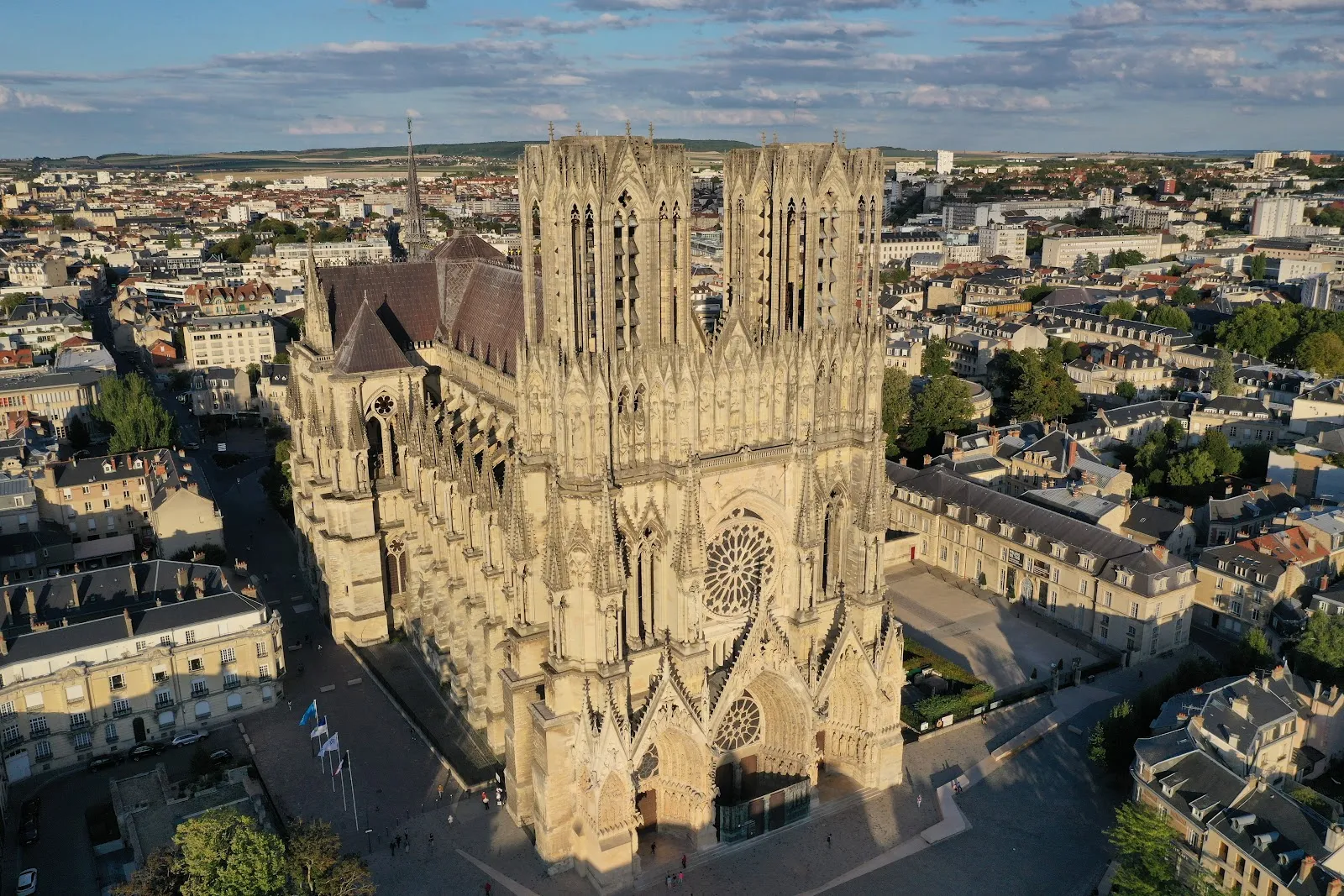
Tradition links this spot to Saint Remi and to the baptism of Clovis, the first king of the Franks, in the late fifth century. An earlier cathedral stood here, and a fire destroyed it in the early 1200s. Work on the present building began in 1211 and continued over the following centuries.
For centuries the cathedral was where French kings were crowned. Its use changed with the times. During the French Revolution it was used for a time as a grain store. During the First World War it served as a hospital, and German shelling damaged it heavily. It was restored after the war and reopened in 1938. Funds from the Rockefeller family of New York helped with the rebuilding. The cathedral is now listed by UNESCO together with the Palais du Tau and the Basilica of Saint-Rémi.
Architecture inside and out
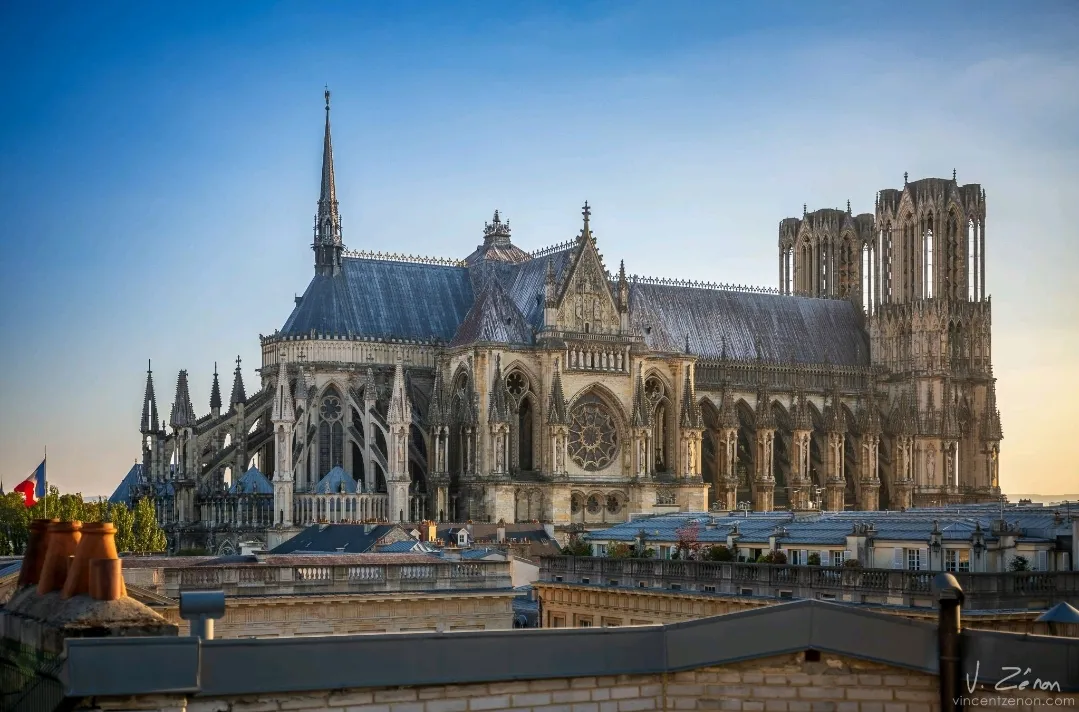
The cathedral is a leading example of early and High Gothic design. Inside, the nave has four levels. From the bottom, you see wide arcades, the double windows of the gallery, the small windows of the triforium, and the upper windows of the clerestory. The arrangement gives the space a sense of order and length.
The east end is flat, an unusual feature for France though common in England. The west front has three doors and two towers, and the central doorway is carved with figures. Take a moment to look at the sculpted details around the arches, which are finely worked up close.
The Smiling Angel and the west front
The Smiling Angel is a 13th-century figure on the north doorway of the west front. It is the city's emblem and one of the best-known sculptures in the cathedral. During German bombardment in 1914, the figure was beheaded. The broken pieces later became a well-known piece of anti-German propaganda in France.
High on the central portal, Clovis is shown being anointed by Saint Remi, and his arms are missing, a result of the shelling. A frieze above the rose window shows David and Goliath.
Stained glass
Most of the original stained glass was badly damaged during the First World War. Medieval glass survives in several parts of the building, and the rose window dedicated to the liberal arts is in the left transept. The windows in the flat east end are also medieval.
Among the later windows, Marc Chagall created three for the central axial chapel in 1974. Imi Knoebel's contemporary glass is also part of the building's collection of windows.
Visiting inside and climbing the towers
The tourist office rents audioguides for a self-paced tour of the cathedral. Guided visits in French last about 1 hour 30 minutes and cover the history of the building and the coronation site.
The tower climb is more than 200 steps. The roof tour has 249 steps and gives panoramic views over the city.
Next to the cathedral
The Palais du Tau, a few metres from the cathedral, was the residence of the archbishops of Reims. Its name comes from its T-shaped plan in the Middle Ages. Today it is a museum with original statues from the cathedral and objects linked to the coronations.
The Basilica of Saint-Rémi is a short walk away and almost matches the cathedral in height. The Porte de Mars, a Roman triumphal arch, stands north of the old centre, near the start of the Boulingrin quarter.
Häufige Fragen
Is there an entry fee for Notre-Dame de Reims?
Entry to the cathedral is free. Some guided visits and the tower climb are paid, so check the official website for current prices.
How long do you need to visit?
A guided visit lasts about 1 hour 30 minutes. Add time for the tower climb, which has more than 200 steps.
Can you climb the towers?
Yes. The tower climb has more than 200 steps, and the roof tour has 249 steps with panoramic views over the city.
Where is the Smiling Angel?
The Smiling Angel is on the north doorway of the west front. It is a 13th-century sculpture and the emblem of the city.


