The Biosphere is an environment museum inside Buckminster Fuller’s geodesic dome, built for Expo 67 in Parc Jean-Drapeau on Île Sainte-Hélène. Its hands-on displays explore climate change, water, biodiversity and sustainable living through images, models and activities for different ages. The steel lattice is striking from outside, while exhibits inside connect environmental questions with everyday life. Head to the upper level for views over Montréal and the St. Lawrence River. Set aside two to three hours if you want time for the exhibits as well as the architecture.
A pavilion from Expo 67
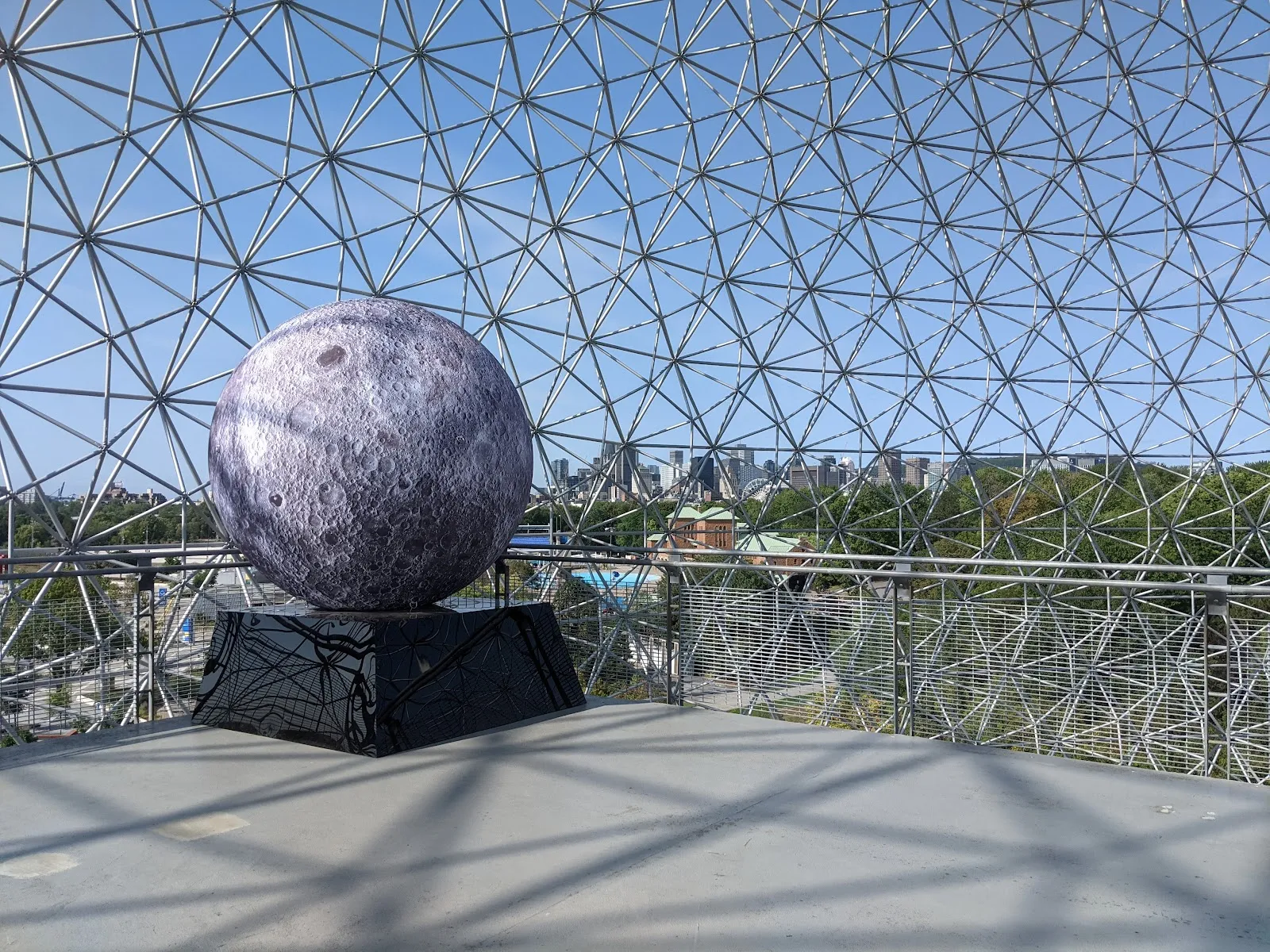
The geodesic dome was built for Expo 67 as the United States pavilion. Designed by Buckminster Fuller, it became one of the most distinctive structures on the St. Lawrence River skyline. The building’s steel framework remains visible: a fire in the 1970s destroyed the original polymer panels, and the structure later reopened as a museum in 1990.
Today, the Biosphere uses the former pavilion to explore how people and the environment affect one another. Its location in Parc Jean-Drapeau, on Île Sainte-Hélène, places the museum within a setting shaped by the river and the Expo-era site. Even a visit focused on the exterior gives you a close look at the dome’s repeated geometric framework; from farther away, its spherical outline stands apart against the surrounding landscape.
Exhibits on environmental questions
Inside, exhibitions and activities address subjects including climate change, air, water, biodiversity and sustainable development. Displays combine hands-on elements with photographs, illustrations, animations and models, so visitors can encounter the same subject in different ways. The museum’s material also considers Canadian environments, energy and temperature.
Water has a dedicated place in the exhibition mix: the Source of Life exhibit focuses on this resource. Other spaces use multimedia presentations and interactive science activities to help explain environmental systems. The museum’s approach brings together science, art and social questions, inviting visitors to think about the effects of human activity and possible more sustainable futures.
Explanations and visual material make the exhibits accessible to children as well as adults. Families can also look for the free Biokit geocache activity for children. Activities and displays may vary, so check the museum’s current information when planning around a particular exhibit or program.
Views from the dome
The upper level provides a different way to take in the building: look out towards Montréal and the St. Lawrence River from within the dome. The view adds a sense of the museum’s position in Parc Jean-Drapeau, while the exposed structure overhead keeps the architecture in view indoors as well.
The Biosphere can fit into a wider visit to the park, where other attractions include La Ronde and the Stewart Museum. If you are planning to visit more than one attraction, the museum information mentions passport tickets that can include nearby sites such as the Planetarium and Botanical Garden. Check the current ticket details before choosing a pass, since the available inclusions are not specified here.
Häufige Fragen
How long should I spend at the Biosphere?
Allow two to three hours to explore the exhibits and the dome.
What can you see inside the Biosphere?
Exhibits and activities cover climate change, air, water, biodiversity and sustainable development. The Source of Life exhibit focuses on water.
Is the Biosphere the same as the Biodome?
No. They are separate attractions more than seven kilometres apart.
Was the Biosphere built for Expo 67?
Yes. The geodesic dome was built as the United States pavilion for Expo 67 and later became an environment museum.