The Golden Roof, or Goldenes Dachl, is a late Gothic balcony at the end of Herzog-Friedrich-Straße in Innsbruck's Old Town. Emperor Maximilian I had it finished around 1500 to mark his marriage to Bianca Maria Sforza. More than 2,600 fire-gilded copper tiles cover the roof, and painted frescoes and carved reliefs decorate the three-story oriel below it. The building is small, so the details reward a slow look from the square. A museum inside covers Maximilian's era and the history of Innsbruck. Viewing the roof from the street needs no ticket.
Why Maximilian I built the balcony
The Golden Roof was completed around 1500 for Emperor Maximilian I. The official reason was his marriage to Bianca Maria Sforza, his second wife, and the union brought the Duchy of Milan into the Holy Roman Empire. Around that time rumours circulated that the emperor was short of money, and a lavish gilded roof also showed that he was not.
The oriel was added to the Neuer Hof, a former palace of the Tyrolean rulers. The master builder is named as Nikolaus Türing the Elder. From the loggia the emperor and his wife could watch festivals, tournaments and theatre performances in the square below.
The roof is covered with more than 2,600 copper tiles, gilded by the fire-gilding method. The exact count differs from one account to another, so it is safest to say that it runs well over two thousand.
What the balcony shows
The oriel is decorated with carved reliefs and painted frescoes. On the first-floor balustrade are eight sculpted coats of arms, each standing for one of Maximilian's territories. Above them are frescoes painted in 1500 by Jörg Kölderer, with two knights carrying the banners of the Holy Roman Empire and Tyrol.
The second-floor balustrade has eight reliefs with scenes from Maximilian's life. The two central ones show the emperor. In one he is with Bianca Maria Sforza, who holds an apple, and with his first wife, Maria of Burgundy. In the other he appears with his court jester and his chancellor. The reliefs on either side show Moorish dancers, a popular form of entertainment at the time.
The details are small and sit high above the street, so a few minutes of looking up is worth it.
The museum inside
Most people stop for the roof and miss the museum in the same building. It presents the history of the Golden Roof, the life and era of Maximilian I, and the story of Innsbruck from antiquity to the Olympic Games the city has hosted twice. Older exhibits are combined with multimedia, and an audio guide leads you through the history.
Look for the tournament helmets with grotesque faces, made to resemble the Ottoman rivals of the empire. The museum is open daily until 5 pm and is included in the Innsbruck Card. Entrance is wheelchair accessible, and the museum suits children.
The square and the Old Town around it
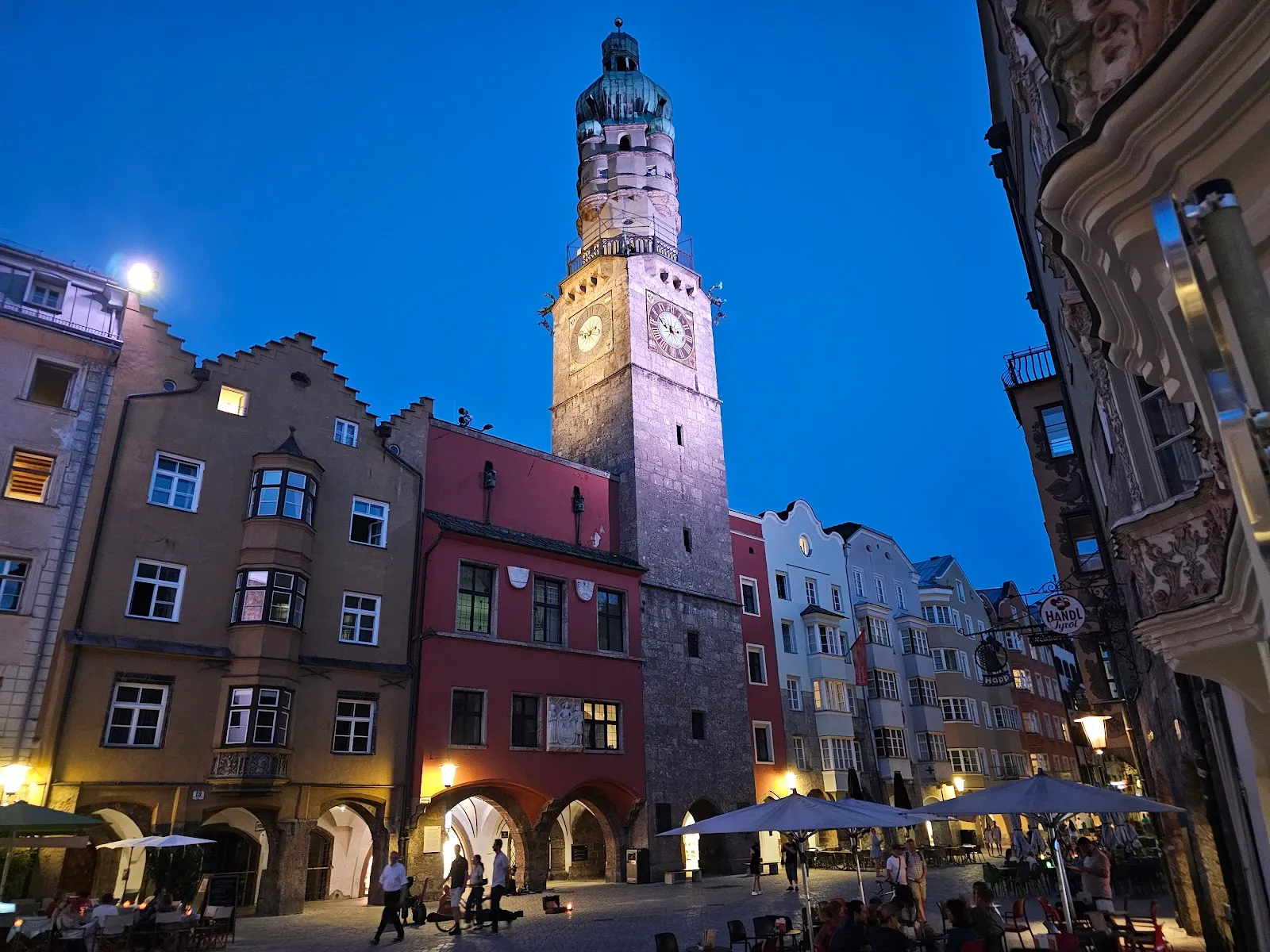
The roof stands at the end of Herzog-Friedrich-Straße, in the middle of the Old Town. Narrow cobbled streets lead off from it, lined with historic houses, cafés and small shops. The City Tower, about 30 metres high, is close by and gives views over the roofs toward the Alps. The Hofburg, the Hofkirche with Maximilian's cenotaph, and the Triumphal Arch are all within a short walk.
In the weeks before Christmas the Christmas market is set up in front of the roof, with more than 70 stalls selling tree decorations and crafts. Tower musicians play Christmas music from the Golden Roof at 5:30 pm each day during the market. The terrace in the centre of the market gives the best view of both the musicians and the building.
Guided Old Town walks also pass here. One source lists daily city tours at 11 am in German and 2 pm in English, with tickets from the Innsbruck Information shop.
Häufige Fragen
Is there an entry fee for the Golden Roof?
You can see the roof and balcony from the square without a ticket. The museum inside is a separate visit and is included in the Innsbruck Card.
How long do you need at the Golden Roof?
The roof itself takes about 10 to 15 minutes to see. Allow more time if you go into the museum.
Where is the Golden Roof?
It is at Herzog-Friedrich-Straße 15, at the end of the street in Innsbruck's Old Town.
Why was the Golden Roof built?
Emperor Maximilian I had it finished around 1500 to mark his marriage to Bianca Maria Sforza. From the balcony the couple could watch festivals and tournaments in the square.
When is the best time to photograph it?
Early in the morning, when the forecourt is quiet. Later in the day and in the evening it is crowded with groups.