The Aqueduct of Segovia is a Roman water channel from the late 1st or early 2nd century AD. It rises over the Plaza del Azoguejo at the edge of the old town. Two tiers of granite arches reach 28.5 metres at the tallest point, and the blocks are cut to fit without mortar. The structure is free to see and the area is open around the clock. Most people start their day in Segovia here, then follow the old streets toward the Cathedral and the Alcázar. Cafes and shops stand close to the arches.
Granite blocks, no mortar
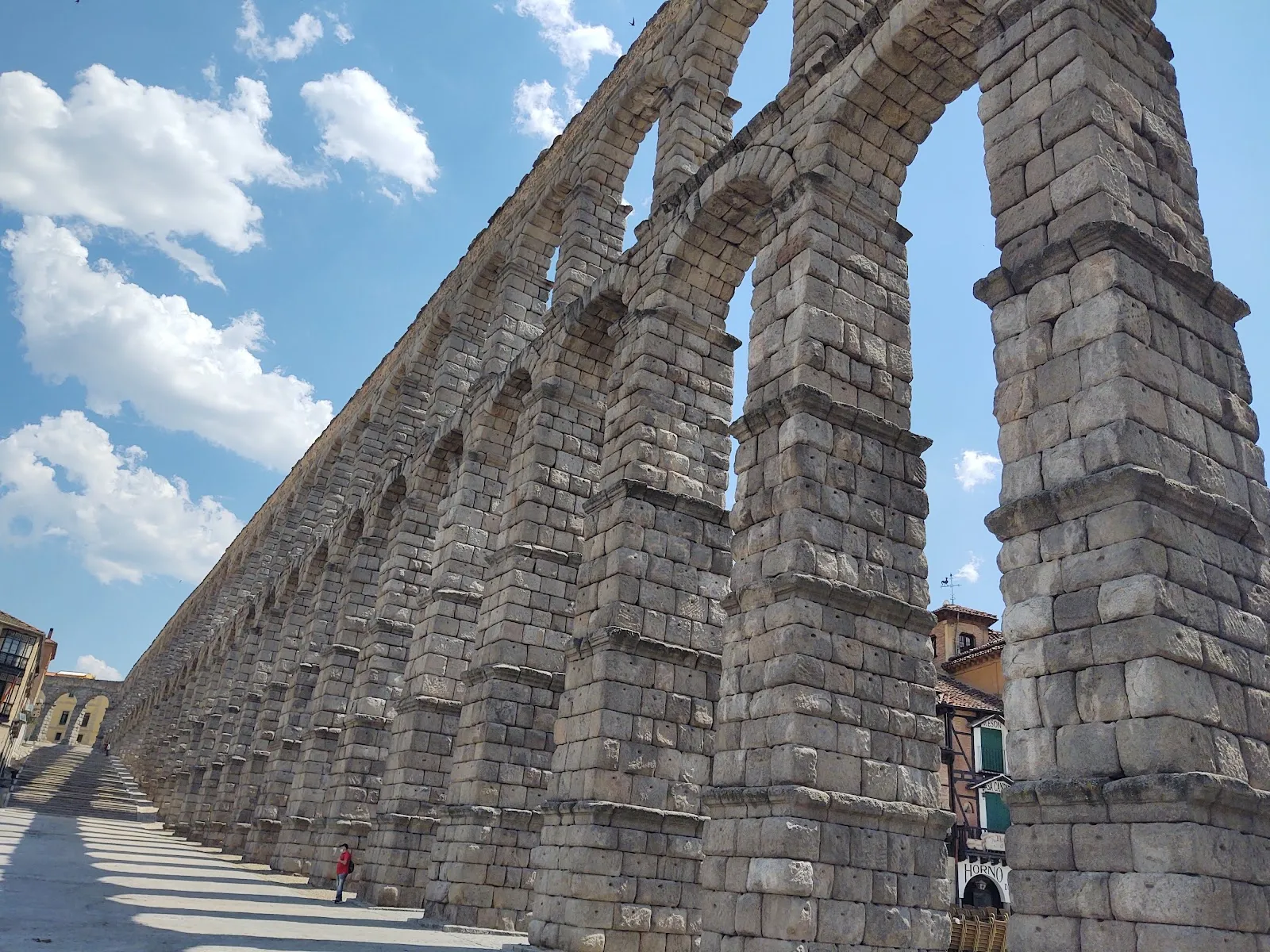
The aqueduct dates to the late 1st or early 2nd century AD. Its best-known stretch crosses the Plaza del Azoguejo in two tiers of stacked arches, rising 28.5 metres at the highest point. The stones are cut so precisely that they hold together by their own weight and fit. One account suggests that the lack of limestone for cement in this part of Spain was the likely reason mortar was not used.
The raised section of stonework in the centre once carried an inscription. Only the holes where the bronze letters were fixed remain. No document records the construction, so the exact date and the emperor in charge are matters for historians rather than for any inscription you can read today.
Water for the city
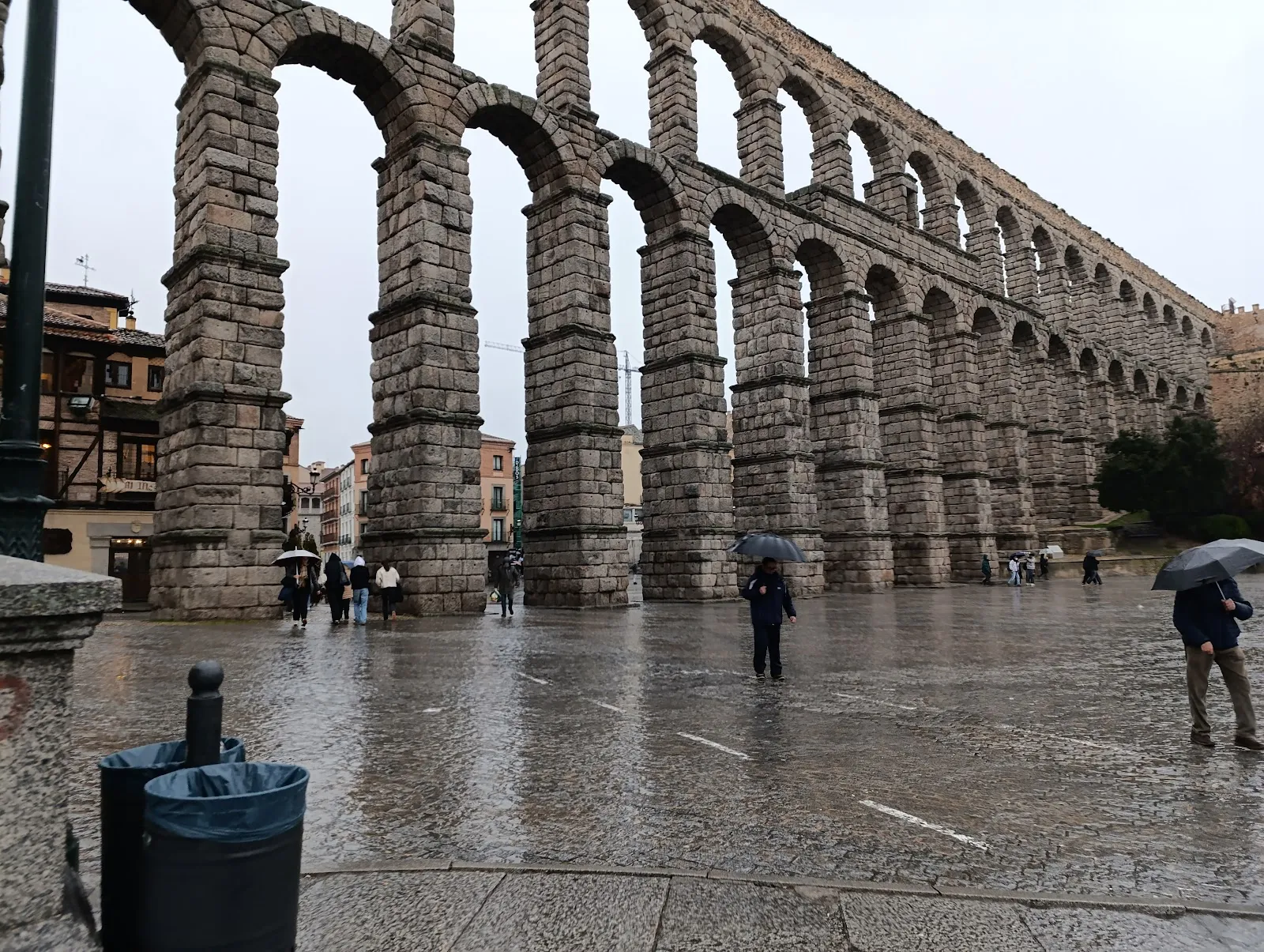
The aqueduct was built to bring water from the mountains to Segovia, drawing on the Frío River. The water ran through channels outside the city before it reached the arcade that crosses the valley. In the city it fed fountains, public baths and private houses.
It worked for a very long time. Parts were damaged in the Middle Ages and were restored in the 15th century under Isabella I of Castile. The structure is on the city's coat of arms, and a local legend credits the devil with building it.
Seeing it from below and from the side
The scale is clearest from underneath, in the Plaza del Azoguejo, where the arches rise above the surrounding buildings. Beside a two-storey house the height is easy to judge. Walking the length of the aqueduct gives you more angles than a single photograph from the plaza.
The area around the arches has shops, bars and cafes. Sitting for half an hour with a coffee or a glass of wine is an easy way to watch the structure and the square. If you stay the night, the aqueduct is lit after dark.
Works have sometimes limited the view from the staircase area, so you may find some angles closed off.
From the aqueduct to the Alcázar
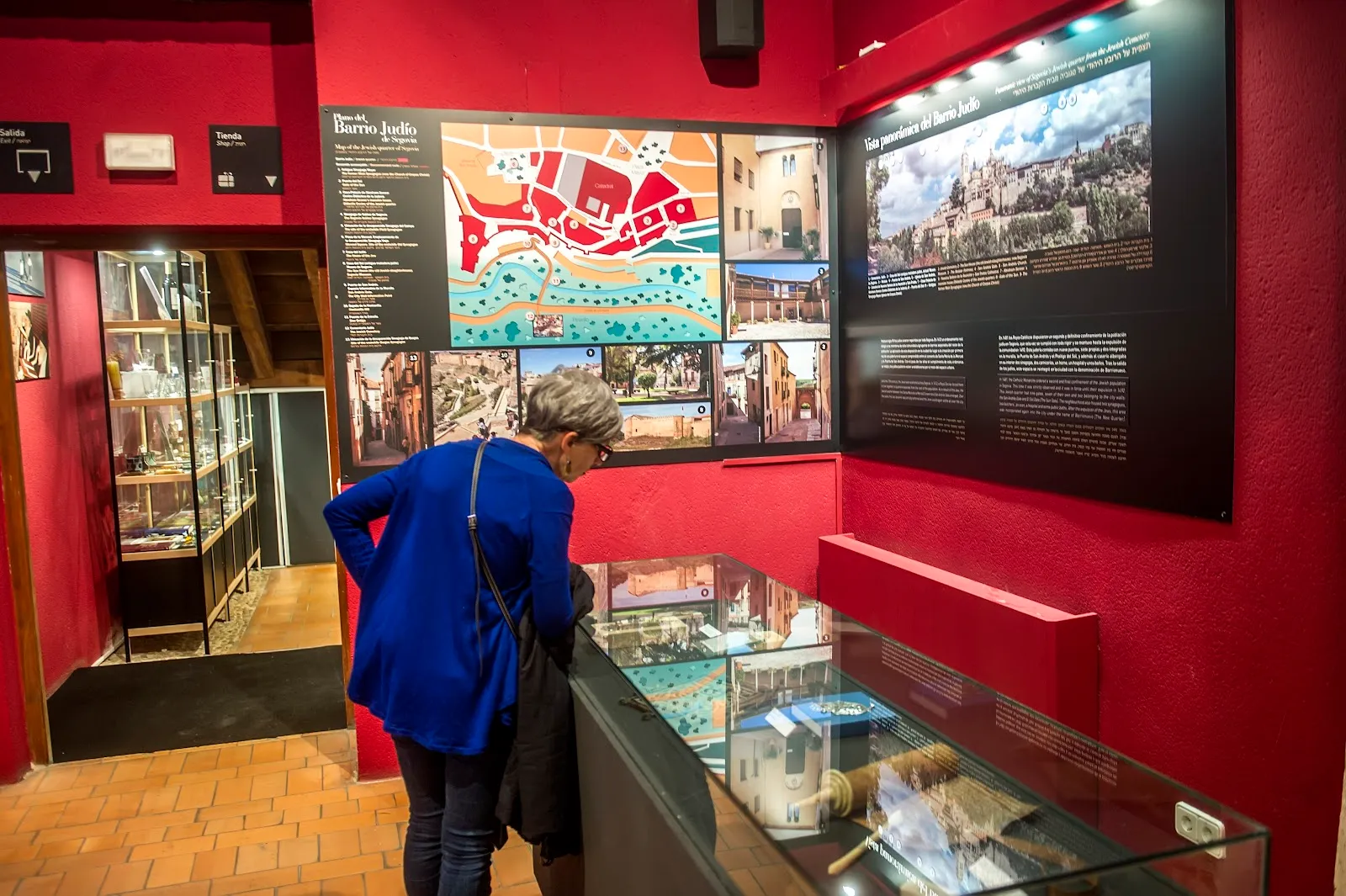
The aqueduct and the old town of Segovia were declared a UNESCO World Heritage site together in 1985. A short route begins at Plaza del Azoguejo and goes up Cervantes Street into the Royal Street. It leads to the Plaza Mayor, the Cathedral and the Alcázar. The Casa de los Picos, the Jewish quarter and the old walls are also within walking distance.
Segovia is about 90 kilometres northwest of Madrid. The high-speed train from Chamartín takes around half an hour, and from the station the city bus takes you to the aqueduct. Many people visit on a day trip, but a night in town gives time to see the aqueduct lit up and to explore beyond the main sights.
Perguntas frequentes
Is there an entry fee for the Segovia Aqueduct?
No. You see it from the outside, there is no ticket, and the area is open around the clock. Guided tours of Segovia that include it are available separately.
How long do you need at the aqueduct?
Allow 30 to 60 minutes to see it from below, walk along it and take photographs. Add time if you want to sit at a nearby cafe.
When was the Segovia Aqueduct built?
It was built in the late 1st or early 2nd century AD under Roman rule. No document records the construction, so sources differ on the exact date.
How do you get to the aqueduct from the train station?
Bus 11 goes from the Segovia train stop directly to the aqueduct. Bus 12 stops about 150 metres away.
Is the Segovia Aqueduct a UNESCO site?
Yes. It was listed in 1985 together with the old town of Segovia.