Palazzo dei Diamanti stands on Corso Ercole I d'Este in Ferrara, at the crossroads called the Quadrivio degli Angeli. Its facade is covered in some 8,500 marble blocks carved into diamond points, which catch the light differently as the sun moves across the day. The upper floor holds the Pinacoteca Nazionale, with paintings of the Ferrara school, and the ground floor hosts temporary exhibitions. Come for the building itself and for the Ferrarese paintings inside.
The diamond facade
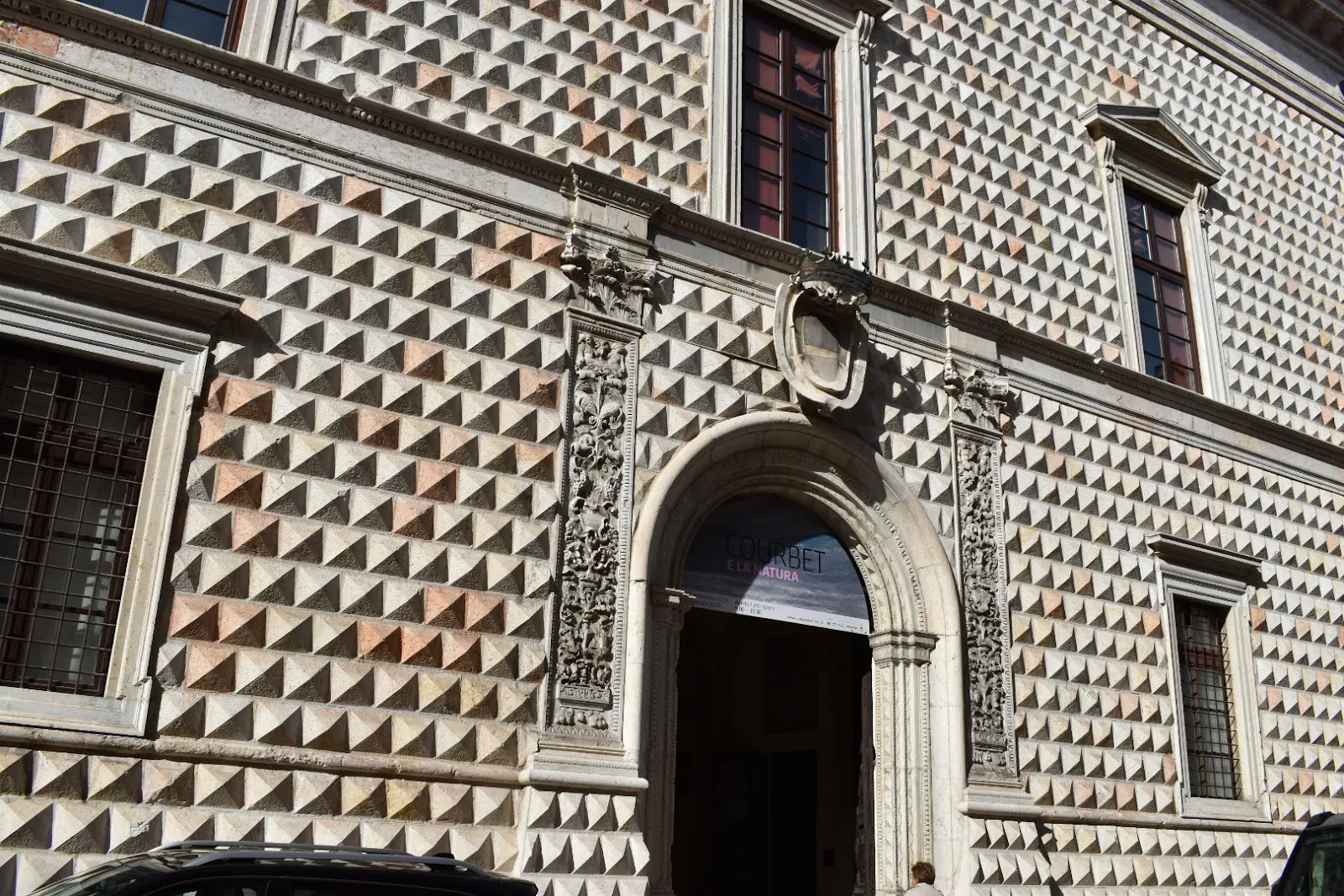
Biagio Rossetti designed the palace, and its most striking feature is the exterior cladding. The rusticated marble is cut into raised points, so the walls hold the light in changing ways. The position of the diamonds varies to maximise the light reflected off the building, which means the effect shifts as the sun moves over the day.
The palace was not planned to be seen only from straight on. Rossetti designed it to be viewed in perspective, from the corner at an angle, so the building and the intersection read together. Stand across the street, diagonally from the corner, to see this.
Local legend says that one of the blocks hides a real diamond, set where it would draw positive energies into the building. The duke is said to have held sessions of astrology and alchemy inside, which is why the placement mattered.
From the Este family to the present
Sigismondo d'Este, brother of Duke Ercole I, commissioned the palace in 1493. Sources date the building work from around 1493 to about 1503. Members of the Este family lived in the palace until 1598, when Ferrara passed to the Holy See in what is known as the Devolution.
The building is now owned by the Municipality of Ferrara and works as an exhibition space. It sits in the Addizione Erculea, the Renaissance urban project that extended the city to the north, and it is one of the palaces that line the main axis through this part of Ferrara.
Inside the palace
The upper floor holds the Pinacoteca Nazionale, the national art gallery, with its permanent collection of paintings from the Ferrara school. Look for works by Cosmè Tura, Francesco del Cossa, Ercole de' Roberti, Dosso Dossi and Garofalo. The collection covers several centuries of Ferrarese painting.
The ground floor is used for temporary exhibitions. Since the 1960s and 1990s, the palace has staged shows on Marc Chagall, Claude Monet, Jim Dine and Robert Rauschenberg, among others. Some exhibitions include an audio guide with the ticket, which helps with the context of the works.
The palace also hosts private events and live performances, so check the programme if you plan a visit around a specific show.
Visiting and getting around
Admission is charged, and tickets can be bought in advance. The entrance and the restroom are wheelchair accessible, and there is an accessible parking lot nearby. A restaurant is on site.
From the palace, Corso Ercole I d'Este leads north towards Castello Estense, passing other Renaissance palaces such as Palazzo Prosperi-Sacrati and Palazzo Turchi di Bagno. Via delle Volte, with its medieval arches, is a short walk away, and it makes a good starting point for a walk through the old centre.
Perguntas frequentes
Is there an entry fee?
Yes, the palace charges admission. Buying tickets in advance is recommended.
How long do you need?
Plan 1 to 2 hours for the gallery and the building, longer if you want to see a temporary exhibition in full.
Is the palace open on Mondays?
Yes, it is open daily, including Mondays and certain holidays. Check the official website before you go, especially around holidays.
Is the palace wheelchair accessible?
Yes. The entrance and the restroom are wheelchair accessible, and there is an accessible parking lot.