
The Temple of Apollo stands on the slopes of Mount Parnassus in Delphi, at the centre of an archaeological site that is a UNESCO World Heritage Site. In antiquity, pilgrims from across the Greek world climbed the Sacred Way to seek prophecies from the oracle here. Today you can walk the same route past treasuries and monuments, see the remains of the Doric temple from its terrace, and climb to the theatre above it for wide views. Starting at the museum gives useful context before you walk the site.
Myth and the oracle
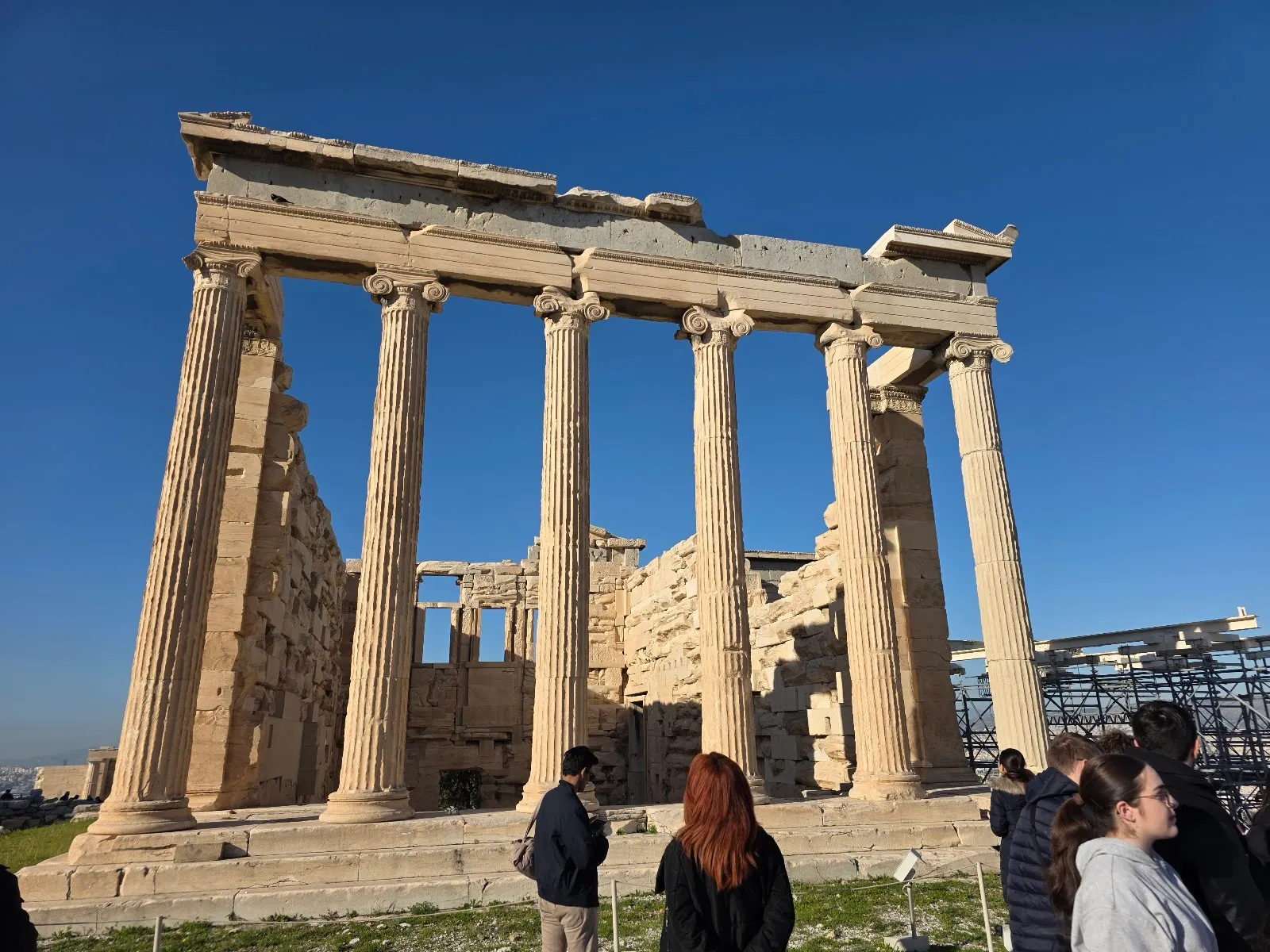
In the myth told at the site, Delphi was once sacred to Mother Earth and guarded by the serpent Python, whom Apollo later killed. The sanctuary was founded by Cretans who landed at Kirrha, the port of Delphi, and were led there by the god in the form of a dolphin.
The myth also explains the site's place in the world. Zeus is said to have sent two eagles flying from opposite ends of the earth, and their paths crossed at Delphi, where the omphalos, or navel stone, was set. The stone is still shown near the Sacred Way.
The oracle is the reason the sanctuary grew. The priestess Pythia spoke as the mouthpiece of Apollo, and her answers were sought by people from across the Greek world. She gave her words in the adyton, a restricted room at the rear of the temple. Her answers are said to have shaped the decisions of rulers and generals across Greece.
The Temple of Apollo
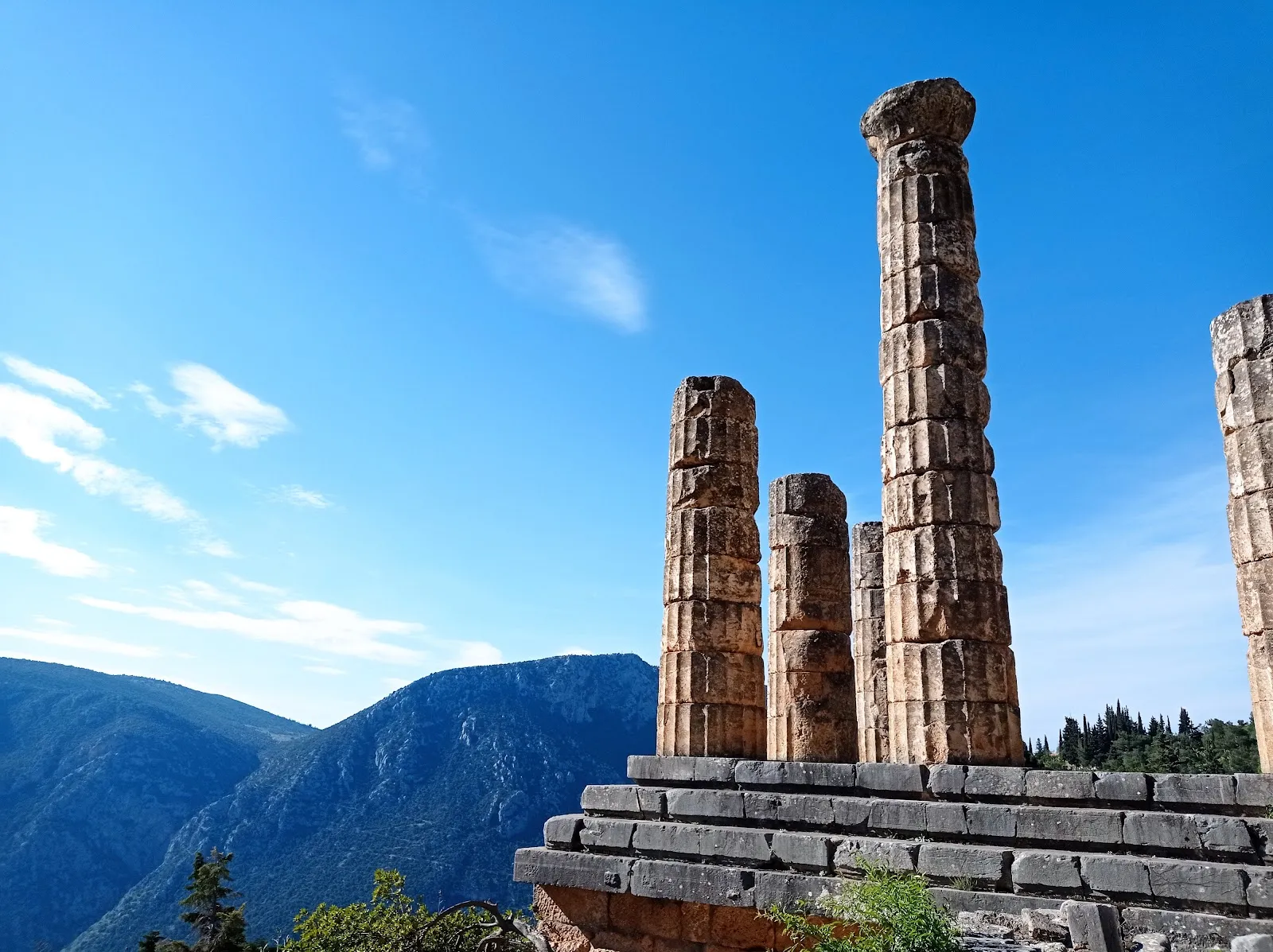
The temple you see today is a Doric temple from the 4th century BC. The sanctuary's earlier temples were rebuilt several times. An earthquake in 373 BC destroyed the temple of that period, and Greek cities collected money again to rebuild it, with the work completed around 330 BC.
The temple sits on a large terrace supported by a polygonal wall. Its foundations are visible, and part of the colonnade still stands. Although the site was restored in the 20th century, only part of the colonnade has survived.
From the terrace, you can see how the building dominated the sanctuary and how the mountain falls away below it.
The Sacred Way and its monuments
The Sacred Way climbs the mountainside in switchbacks and was the main route to the temple. The sacred precinct was built in stages, from about 600 BC into the Roman era. Entry is near the old Roman agora, and the path passes the Treasury of the Athenians and the Sibyl Rock before reaching the temple.
City-states built treasuries and monuments along the route to thank the oracle for its advice. Some of these were set up to mark victories. In the first section, bronze statues once stood in large numbers. Today, many of the treasuries survive only as foundations, columns and parts of walls, but the line of the route is clear.
The Sacred Way was once an approach used by visitors arriving from far away, and walking it slowly helps you picture the procession of pilgrims.
Theatre, stadium and the sanctuary of Athena Pronaia
The theatre is built high in a corner of the sanctuary and once seated around 5,000 spectators. Its position gives some of the best views on the site, looking down over the temple and the valley. Parts of the theatre are intact enough for you to sit in.
Above the theatre, the stadium is one of the most complete ancient stadiums you can visit. Its starting blocks are visible, and it was used for the athletic contests of the Pythian Games. The Romans rebuilt the stadium.
Lower down the road is the sanctuary of Athena Pronaia, where visitors arriving from Athens reached the site first. Its circular Tholos, built in the 4th century BC, is the best-known building here. Its purpose is uncertain, because the ancient sources do not explain it. The sanctuary also contains the remains of three temples dedicated to the goddess Athena.
The Delphi Archaeological Museum
The museum stands next to the archaeological site and holds many of the most important finds from the excavations. The bronze Charioteer of Delphi, dated to about 475 BC, is the most famous piece. Other highlights include the Sphinx of Naxos and the statue of Antinous.
An inscription from the wall of the Athenian Treasury may contain the earliest recorded notation of a melody. It is one of the finds that connects the sanctuary to the music of the Pythian Games.
Visiting the museum before the site helps you recognise the figures and inscriptions you will see on the monuments outside.
Perguntas frequentes
Is there an entry fee?
Yes. The site recommends buying tickets in advance. One visitor reports that children and EU citizens under 25 enter free, so check the official website for current prices.
How long do you need?
Plan for about half a day to cover the museum, the temple, the theatre and the stadium.
How do I get to Delphi from Athens?
Delphi is about 180 kilometres from Athens, roughly a two and a half hour drive. From the modern village of Delphi, the archaeological site is about a 10-minute walk.
Is the site suitable for children?
The site is listed as good for kids. The walk up the mountainside is not easy but is not difficult, and it is worth bringing sunscreen.


