
Porta Nigra is a Roman city gate on the northern side of Trier's old town. It is the largest Roman city gate north of the Alps and one of the best preserved. You can see and walk around the outside for free, while a ticket opens the interior, where stairs climb to upper levels with wide views over the city. Displays inside explain Roman life and the gate's later history. Allow about an hour for a full visit.
A Roman gate on the northern edge of Augusta Treverorum
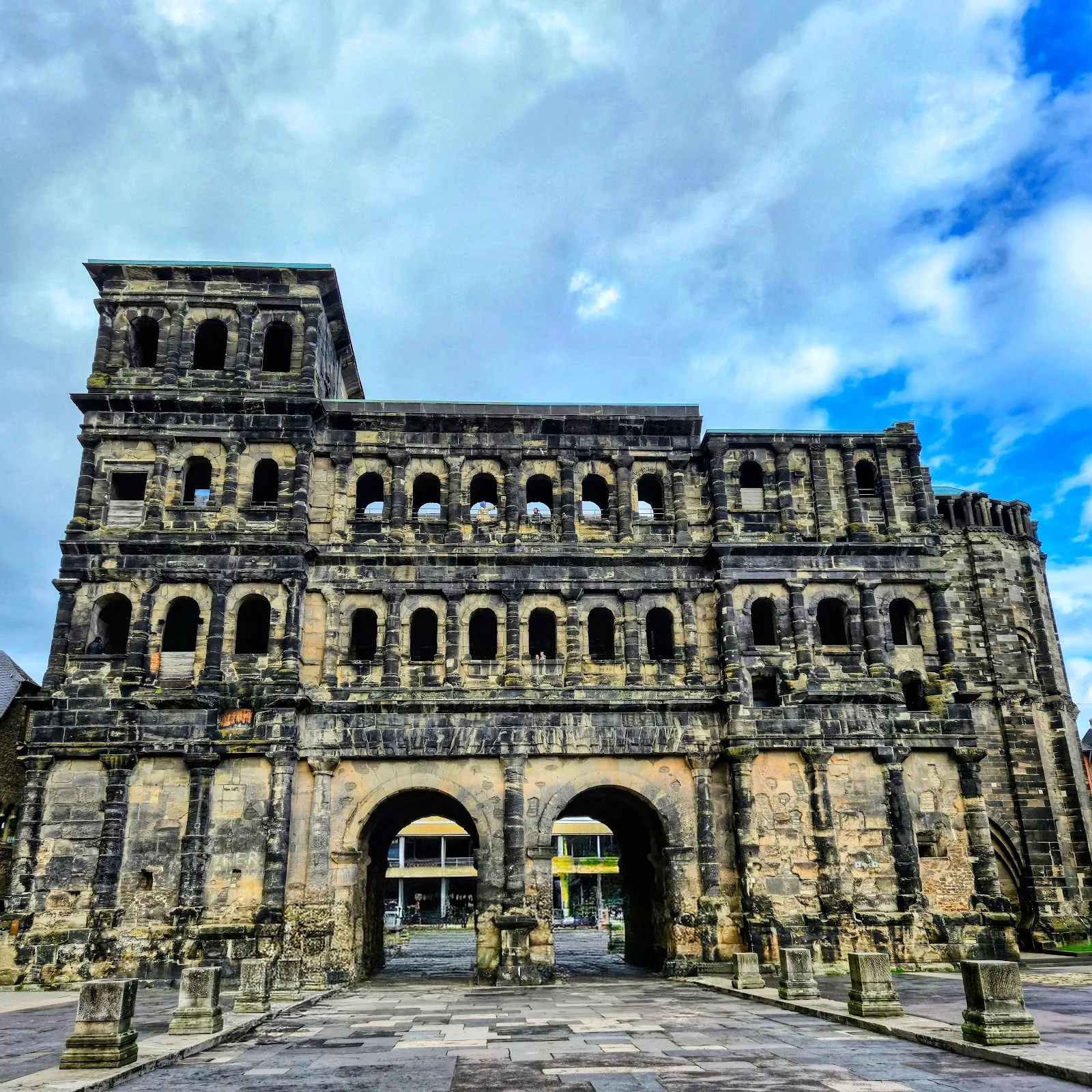
Porta Nigra was built as the northern gate of Augusta Treverorum, the Roman city on the site of present-day Trier. It formed part of the city's defensive wall and also served as a grand entrance. The gate dates from the second century AD.
Four gates once stood at the ends of the two main streets of the Roman city, one on each side. Porta Nigra is the only one still standing. The city wall ran for more than six kilometres, and the cemeteries lay outside it.
How the gate was built
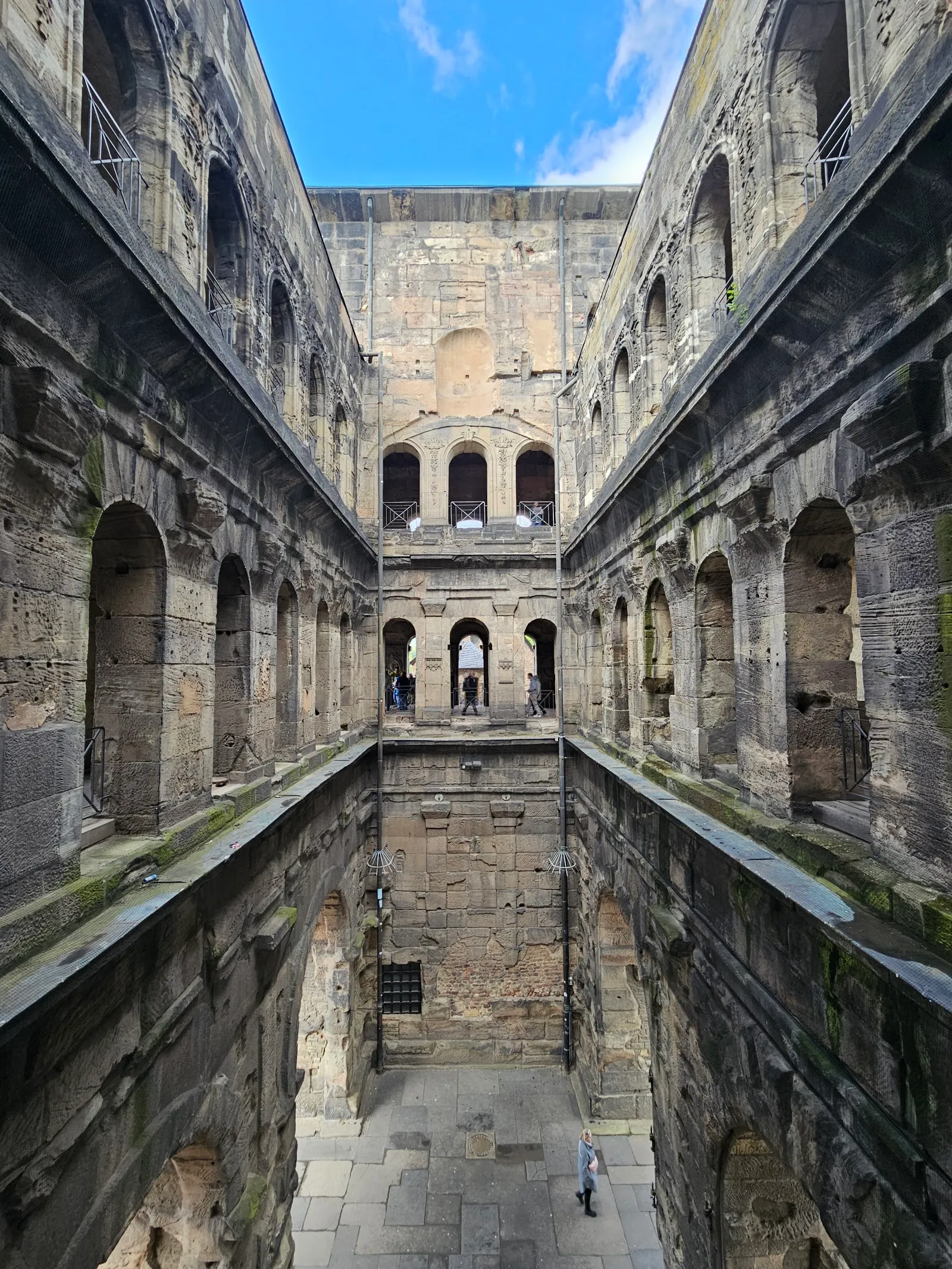
The gate is made of sandstone blocks, and the heaviest are said to weigh up to six tons. The blocks were set on each other without mortar. Iron clamps held them together, and the marks of those clamps can still be seen.
From outside, the gate looks like two arched entrances between rounded towers. Once through the arches, you enter an inner courtyard, where anyone who pushed in would have been exposed to the defenders of the town. The original gate was made up of two towers, each four storeys high.
Why it is called the Black Gate
Porta Nigra is Latin for black gate. The Romans did not give it that name. It came into use in the Middle Ages, after weathering and age darkened the sandstone. The original Roman name is not known.
From Roman gate to church
In the eleventh century, Simeon, a Greek monk and hermit, lived inside the gate. Archbishop Poppo of Trier met him in 1028. Simeon died in 1035 and was buried in the gate. Reports of miracles at his tomb led to his canonisation, and the tomb drew Christian pilgrims through the Middle Ages.
The gate was later turned into a double church, with a tower and spire on top. Those were removed afterwards. Under Napoleon, the building was restored to its Roman appearance. Restoration work has been ongoing on the gate in more recent years.
Inside the gate
Entry to the interior costs a small fee, and a visit includes climbing through the levels. Each site has a brochure in several languages. The signage is clear, and the displays include a model of how Trier looked in Roman times.
In summer, some tours are led by a guide dressed as a centurion. A guided tour gives more detail on the gate's history than the displays do, so it is a good choice if you want more background.
Nearby sights and tickets
Within walking distance of the old town are Constantine's Basilica, the imperial baths (Kaiserthermen), the amphitheatre, the Roman Bridge over the Moselle, and Trier Cathedral. The Rhineland State Museum is also close. Next to the gate, the buildings of the former St. Simeon's collegiate church now house the Simeonstift City Museum, which shows everyday life in Trier from the early modern period to the 20th century.
The tourist information office next to the gate sells tickets and town maps. It also offers a Trier Card, which gives free or reduced entry to the main attractions and museums. The Mariensäule viewpoint on the west bank of the Moselle gives city views without charge.
Perguntas frequentes
Is there an entry fee for Porta Nigra?
You can see and walk around the outside of the gate for free. A ticket is needed to go inside, and it is a small fee. Student reductions may apply, so ask at the ticket desk.
How long do you need at Porta Nigra?
Allow about an hour to see the gate and climb through its levels.
Is Porta Nigra accessible for wheelchair users?
The site has a wheelchair accessible entrance and an accessible parking lot. Reaching the upper levels involves several sets of stairs.
Do you need to book tickets in advance?
Buying tickets in advance is recommended for this site.


