
Strasbourg Cathedral rises on Place de la Cathédrale, on the Grande Île, and its single off-center spire, 142 metres high, can be seen across the plain of Alsace. The façade is cut from pink Vosges sandstone and carved so finely that it rewards slow looking. Inside, medieval stained glass and an 18-metre astronomical clock are the main draws. You can also climb to a platform for a view over the old town, the Vosges and the Black Forest. Entry to the cathedral is free, and the clock's figures parade at 12:30.
A 142-metre spire in pink sandstone
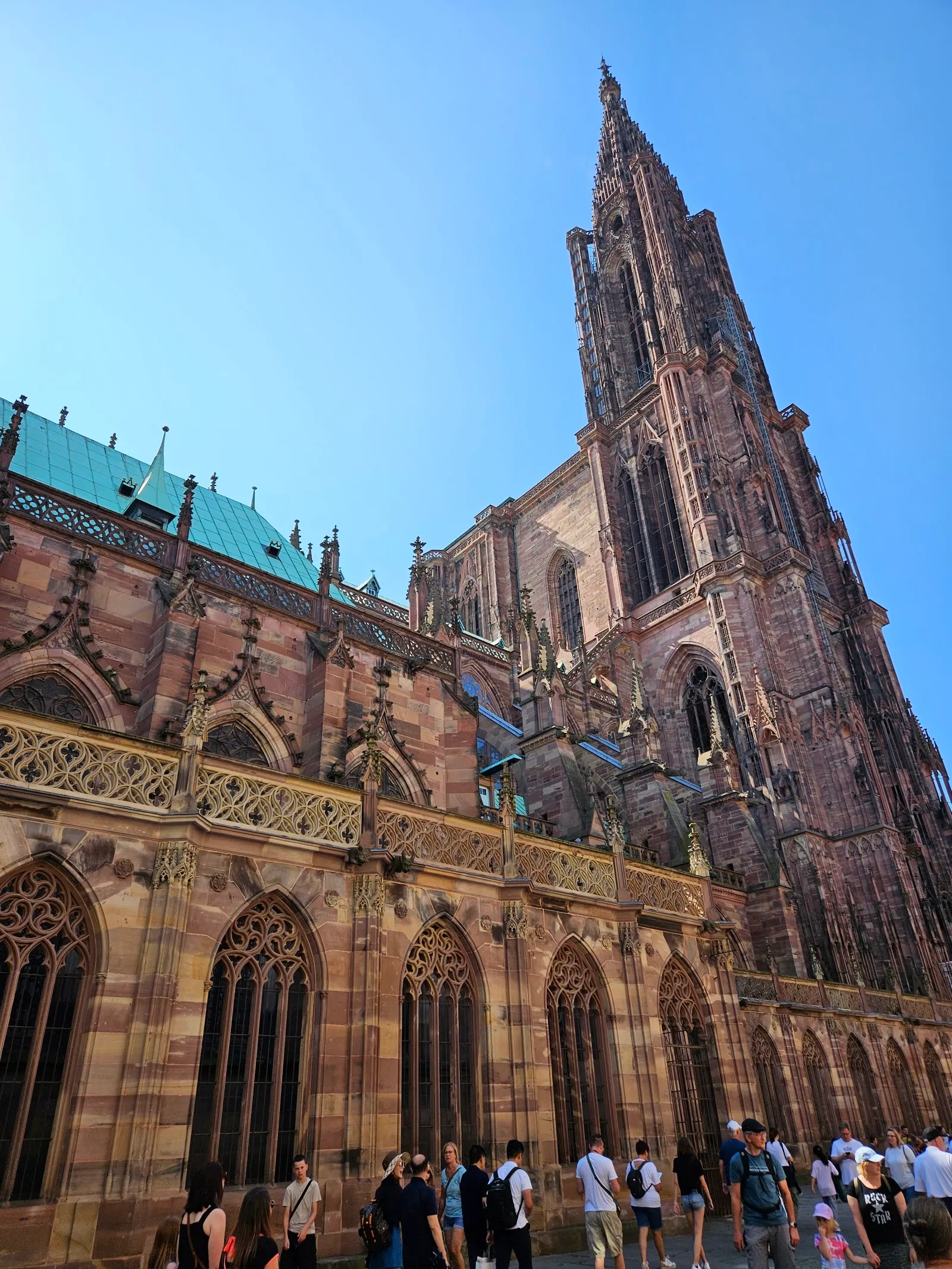
The spire of Cathédrale Notre-Dame reaches 142 metres (466 feet). From 1647 to 1874 it made the cathedral the tallest building in the world. Today it is the sixth tallest church, and the tallest building still standing that was made entirely in the Middle Ages. On a clear day it can be seen from the Vosges Mountains and the Black Forest, on the far side of the Rhine.
The walls are built of sandstone from the Vosges, which gives the cathedral its pink colour. The building took centuries to finish, and the result mixes Romanesque and Gothic styles. The spire was completed in 1439. Only one tower was ever finished, although the plan is said to have called for two, so the spire sits off-center.
The cathedral has been a classified historic monument since 1862 and was added to the UNESCO World Heritage list in 1988, mainly for its Gothic architecture. Victor Hugo described it as both gigantic and delicate.
The west façade and what the Revolution left
The west façade has three portals. Slender stone shafts are set in front of the walls like lace, so the stonework looks lighter than it is. The sculpture is dense, and a few minutes at the portals show how many different figures there are.
The statues of Ecclesia and Synagoga are among the best known. The originals are now kept in the Musée de l'Oeuvre Notre-Dame, so the ones outside are copies.
In 1789, during the French Revolution, many statues and religious objects in the cathedral were destroyed and seven bells were melted down for cannon. A few statues from the portal survived. The spire itself was at risk of being taken down, because it towered over every other building. According to one account, it was saved when citizens covered it with a giant tin Phrygian cap, the symbol of liberty.
Inside the cathedral
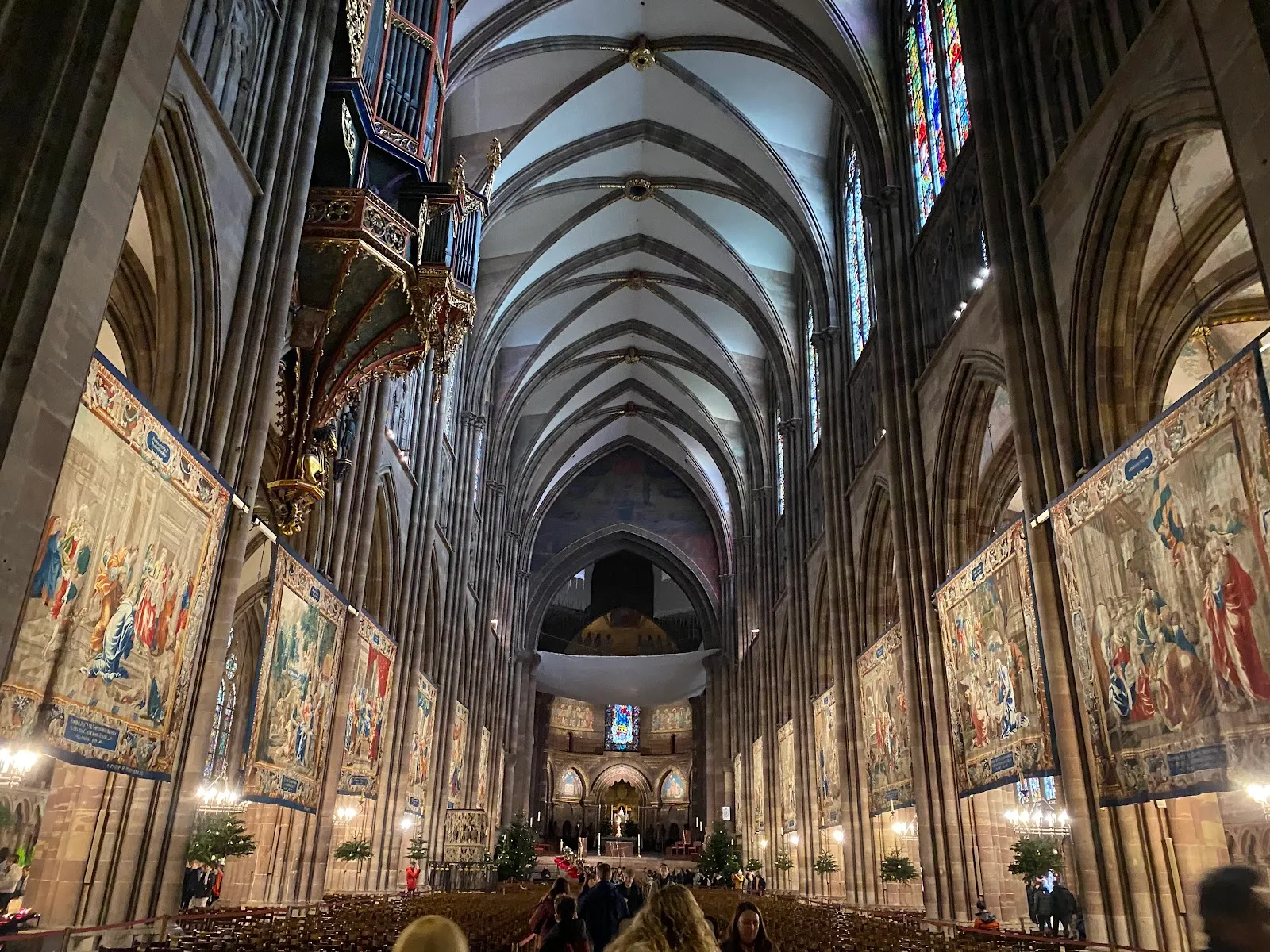
Entry is free. The windows are the first thing you notice. They date from the 12th to the 14th centuries, and most are from the 14th, and they light the nave in colour. The rose window above the west portal is the best known.
Other things to look for are the pulpit, the organ and the tombstone of Conrad de Lichtenberg. Small candles can be bought to light inside, at €2 each.
The cathedral is a working church. If a service is in progress, such as Sunday mass, sightseeing inside may not be possible, so keep voices low and follow the signs.
The astronomical clock
The clock is a Renaissance work, about 18 metres tall, and it stands towards the back right of the interior. It also indicates the precession of the equinoxes, a detail that is easy to miss among the crowd.
Every day at 12:30 the figures set off. The twelve apostles pass before Christ, and other figures represent the stages of life. Crowds gather well before the time and the space fills early. One visitor who arrived 15 minutes ahead could not get in, so aim for at least half an hour. Outside the show you can look at the clock more calmly, though the 12:30 parade is the moment it was built for.
Climbing to the platform
The climb is a winding, narrow staircase of a little over 330 steps that ends at an observation platform just below the long spire. A fee applies and the tower opens at 10:00. The staircase is shared by people going up and coming down, but visitors report that you can still go at your own pace.
From the top you see the Grande Île, the historic center, which is ringed by canals. The streets below are narrow and the buildings tall, so the size of the cathedral is hard to judge from the ground. The platform gives you the layout of the old town and the roofline around it. The view stretches to the Vosges and the Black Forest.
On the staircase you also pass views over the cathedral's own roof, with the city spread behind it.
Around the cathedral square
The square in front of the cathedral has cafés opposite the façade, where you can sit with a drink and look up at the stonework. Souvenir shops line the streets nearby, including one in a former bookshop.
Place Gutenberg is a short walk away, and Place Kléber is about five minutes on foot. The Palais Rohan, with its Fine Arts, Decorative Arts and Archaeological museums, is also close. The Petite France district is a walk of around ten minutes.
At Christmas the cathedral square hosts part of the city's Christmas market, and the spire is lit with festive lights. The façade is also lit in a golden glow in the evening.
Perguntas frequentes
Is there an entry fee for Strasbourg Cathedral?
No, entering the cathedral is free. Climbing the tower to the platform is ticketed, and the fee is paid separately.
What time does the astronomical clock show happen?
The figures parade every day at 12:30, when the apostles pass before Christ. Arrive well before the time, because the space inside fills quickly.
How many steps is the tower climb?
It is a little over 330 steps, up a narrow winding staircase. The platform sits just below the spire and opens at 10:00.
When is the best time to visit to avoid crowds?
Early in the morning, before tour groups arrive around 9:30 to 10:00. Weekdays are quieter than weekends and holidays.
Is the cathedral wheelchair accessible?
The cathedral has a wheelchair accessible entrance. The tower climb is a staircase only.
How tall is Strasbourg Cathedral?
The spire is 142 metres high. It was the tallest building in the world from 1647 to 1874 and is now the sixth tallest church.


